INVEST · Research → story
The cost of waiting
Financing can remove one obstacle while exposing another: the time between drawing money and earning from the asset.
A data centre can incur interest before it earns a pound from a customer. That makes the date on a construction schedule part of the financing story.
On 24 September, VIRTUS announced £2.45 billion of committed financing. Standard Chartered’s account the following day identified a £1.2 billion green capex facility within that total, with term and revolving tranches. On 28 September, Clifford Chance described a refinancing that replaces existing debt and supports new development.
Those are useful facts. They still leave a question a headline cannot answer: how much money will be outstanding while the next capacity waits to earn?
Put a calendar beside the balance
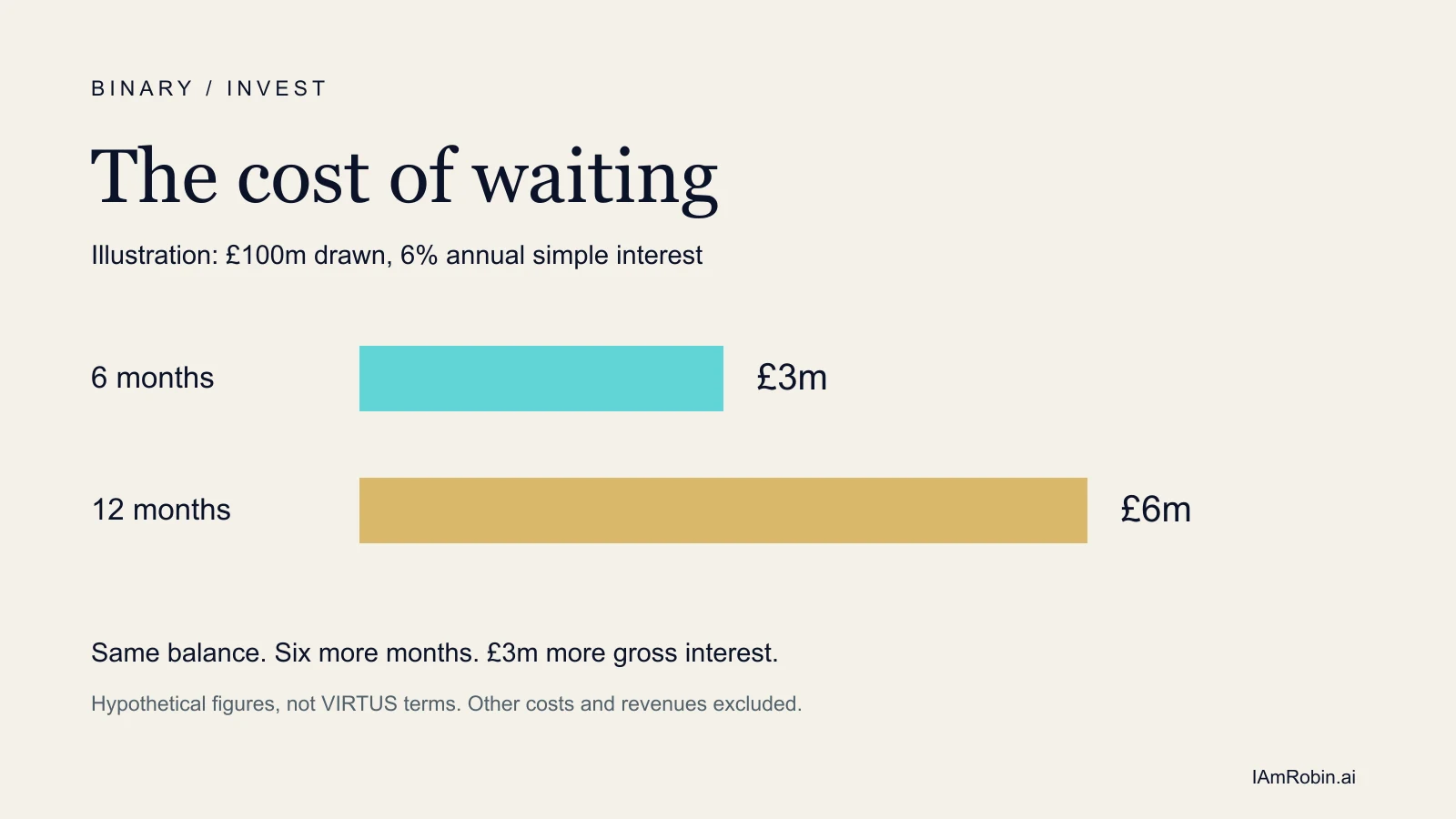
Imagine a different, entirely hypothetical project. Its developer has already drawn £100 million at a fixed annual simple interest rate of 6%. The balance stays outstanding for six months before customer service begins.
That interval produces £3 million of interest: £100 million × 6% × 6/12. Extend it to twelve months with the same balance and rate, and the interest reaches £6 million. The extra six months adds £3 million even if the building’s eventual capacity stays the same.
These figures are invented to show the mechanism. They are not VIRTUS’s loan balance, rate or delivery timetable. The calculation excludes fees, compounding, hedges, interest on cash, operating costs and revenues. It measures gross interest over the stated interval, not a project’s total loss or return. Starting customer service does not itself repay the loan or stop interest.
Now change the draw schedule. Draw £50 million at the start and another £50 million three months later. Over the same six-month window, simple interest is £2.25 million: £1.5 million on the first tranche and £0.75 million on the second. The £0.75 million difference comes from borrowing later. It is not free money. The developer needs the contract and construction payments to permit that timing, and any cost of keeping undrawn funds available belongs in a fuller comparison.
The cheque and the switch
That is why the revolving tranche is an interesting detail, without being proof of a better outcome. Availability, draw conditions and repayment rights determine how much flexibility a borrower can use. The reviewed announcements do not establish those terms, actual draws or pricing. They also do not establish a delay at VIRTUS. A missing milestone announcement cannot supply one.
The September 29 Special follows evidence from financing through working capacity. This story takes one further step: lay the debt balance over that timeline. A grid connection, commissioning or customer acceptance date can matter to cash generation; the financing balance can keep accruing interest while a project waits. Phases may enter service separately, and an operating portfolio may already generate cash. A single opening date would hide that complexity.
For VIRTUS, the package spans refinancing and development. Charging interest on the full £2.45 billion as though it were newly drawn construction cash would invent both the balance and its use. Dividing the package by one campus’s megawatts would compound the mistake.
The next useful disclosure would connect dated draws and costs to the capacity and customer cash flows they fund. Until then, keep the financing achievement and the unresolved economics side by side. For the imaginary £100 million project, the extra six months costs £3 million in gross interest. For VIRTUS, that bill cannot be calculated from these announcements.