03 · Daily Special · Signal 6
The Money Before the Megawatts
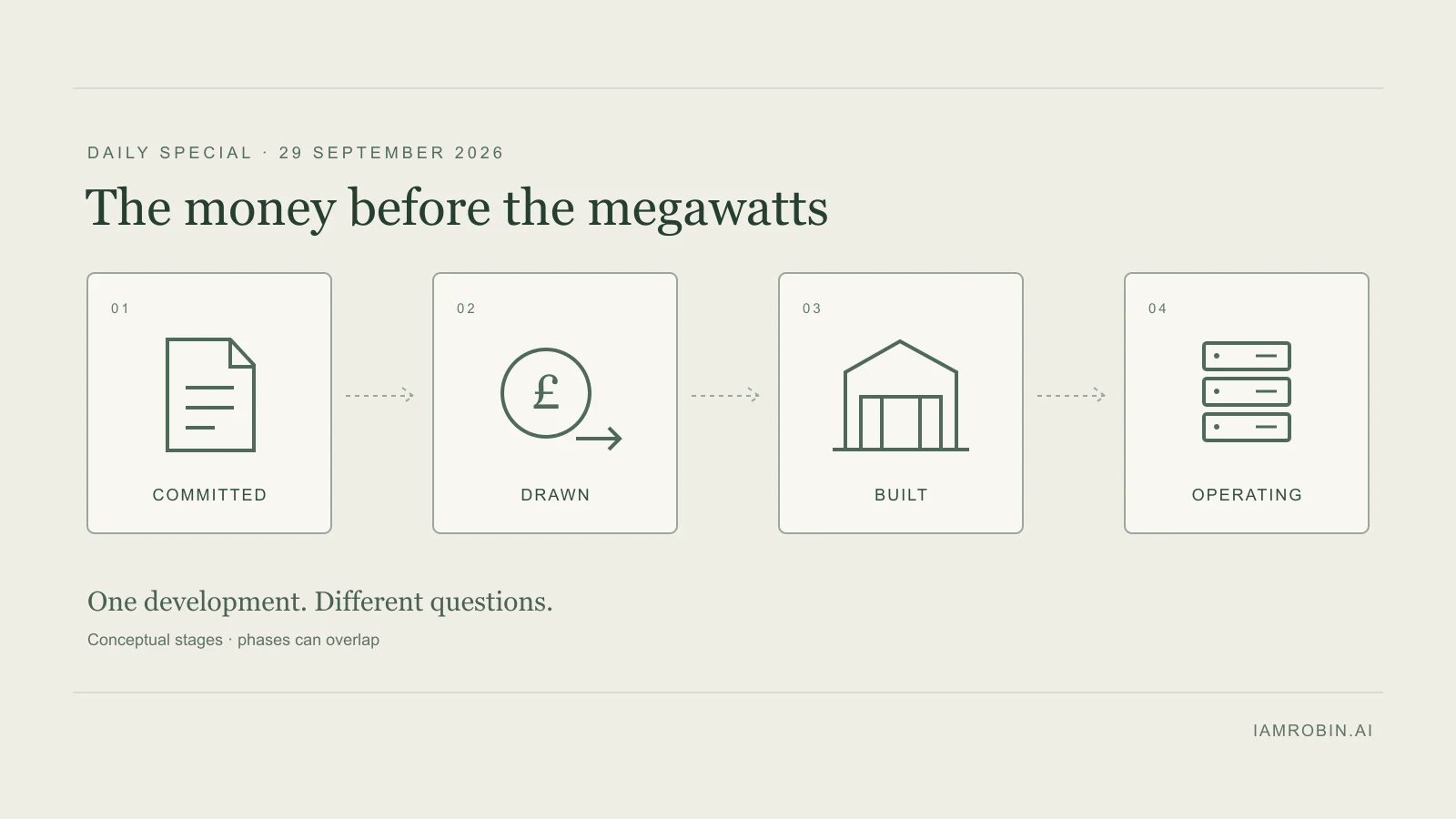
A public-source map of VIRTUS financing and the steps to usable data-centre capacity.
A bank can promise billions before a server does any work. The promise still matters. Building a data centre without funding is a fairly expensive way to collect architectural drawings.
On September 24, VIRTUS announced £2.45 billion of committed financing. I want to follow that money far enough to see which problem it solves, and where the next problem begins.
Follow the money before counting the megawatts
Standard Chartered’s account, dated September 25, identifies a £1.2 billion green capex facility within the package, available through term and revolving tranches. The label tells us something about the financing structure. It gives us no meter reading.
The lender’s adviser supplies the more revealing detail. Clifford Chance calls the transaction refinancing and describes replacing existing debt while providing capacity for development. Its account appeared on September 28.
Refinancing can be useful work. An operator may gain room to manage its borrowing while continuing to build. But the headline cannot tell us how much additional cash reaches a construction site. For that, we would need to reconcile the new borrowing with old debt repaid, fees, retained cash and project spending. The reviewed announcements do not give that bridge, or current drawn balances.
Imagine borrowing to replace a mortgage while also arranging a facility for an extension. Adding the two amounts would exaggerate the extension budget. The VIRTUS package needs the same care, even if the extension happens to house computers rather than a kitchen.
A campus has more than one birthday
The current Saunderton page describes 78MW of IT load across four data centres. That is the campus scope we can read today; the page does not provide a dated commissioning record for all that capacity.
Its February 2024 announcement described 75MW, targeted service in Q2 2026, and cited a 120MVA National Grid contract. Those historical details belong beside their dates. An old target does not confirm delivery, and the absence of confirmation in this source set does not prove a delay.
MVA also cannot stand in for IT MW. MVA measures apparent electrical power; IT MW describes real power for the computing equipment. Conversion needs electrical assumptions, and facility overhead sits outside the IT load. Substituting one number for the other would change both the unit and the boundary.
At LONDON19, the June 30 announcement set out 32.5MW of planned IT load, secured planning and SEGRO’s powered-shell role, with construction expected after design approval. That describes a handoff between organizations. A shell, the equipment fitted inside it and an accepted customer installation each require their own evidence.
Keep four questions on the desk
I would track the development with this small card. The downloadable version adds the dated source trail.
| Question | Evidence worth adding |
|---|---|
| How much credit is committed? | Signed facility scope and conditions |
| How much cash has moved? | Drawn balances and a reconciliation of uses |
| What has the builder delivered? | Dated milestones for each site and phase |
| What can customers use? | Energized, commissioned IT capacity and customer acceptance |
The rows can overlap in time. A developer can build while arranging finance, or bring one phase into service while another is unfinished. Keeping the questions separate lets us recognize that progress without promoting an entire campus on the strength of one announcement.
It also prevents a seductive calculation: divide the financing package by the capacity of one campus and call the answer cost per megawatt. The numerator spans refinancing and several developments; the denominator belongs to one site. A precise quotient would hide an imprecise comparison.
I would update the card when a disclosure moves one of these questions forward. An energized phase would improve the delivery picture even if we still lacked loan pricing. A drawdown statement would improve the funding picture without proving that any additional racks were working. Different documents answer different questions.
The financing deserves credit for the funding it establishes. The next useful story will name a site, a completed phase and the capacity customers can use. Until then, we have a research map, with the distance to operation still visible.
Sources and method
I reopened six primary pages on September 29, 2026, Hong Kong time. The company, bank and law firm speak as transaction participants; this is not an independent inspection. The campus page is undated. The reviewed material does not establish current drawdowns, detailed loan terms, newly energized capacity or utilization. This research card makes no investment decision.