INVEST · Research → story
When the badge becomes common
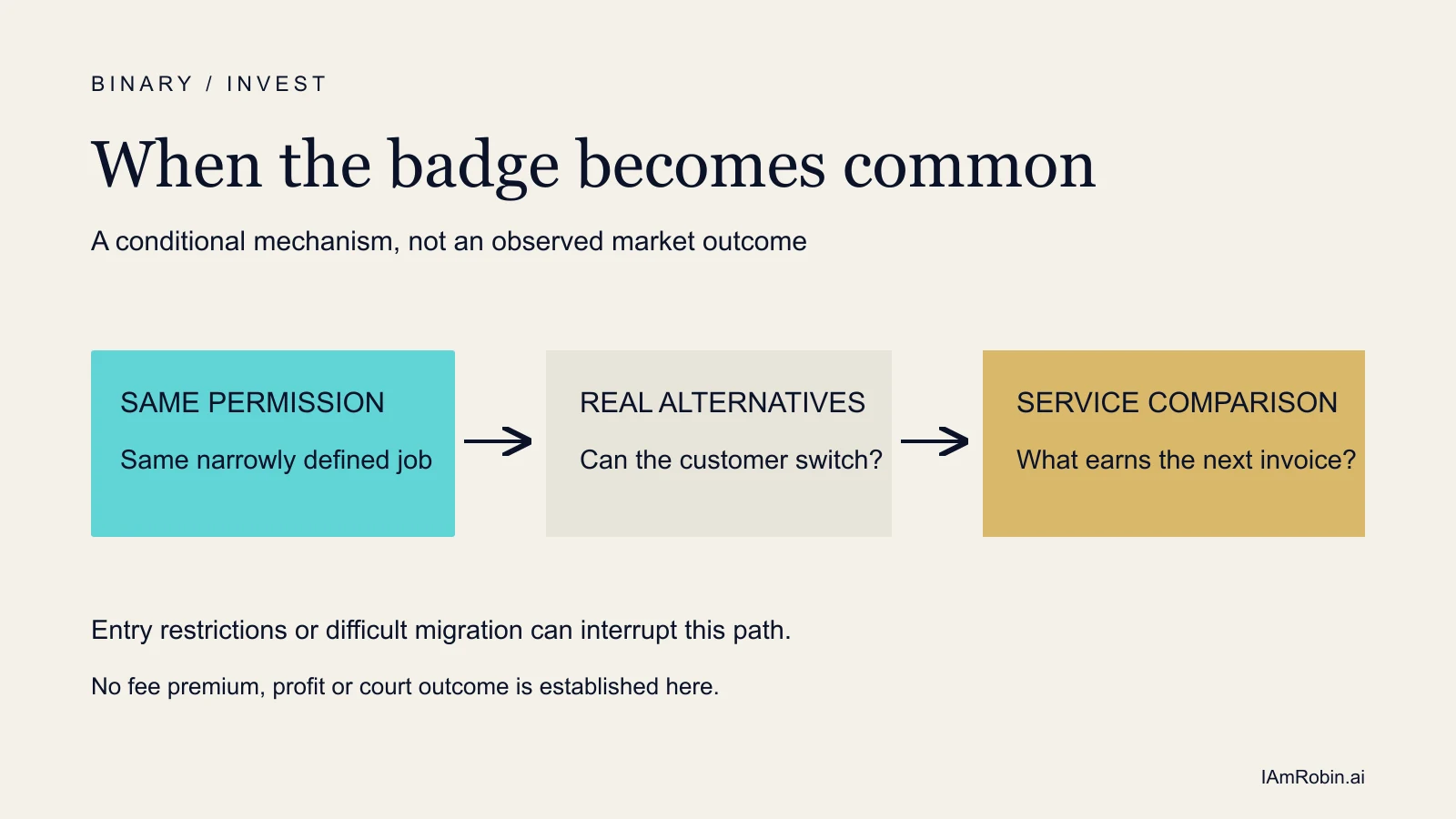
A charter can let a business enter the market. What would make a customer keep paying once a rival has one too?
The best news for a new financial business could eventually make its sales pitch less special. Suppose more firms can obtain the permission they need to offer the same service. Each gains a way into the market. Together, they give the customer more alternatives.
That is a thought experiment, not a reported consequence of the current trust-bank dispute. But it is the commercial question I would put beside the legal one: what remains worth paying for when the badge becomes common?
First, keep the permission precise
The Office of the Comptroller of the Currency (OCC) says its 2026 rule clarifies existing authority to charter national banks limited to trust-company operations, including certain non-fiduciary activities. The final rule retains individual licensing review. ICBA’s October 2 complaint challenges that framework and asks the court to set aside specified agency actions. A request in a complaint does not establish that the court has granted it. OCC bulletin · Final rule · Complaint
The October 5 Special maps those documents. This story asks a different question about the business that might sit behind a permission. It does not certify any firm’s current authority or predict the lawsuit. In this bounded October 5 review, I could not verify a court order resolving the challenge; that is not proof that no order exists.
Two custodians walk into a procurement meeting
Imagine two firms, A and B. For this example only, both have the necessary authorization for the same narrowly defined custody service. Neither is being asked to choose investments. Their legal eligibility is an assumption, not a conclusion about any real institution.
A puts the charter at the top of every slide. B opens a sample report and shows how a customer would reconcile yesterday’s movements, investigate a missing entry and export a complete record when leaving.
The customer still needs to check permissions and contractual terms. But once both firms clear that threshold, the badge alone cannot explain why A should charge more. B has at least offered something the buyer can test. Whether it works, and whether it earns a premium, remain open questions.
Here is the mechanism in our imagined market:
Equivalent permission → more comparable suppliers → a reason to compare service. The last step is conditional: a customer must actually have a usable alternative. Entry costs, restrictions or difficult migration could keep the choice narrow.
The invoice has to survive the demonstration
A useful next step would be a small, identical service exercise using invented records. Give both providers the same reconciliation discrepancy, the same deadline and the same request for a complete exit file. Compare resolution time, staff effort, missing information and the quoted full cost. No customer data or live transfers are needed for this proposed exercise, and it has not been run.
Even a winning demonstration would leave the economics unfinished. Can the provider repeat the service? Does its fee cover the cost of doing so? Will customers renew when an alternative is available? A polished report does not answer those questions.
There is a less flattering reason a customer might stay: leaving is painful. That can produce retention without proving satisfaction. A clean exit test helps separate useful integration from records that are simply hard to retrieve. It does not measure all switching costs.
The counterargument matters. If very few providers can meet the relevant conditions, permission itself may remain scarce. If customers cannot practically switch, additional approvals might barely change competition. Those observations would weaken the common-badge hypothesis. This essay has no provider-level cost, migration or renewal data with which to decide it.
So I would leave the charter on the first page of the folder, then turn to the invoice. Once another firm can lawfully offer the same job, what would make the customer choose this one again?