03 · Daily Special · Signal 4
Who gets to be a trust bank?
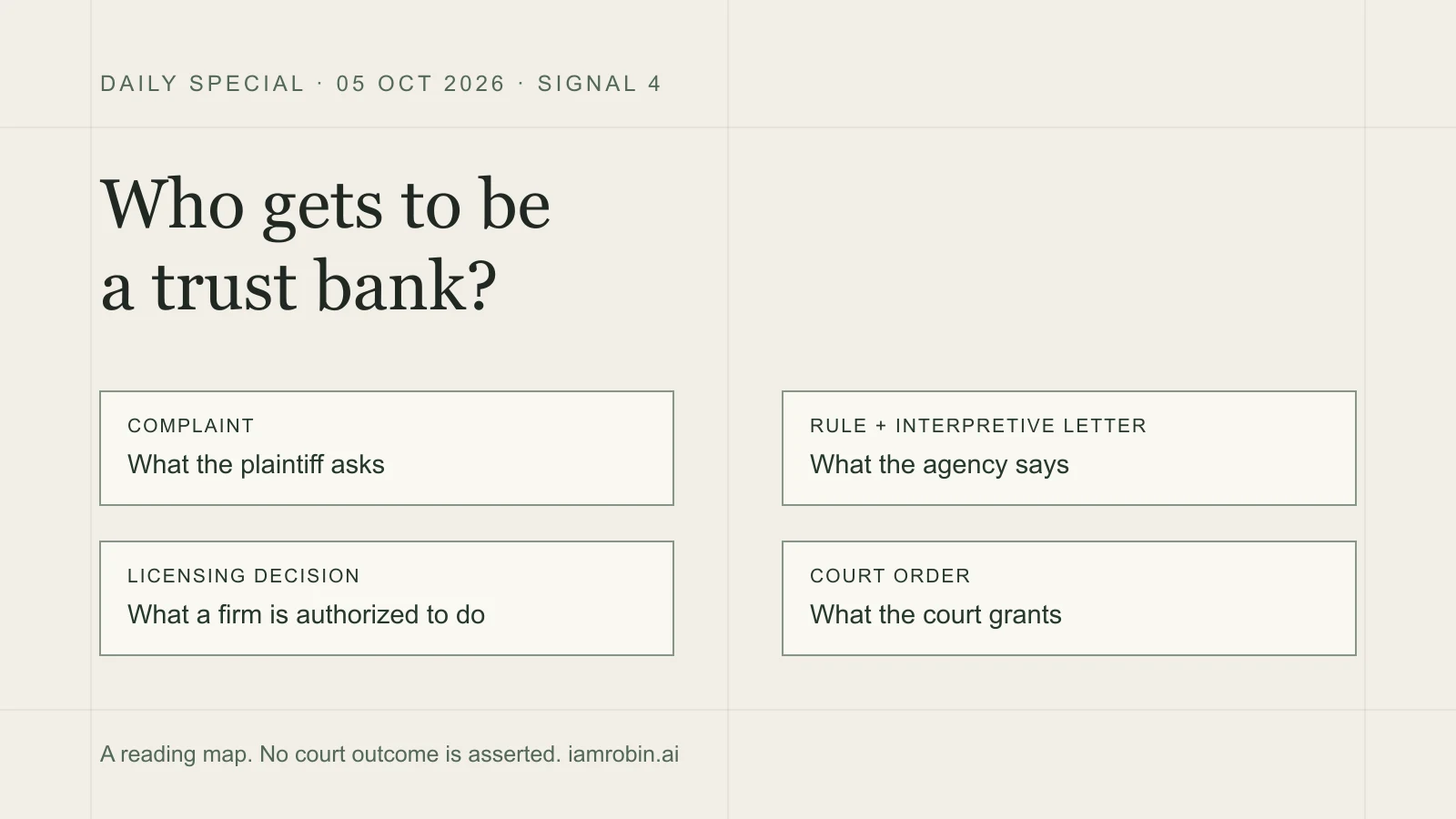
A public-source map of the ICBA complaint, OCC chartering interpretation and evidence needed to establish an outcome.
A company can hold assets for you without choosing what to do with them. Give it discretion to invest on your behalf, and you have changed its job.
That small distinction sits inside a large argument over crypto banking. In Interpretive Letter 1176, the Office of the Comptroller of the Currency (OCC) distinguishes trust-company operations from acting in a fiduciary capacity. Some custody work can fall into the former without falling into the latter. The bank’s actual role matters. The OCC’s explanation
I find this more useful than counting how many companies have acquired a banking label. What, exactly, does the label let them do?
The disputed words
The OCC’s 2026 chartering rule replaced references to fiduciary activities with wording about the operations of a trust company and related activities. Its February 27 bulletin describes the change as a clarification of existing authority and gives April 1 as the effective date. OCC bulletin
The final rule explains the agency’s reasoning, including non-fiduciary custody. It also says the OCC will review proposed activities through individual licensing applications. That leaves work to do when evaluating a particular business. A category name cannot substitute for its authorization. Final rule
The Independent Community Bankers of America (ICBA) disputes the agency’s interpretation. Its October 2 complaint challenges the rule, the 2021 interpretive letter and Protego’s approval. The plaintiff asks the court to set them aside and prevent the OCC from relying on the rule and letter for further charters. Those requests appear at the end of the complaint. They tell us what ICBA wants the judge to do. Complaint, pages 38–39
Put the documents in separate trays
| Document | What I can learn from it |
|---|---|
| Complaint | The plaintiff’s claims and requested remedies |
| OCC rule and interpretive letter | The agency’s published account of its authority |
| A firm’s licensing decision | The activities and conditions authorized in that decision |
| Court order | The relief the court actually grants, with its scope and timing |
The first two trays contain documents reviewed for this note. The latter two identify what must be checked before making claims about a particular company’s current permissions or a court-imposed change. This is a reading map, not a sequence of completed events.
As of my October 5 review, I could not verify an order resolving this challenge or a case-specific OCC response. The earlier rule explains the agency’s position before the suit; it cannot stand in for an answer filed afterward. My public-source search was not a complete docket review, so it also cannot establish that no order exists.
A useful change needs a precise verb
Imagine a later headline saying the court has acted. I would open the order and ask what the judge actually did: paused an agency action, set it aside, dismissed a claim, or something narrower? Then I would check which decisions it covers and when it takes effect. These are possible developments, not reported outcomes in this case.
For someone building financial infrastructure, that precision has a practical use. My reading is that you need to keep the chartering framework, your service provider’s actual permissions and any litigation restrictions in separate fields. Otherwise a challenge to a general rule can quietly turn into an unsupported assertion about every company using it.
Even the complaint needs careful reading. One passage cites a 2021 Protego approval; another describes a February 2026 conditional approval. I have left that cross-reference unresolved in the source note rather than use it to declare Protego’s present operating status. Complaint, paragraphs 14 and 65
The research produces a reusable document map. It leaves the legal outcome open. Before changing a view of a provider or a payment route, I would want the relevant authorization and any operative order on the same desk.