INVEST · Research → story
The second payment is the harder test
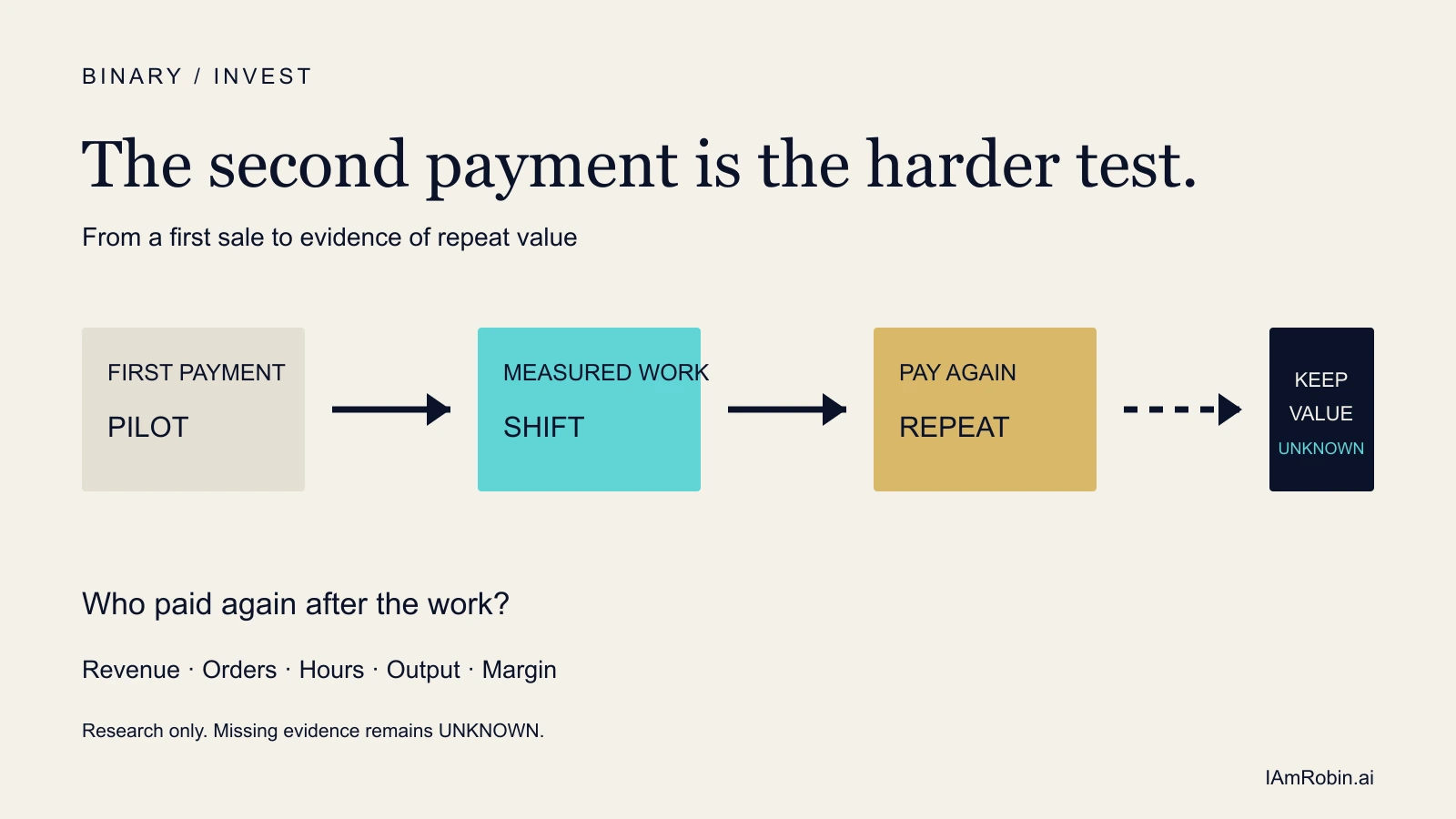
A first robot can sell on promise. A second payment must survive measured work, service cost and the buyer's alternatives.
The first robot arrives with cameras. The second arrives with accountants.
A first order can buy an option on the future: access to a new machine, a place in the supplier queue, a public innovation story, or a controlled pilot whose friction is expected. A second payment faces a harder room. The buyer has watched the robot work. Safety teams, production engineers and finance have seen the interventions, integration effort and service burden. The machine now competes with every other use of the next dollar.
That makes repeat payment one of the cleanest bridges between technical activity and commercial quality. It still does not prove attractive margins or a durable moat. It does force more of the story to meet in one place.
Three windows onto one unfinished market
UBTECH’s interim filing supplies a substantial financial window. For the first half of 2026, it reported RMB590.3 million of revenue from full-size embodied intelligent humanoid products and services and sales volume of 921 units. Group gross margin was 44.7%, while the company recorded a RMB338.8 million loss for the period. The filing says the humanoid category carried a higher gross margin, but it does not publish that category’s percentage after installation and field service. It also does not disclose a repeat-order cohort by customer. UBTECH interim results
Agility Robotics supplies an operating window. Its company presentation filed with the SEC reports nine committed customer facilities and 65,000 operating hours. The same page carries more than $300 million of committed Digit 5 orders. The footnote matters: the amount relates to 1,000 robots under one purchaser’s three-year Robotics-as-a-Service contract, depends on contractual milestones, includes deployment-linked warrants and is not current-period revenue. These are real commitments with real concentration and timing conditions. Agility investor material
BMW supplies the customer window. It says Figure 02 supported production of more than 30,000 BMW X3 vehicles, moved more than 90,000 components and logged about 1,250 operating hours over ten months at Spartanburg. That is unusually concrete customer-side evidence of work. The disclosure does not state the price, Figure’s economics after support, or a completed second purchase. BMW production account
Each window improves the picture. None closes it.
Why the second payment changes the question
The first payment asks whether a buyer is willing to try. The second asks whether the machine earned another claim on the budget.
To reach that point, five things have to survive:
- Reliability: useful shifts must survive interventions, exceptions and downtime.
- Integration: safety, production IT and process work belong in the real deployment cost.
- Service: field engineering, maintenance and warranty can absorb the margin suggested by a product sale.
- Budget: the buyer must choose the robot again over automation, labor redesign or doing nothing.
- Concentration: one milestone-dependent buyer cannot stand in for a broad customer cohort.
This is why revenue, orders, units, hours and output belong in separate columns. They answer different questions. Combining them too early creates a synthetic certainty that no source actually provides.
The next useful disclosure is smaller than a market forecast and harder than a demo: the same customer paid again after a measured operating period, and the supplier showed what remained after making the system work.
Until then, missing repeat-order or service-margin evidence stays UNKNOWN. It is not zero, and it is not permission to infer a winner. The source Special remains a research screen under WATCH, with no investment, procurement or deployment action attached.