03 · Daily Special · Signal 2
The robot sold. Who paid twice?
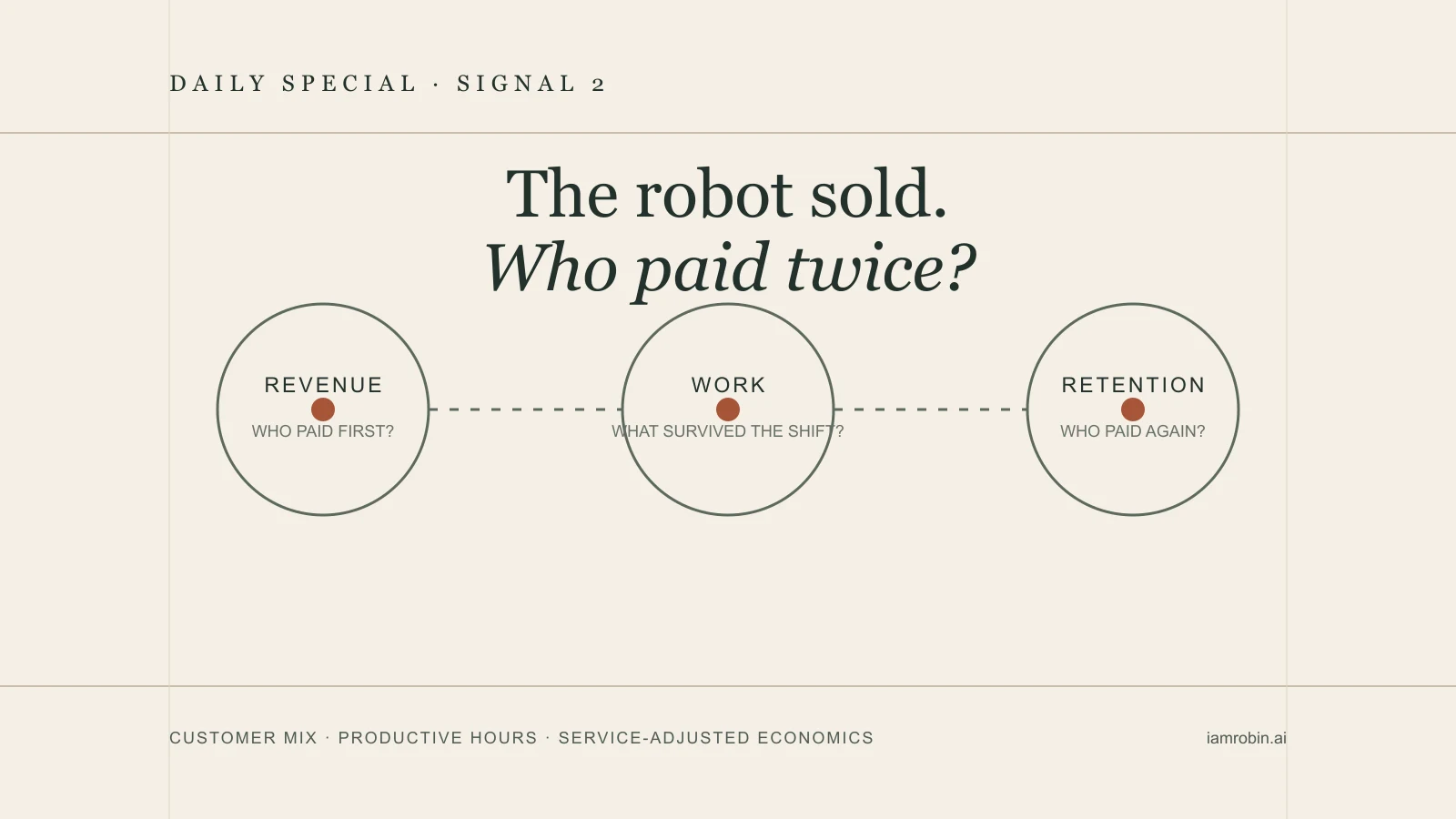
A public-source stress test of a five-receipt humanoid-robot revenue gate using UBTECH, Agility Robotics and BMW/Figure disclosures.
A robot company can now show a large revenue number, a large order number or a large hour count. The awkward question is whether the three numbers have ever met in the same customer.
That question matters more as policy pushes Physical AI out of the exhibition hall. China’s State Council is asking for deeper links between science and industry. The NDRC is more concrete: real scenarios, reliability and safety testing, and help crossing the gap from prototype to mass production. State Council NDRC
Good direction does not remove the need for receipts. It creates more ways to confuse activity with a business.
Two companies, two different windows
UBTECH’s latest interim results give us something unusually solid for a young humanoid market: recognized revenue. For the first half of 2026, it reported RMB590.3 million from full-size embodied intelligent humanoid products and services, up from RMB38.2 million a year earlier, with 921 units sold. Group revenue reached RMB1,269.1 million and the overall gross margin was 44.7%. The company still recorded a RMB338.8 million loss for the period. UBTECH filing
Those numbers establish more than a video or production target. They do not, however, tell us which customers bought again, how many productive hours customers observed, what share came from private rather than government-linked buyers, or the humanoid margin after integration and field service. The filing says the humanoid category carries a higher margin, but it does not publish that category’s percentage separately.
Agility Robotics opens a different window. Its October SEC-filed material reports nine committed customer facilities and 65,000 operating hours for Digit 4. It also carries a much louder number: more than $300 million of committed orders for Digit 5. Agility operating record
Then the footnote walks into the room.
The $300 million relates to 1,000 robots under one purchaser’s three-year Robotics-as-a-Service contract. It depends on contractual milestones, includes warrants that vest as robots deploy, and is explicitly not current-period revenue. Digit 5 early access is expected in the first half of 2027, with general availability by year-end. The registration statement also describes four customers paying about $500,000 each to enter Agility’s evaluation program. That is real commercial commitment. It is not yet four scaled repeat deployments. Agility registration material
UBTECH therefore shows more recognized humanoid revenue and units. Agility shows more supplier-reported duration and a large conditional commitment. Neither disclosure is “better” in the abstract. They answer different questions.
The customer has a third window
BMW’s account of Figure 02 adds the missing character: the buyer.
Over ten months at Spartanburg, BMW says the robot supported production of more than 30,000 BMW X3 vehicles, moved more than 90,000 components and logged around 1,250 operating hours. BMW also describes the actual staircase into its factory: theoretical assessment, laboratory work, test deployment, then pilot operation. BMW production account
This is much stronger evidence of useful activity than “deployed at a leading manufacturer.” We have a customer, task, period and output. We still do not have the price, Figure’s margin after support, or a second purchase. BMW says the companies were evaluating additional Figure 03 uses. Evaluation is progress. It is not a repeat order wearing a clever hat.
Five receipts, or five different questions
I would now keep five receipts beside every humanoid revenue claim:
- Who paid first? Tie recognized revenue to an external customer, separating affiliates and government-linked demand.
- Who paid again? A renewal, expansion or repeat order is stronger than another pilot announcement.
- What work survived the shift? Keep customer-confirmed output and hours beside intervention and exceptions.
- What remained after service? Installation, field engineering, maintenance, warranty and support belong inside the economic picture.
- How concentrated is the demand? One milestone-dependent buyer and a broad customer cohort do not carry the same evidence.
The downloadable research card applies those questions to all three disclosure windows. Its most useful result is wonderfully inconvenient: nobody closes the set.
UBTECH supplies recognized revenue and volume, while the reviewed filing leaves customer cohorts, repeat orders and customer-confirmed hours unpublished. Agility supplies hours, facilities and paid evaluations, while its headline order belongs to one conditional future contract and its attractive margin figures are illustrative projections. BMW supplies customer-side output, while commercial price, supplier margin and a completed reorder remain offstage.
“Not published” does not mean zero. It means this source cannot carry that part of the argument.
What changed after reading the filings
The surprise is not that humanoid robotics lacks evidence. The surprise is how much real evidence now exists, provided we stop asking one number to do five jobs.
RMB590.3 million of recognized humanoid revenue is a meaningful commercial fact. Sixty-five thousand hours are a meaningful operating fact. Ninety thousand components moved for BMW are a meaningful customer fact. The discipline is to let each remain what it is.
This also blocks three seductive substitutions: an order book for revenue, units for productive work, and company-wide gross margin for deployment economics after service. A market can improve on every one of those dimensions at different speeds.
The current public record does not support a like-for-like US-China productivity or profitability league table. It does support a sharper next request: show the same customer paying again after a measured operating period, then show what the vendor kept after making the system work.
That is the gate I would add. The completed work today is the research card, not an investment decision, procurement action or robot deployment. A machine may have been sold. The second payment is where the story starts becoming difficult—and interesting.