01 · AI Circularity Ledger
When AI Chips Become Collateral

A commercial loop with a scoreboard.
The conclusion is that compute credit deserves its own underwriting discipline. Blackstone has committed $5 billion of equity to a Google TPU venture targeting its first 500 MW in 2027. A September 16 Reuters report adds a $22 billion bank loan. The opportunity is to finance useful computing capacity; the danger is to lend for longer than its earnings remain defensible.
These figures describe different evidence and funding states. Equity commitment is public company information. The loan is reported through an unnamed source. Neither establishes that all funds have been drawn or that capacity is operating. Blackstone announcement · Reuters via CNA
For an investor, the interesting question starts after the financing headline. Who pays when the next chip generation makes this one cheaper to rent? Which contract survives a customer failure? What can a lender actually operate or sell? My framework puts those questions ahead of the familiar argument about whether AI is a bubble.
What the public record establishes
The May announcement defined a new compute-as-a-service business. Google’s own statement, dated May 19, says it will supply TPUs, software and services. That is an operating dependency as well as a technology advantage. A credit model should price continued access to the whole system, rather than assume that owning silicon delivers a working cloud. Google announcement
Crux AI’s September 9 launch announcement describes an integrated platform joining power, data centers, networks, compute, software and operations. It repeats the initial capacity plan. This remains a company plan, without evidence here that the planned fleet has entered service. Crux launch release
Reuters identifies ten banks, including Goldman Sachs, SMBC, Barclays, BNP Paribas and Scotiabank. Its account attributes the chip-and-contract backing, further syndication and potential investment-grade bond refinancing to Bloomberg. Several banks declined comment; other parties had not immediately responded. Public reporting is useful evidence, with a different status from a signed financing agreement.
Pricing, maturity, amortization, borrower-level recourse, advance rates and contract remedies are UNKNOWN in the reviewed material. The reported bond destination establishes neither a rating nor completed securitization. I would enter these fields separately in a credit memo and leave them open until documents answer them.
A capital stack is a sequence of obligations
The arithmetic is tempting: $22 billion divided by $5 billion equals 4.4 times debt to equity; debt divided by their $27 billion sum equals about 81.5%. These are illustrative ratios combining an announced commitment and a reported loan. They are neither verified company leverage nor loan-to-value. Timing, entity perimeter, other liabilities and asset valuation could change the denominator materially.
The same discipline prevents dividing total financing by 500 MW and calling the result a construction cost. Chips, land, power, buildings, working capital and later phases may occupy different entities and draw schedules. A capacity target is an operating ambition. It does not supply an asset valuation or a sources-and-uses statement.
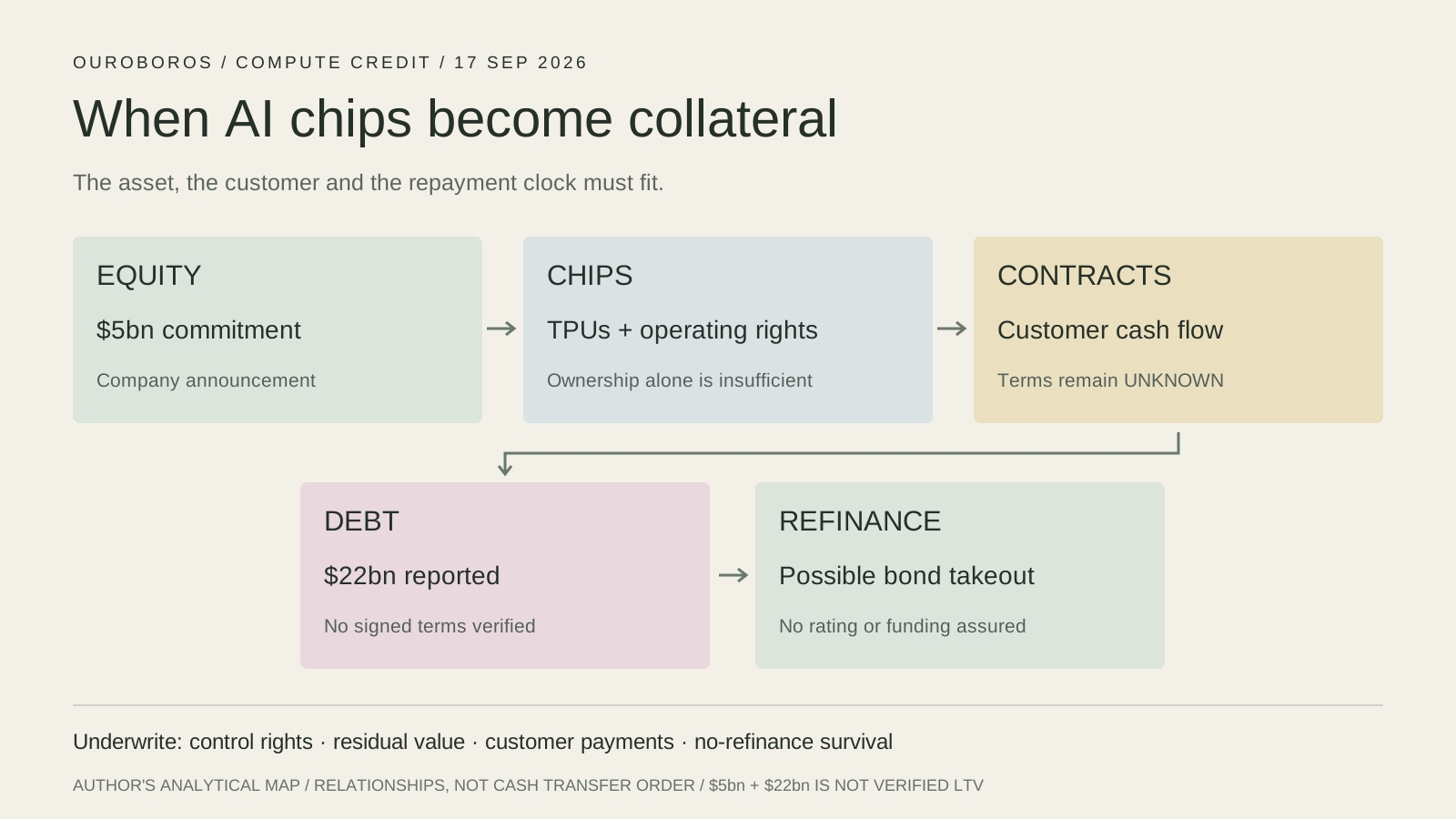
Author’s analytical map. Equity is an announced commitment; the debt and collateral linkage are reported; refinancing is a possible future route. The arrows describe financing relationships, not a verified cash-transfer schedule.
The useful deliverable is a dated sources-and-uses table. Record each commitment, draw condition, recipient and repayment claim. A dollar of sponsor equity, a supplier payment and a customer’s prepayment play different roles. Combining them too early can make the business appear better funded while concealing who can withdraw first.
The collateral is an operating chain
Imagine a lender taking possession of a room full of accelerators after a default. The machines remain physically present. Their revenue depends on power, cooling, networking, software access, customers and people who can run the cluster. Collateral value therefore depends on the continuity of several contracts at once.
Crux’s public website presents a single operator responsible for the integrated stack. That product promise makes operational sense. The financing question is whether the corresponding continuity and transfer rights survive distress. The website is evidence of positioning, without establishing those legal rights. Crux AI
The underwriting request should cover serial-number inventory, ownership, encumbrances, location, maintenance, power availability, service dependencies and permission to transfer use. Counsel must establish enforceability. Technical diligence must establish whether a replacement operator can produce saleable capacity within the recovery budget. Neither discipline can substitute for the other.
This is where an engineer who understands credit can add value. A technically intact asset can have weak recovery value if essential service rights disappear. Conversely, a well-supported older fleet might continue earning after the market has moved to a newer generation. Both cases require evidence about the actual deployment.
Borrow lessons from power plants and aircraft
A power project supplies a useful comparison because cash flow depends on a facility, an operating regime and buyers. For a particular compute project, test whether customer commitments genuinely resemble dependable offtake: who pays, for what service, under which conditions, and for how long? Calling an agreement long term does not settle those questions.
Aircraft offer a different diligence analogy: an asset has maintenance needs, a remaining economic life and potential alternative users. For accelerators, investigate those dimensions directly. Do not assume a deep secondary market, easy relocation or transferable software support merely because the equipment can be inventoried and pledged.
A conventional data center also contains assets with different useful lives. Site access and power infrastructure can outlast one generation of computing equipment. A financing model that depreciates the entire project at one rate hides that difference. Build separate schedules for durable infrastructure, networking and accelerators, then connect each schedule to contractual cash generation.
These are analytical comparisons, rather than claims that Crux has the legal or economic structure of any particular aircraft or power transaction. The lesson is practical: match each liability to the cash flows and recovery rights that can support it. A long-lived building cannot automatically rescue short-lived equipment debt.
Underwrite the customer before the backlog
A large contract is worth more when the customer can pay through a difficult funding market. Ask for concentration by legal obligor, cancellation provisions, minimum payments, deposits, performance credits and termination rights. Revenue forecasts should distinguish contracted minimums from expected usage and from pipeline conversations.
The critical stress is simultaneous deterioration. A customer may seek cheaper compute just as a more efficient generation reduces the fleet’s rental rate. If that customer also depends on new equity funding, weaker capital markets could hit demand, collections and refinancing together. These risks are correlated in the analytical scenario; their actual magnitude at Crux remains UNKNOWN.
Google’s multiple roles also deserve a transaction map. It supplies the technology and participates in the venture relationship. Those links may improve execution. They may also concentrate exposure to one ecosystem. The record reviewed here does not establish a purchase guarantee, a residual-value guarantee or unconditional parent support.
The earlier AI Circularity baseline examined Google’s Marvell-linked economic structure. Today’s extension follows the same accounting instinct: draw the relationships, then identify the independent customer cash entering them. Repeatedly counting the same funding flow can manufacture an impression of independent demand.
Residual value must survive a different buyer
Residual value is the cash recoverable from an asset under specified conditions. It differs from purchase price, accounting book value and value to the original operator. A useful underwriting exercise asks what an unrelated buyer would pay after removal, testing, installation and support costs, with a realistic sale period.
Technological obsolescence can appear through lower rental prices before physical failure. A fleet may keep functioning while producing less cash per unit of power. A newer system’s commercial advantage can therefore erode debt coverage even when every machine passes its maintenance checks. Avoid treating engineering availability as proof of financial durability.
Separate a going-concern case from a liquidation case. The first assumes continued service, customers and operating rights. The second includes disruption, remarketing and potentially a smaller buyer pool. Applying the first valuation to a loan whose recovery plan relies on the second would overstate protection.
No verified Crux chip depreciation curve or third-party recovery appraisal appears in the reviewed sources. That gap belongs near the front of the memo. It cannot be filled with a generic chip-life assumption dressed up as a company-specific fact.
Test the failure before admiring the refinance
Consider an illustrative operating model with 100 units of revenue, 60 of cash operating cost and 30 of debt service. Cash available for debt service is 40, giving coverage of 1.33 times. This is a teaching scenario, unrelated to disclosed Crux economics; taxes, working capital and maintenance capital are assumed already reflected or absent for simplicity.
If the rental rate falls 20% at unchanged volume and costs remain 60, revenue falls to 80 and available cash to 20. Coverage becomes 0.67 times. A 20% revenue decline halves the original cash cushion. The point is sensitivity, without predicting that this price change will occur.
In a separate scenario, a six-month commissioning delay produces no modeled rental revenue during that interval. Some interest, staffing or contracted site payments may still fall due. The actual draw schedule determines the exposure. Record the financing needed to bridge the delay before assigning value to future operating years.
A refinance should be an upside route in the initial survival test. Require a no-refinance case that shows debt repayment, sponsor support or asset disposal under documented terms. An expected investment-grade bond buyer cannot be treated as cash already committed. A good market can refinance a sound project; underwriting must also survive a closed market.
The Compute Credit Underwriting memo
My proposed memo fits on one page, with supporting documents behind it. It starts with six questions and an explicit evidence owner for each answer. The framework is a research tool, without implying a rating, lender mandate or recommendation to buy this financing.
| Question | Evidence required | Current public boundary |
|---|---|---|
| What money is committed and drawn? | Sources and uses, funding conditions, draw history | Equity commitment announced; debt reported; draws UNKNOWN |
| What can the lender control? | Ownership, security, service and transfer rights | Chip-and-contract backing reported; enforceability UNKNOWN |
| Who pays for the compute? | Obligors, minimum payments, cancellation and concentration | Detailed contract economics UNKNOWN |
| How does equipment earn and age? | Utilization, rental rates, power cost, maintenance and resale evidence | Operating and residual-value curves UNKNOWN |
| Does cash survive a shock? | Delay, pricing, customer failure and no-refinance scenarios | Framework prepared; Crux outcomes UNKNOWN |
| What permits an upgrade? | Signed terms, operating evidence and independent verification | Further diligence required |
Keep the conclusion conditional: investigate the financing structure, withhold a credit judgment until the missing evidence arrives. Strong sponsors and a compelling product can justify attention. Loan suitability depends on contractual protection, cash generation and loss absorption at the actual entry terms.
The first completed action is this framework, its evidence record and an archived distribution draft. The separate one-page Crux memo records unknown fields rather than inventing them. No bank contact, application, investment or transfer follows automatically from producing either document.
What changes the judgment next
Watch for a financing close or filing that identifies the borrowing entities, maturity, repayment profile and security package. Then seek evidence of capacity commissioning and billable customer use. Each development resolves a different risk; none should be used as a substitute for another.
An operating milestone matters when it changes the cash-flow model. Track delivered capacity, customer acceptance, collected revenue, utilization and maintenance needs together. A launch date, a reservation or a hiring announcement can signal intent while leaving the corresponding revenue field UNKNOWN.
The optimistic case is substantial: useful infrastructure reaches customers, long-term capital earns an appropriate return, and financing expands access to compute. The disciplined route to that outcome is to make risk visible while it can still be priced. The most valuable question is which obligations remain payable when the attractive story meets an unattractive quarter.
Categories and keywords
Categories: AI Infrastructure; Project Finance; Capital Allocation.
Keywords: compute credit, TPU collateral, Crux AI, residual value, customer concentration, debt maturity, refinancing.
Hashtags: #AIInfrastructure #ProjectFinance #ComputeCredit #CapitalAllocation #Ouroboros