01 · AI Circularity Ledger
Google’s $12.2 Billion Option on Marvell
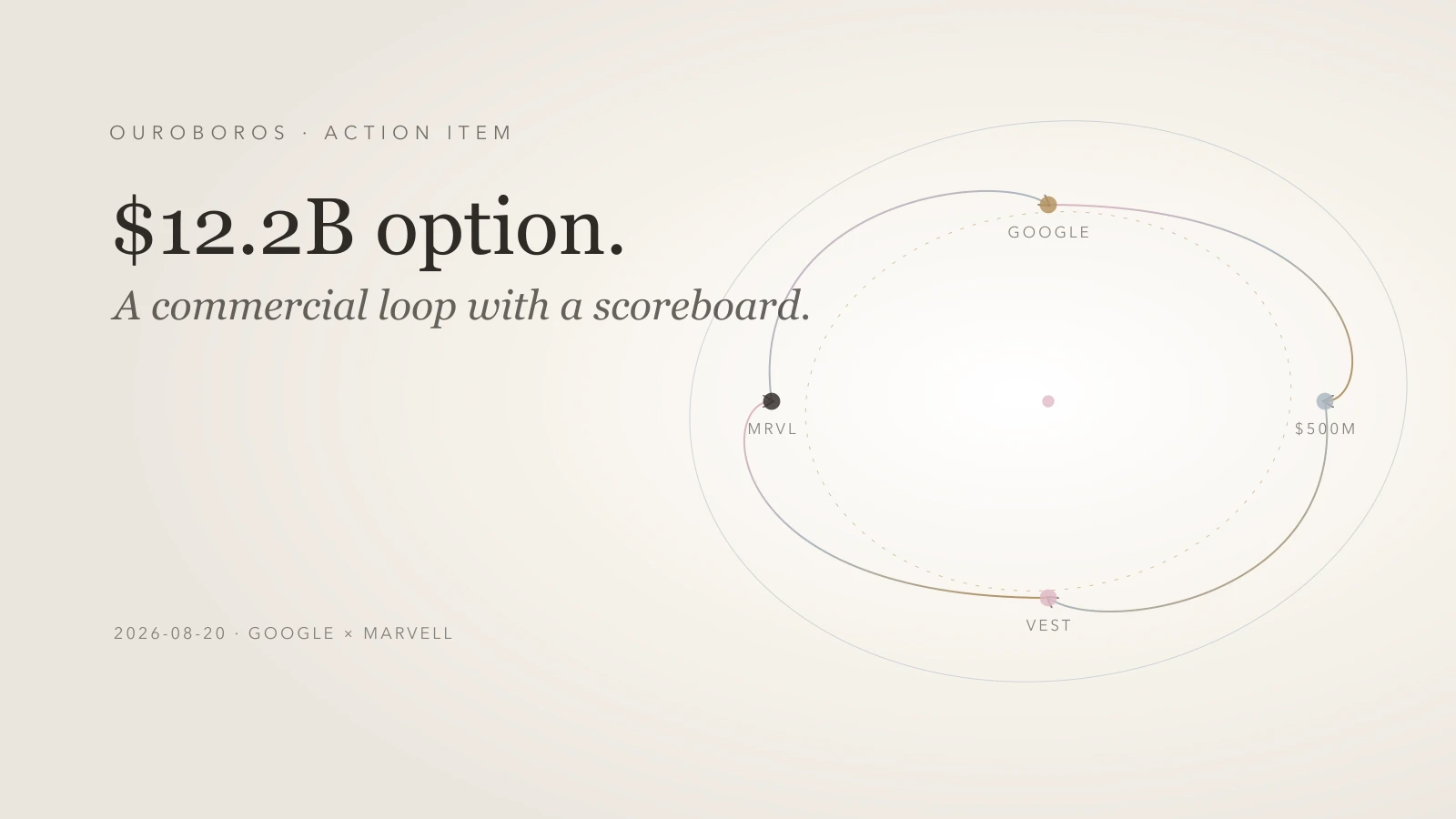
A commercial loop with a scoreboard.
The conclusion in three numbers
$12.18 billion. 58,970,907 shares. Up to $120 billion of qualifying revenue.
Google has received a warrant to buy as many as 58.97 million Marvell shares at $206.58 each. The gross exercise amount is $12,182,209,968.06. Almost the entire award is earned through a commercial scoreboard: Marvell unlocks one tranche each time cumulative qualifying revenue from Google-linked custom products rises by $500 million. Two hundred and forty milestones create a $120 billion revenue arc through fiscal 2033.
The investor conclusion is equally direct. This agreement turns procurement into equity alignment. Google can share in Marvell’s upside as its purchases help create that upside. Marvell gains a visible path into Google’s TPU ecosystem. Shareholders gain a potentially enormous customer opportunity and a large contingent dilution instrument whose economics must be earned over time.
The right posture is WATCH. Wait for proof. The proof will arrive through performance-based vesting, qualifying-revenue disclosures, production scope, margin conversion, and Marvell’s evolving role beside Broadcom.
This is a clean example of AI circularity with a real commercial gate. Cash does not simply travel around a promotional loop. Purchase activity must generate recognized revenue before the bulk of Google’s equity option vests. The contract makes the flywheel measurable.
A contract written like a scoreboard
The story began with a commercial agreement dated July 29, 2026. Marvell agreed to develop custom semiconductor products for Google across a broad set of programs attached to the TPU ecosystem: AI inference accelerators, storage controllers, network-interface controllers, memory-interface controllers, and near-memory compute.
On August 18, Marvell issued the warrant. The company filed the transaction the following day in a Form 8-K, along with the executed warrant agreement. Those documents establish the economic architecture.
The first 1,360,867 shares vest with time. Google receives four quarterly installments during the first year: 340,216 shares after three months, followed by three installments of 340,217 shares after six, nine, and twelve months.
The remaining 57,610,040 shares are performance-based. For each of the first 239 milestones, 240,042 shares vest. The final milestone vests 240,002 shares. Each milestone requires another $500 million of cumulative qualifying revenue. The measuring period began on August 1, 2026 and ends on January 29, 2033. The warrant expires on August 18, 2033, subject to the extensions described in the agreement.
Qualifying revenue has a disciplined definition. It covers GAAP revenue from qualifying custom products purchased by Google, its affiliates, or approved buyers during the measuring period, adjusted for rebates, refunds, credits, and returns. A qualifying product generally needs a written development statement and a Google sale-control right over the product as a whole. The agreement also allows the parties to designate future products in writing.
That distinction matters. A press-release relationship can be broad and soft. This warrant measures a narrower economic stream. It connects the equity reward to recognized revenue from defined commercial arrangements.
The $12.2 billion headline is exercise math
The most repeated number is also the easiest to misunderstand.
Multiplying 58,970,907 shares by the $206.58 exercise price produces $12.182 billion. That is the gross cash exercise amount if every warrant share vests and Google uses a full cash exercise at the stated price. It is different from the warrant’s grant-date fair value, Google’s eventual profit, Marvell’s revenue, and the market value of a future equity stake.
The warrant’s option value depends on Marvell’s share price, time, volatility, vesting, adjustments, and exercise mechanics. The agreement includes a cashless exercise path. Marvell has yet to disclose the new warrant’s grant-date fair value or the complete accounting impact in a periodic report.
The revenue number has its own precision. The 240 performance milestones imply up to $120 billion of cumulative qualifying revenue. That figure is a vesting ceiling embedded in the agreement. It is a commercial possibility with a clear measurement period. It is separate from a minimum purchase guarantee and separate from revenue already earned.
These distinctions make the deal more interesting. The headline carries optionality. The contract carries a scoreboard. Investors can follow the distance between the two.
Why Google chose equity as the alignment currency
Google already has the scale to purchase chips directly. Alphabet reported $91 billion of 2025 capital expenditure and described 2026 investment as another large infrastructure year. Management said around 60% of 2025 investment went to machines, with a similar mix expected for 2026. It also described supply as constrained while demand across Google DeepMind and Cloud remained exceptionally strong in its 2025 fourth-quarter earnings call.
That context changes the financing interpretation. Google is using equity upside as an incentive instrument inside a large procurement relationship. The warrant can align engineering attention, roadmap priority, delivery cadence, and long-range capacity planning. Every additional milestone gives both parties a shared reason to make the custom-product relationship larger and more durable.
The structure also preserves flexibility. Google gains exposure to Marvell’s equity value as the commercial program grows. Marvell receives the opportunity to become a wider supplier across compute, networking, storage, and memory interfaces. The commercial agreement can expand product by product while the warrant translates aggregate success into a repeatable vesting mechanism.
For a hyperscaler, this resembles strategic procurement with an embedded loyalty instrument. For a fintech executive, it looks like programmable commercial settlement: defined activity enters the system, an agreed threshold is crossed, and a financial entitlement is released.
The logic is familiar from payments. Incentives work best when the qualifying event is precise, the ledger is auditable, and the reward is tied to durable economic throughput. Here, qualifying revenue plays the role of settled volume. Each $500 million milestone behaves like a contract-level clearing event.
What Marvell receives
Marvell receives access to one of the world’s most important AI infrastructure buyers across more layers of the stack.
The disclosed scope reaches far beyond a single accelerator. Inference, storage, networking, memory interfaces, and near-memory compute all sit inside the TPU ecosystem. This gives Marvell multiple ways to participate as AI systems become denser, more power-constrained, and more dependent on data movement.
The warrant also creates a public commercial ruler. A fully performance-vested award would correspond to an extraordinary volume of qualifying revenue. Even partial vesting could reveal meaningful program scale if Marvell discloses performance shares separately from time-based shares.
Marvell pays for that alignment through economics that can include dilution and revenue reduction. Its May 2026 quarterly filing shows 875.6 million common shares at quarter-end. The new 58.97 million-share warrant equals roughly 6.73% of that reference count on a gross comparison basis. The performance portion alone equals about 6.58%. These percentages are reference calculations rather than a fully diluted ownership forecast because future repurchases, issuances, vesting, exercise behavior, and capital structure changes will move the base.
Marvell’s prior customer-warrant accounting offers another clue. Its quarterly report for the period ended May 2, 2026 describes earlier customer warrants whose grant-date fair values are recognized as reductions to revenue as qualifying revenue is recorded. The new Google warrant’s specific valuation and accounting treatment remain an open item until Marvell files the relevant details.
The core shareholder equation is therefore simple:
Incremental gross profit and strategic value from Google-linked programs must exceed the economic cost of the warrant, execution investment, and dilution.
Revenue scale will attract attention. Margin quality will decide the value.
Broadcom remains inside the map
The market initially read the warrant as a competitive transfer. Marvell shares jumped while Broadcom shares fell after the announcement, according to Reuters and MarketWatch. The strategic picture supports a wider frame.
Broadcom and Google signed their own long-term agreements earlier in 2026. A Broadcom Form 8-K says Broadcom will develop and supply custom TPUs for future generations and provide networking plus other components for Google’s next-generation AI racks through up to 2031.
The two disclosures can coexist. Google’s infrastructure ambitions are large enough to support multiple partners, multiple product layers, and multiple generations. Marvell’s filed scope explicitly attaches to the TPU ecosystem and includes an inference accelerator plus several controllers and memory-adjacent technologies. Broadcom’s filed scope explicitly includes future TPU generations and rack components.
Public documents provide program descriptions rather than a clean percentage split. Marvell’s TPU share relative to Broadcom is therefore UNKNOWN today. Any precise market-share figure would exceed the evidence.
The better monitoring method is to build the answer from observable pieces:
- Which company owns each disclosed design program?
- Which products enter qualification and volume production?
- How much Google-linked or qualifying revenue is reported?
- Which supplier’s scope expands across generations?
- How do custom-silicon revenue, margin, and backlog evolve?
This creates a patient way to measure competitive change. The first day’s share prices supplied a narrative vote. Future filings will supply the operating score.
Where this sits in the AI Circularity Deal Ledger
AI circularity describes more than money returning to the same ecosystem. It describes a topology where customers, suppliers, investors, and financiers gain linked economic outcomes from the same capacity buildout.
The Google–Marvell structure contains four connected nodes:
- Google buys qualifying custom products.
- Marvell recognizes qualifying revenue.
- Performance warrant tranches vest to Google.
- Google gains equity upside tied to Marvell’s broader value creation.
The loop then returns to the operating relationship. Greater program success can raise the value of tighter roadmap coordination and additional purchases.
This deal earns a stronger circularity profile because the performance gate is commercially observable. The bulk of the option requires up to 240 separate revenue milestones. Customer demand is the engine. Equity alignment is the amplifier.
That structure still deserves careful governance. Customer concentration can increase. Supplier priorities can tilt toward the customer holding the warrant. Accounting costs can reduce reported revenue. The equity award can become large relative to the share base. Commercial success can create bargaining power for Google at the same time it creates scale for Marvell.
These are design features to measure. They give the ledger a practical purpose: track the path from contract to activity, from activity to accounting, and from accounting to shareholder value.
The quarterly evidence loop
The next seven years should be followed through a compact ledger rather than a stream of headlines.
1. Vesting conditions. Separate the 1.36 million time-based shares from the 57.61 million performance shares. Time passage proves continuity. Performance vesting proves qualifying revenue milestones.
2. Actual Google purchases. Use disclosed qualifying revenue as the first
public proxy. If Marvell publishes cumulative performance tranches, translate
those tranches into a minimum milestone count. Keep the value UNKNOWN whenever
public filings leave the bridge incomplete.
3. Marvell’s TPU share relative to Broadcom. Track disclosed programs,
production ramps, customer-attributed revenue, and scope by generation. Preserve
UNKNOWN until the sources support a comparable number.
4. Economics. Record the new warrant’s grant-date fair value, contra-revenue recognition, gross-margin path, operating investment, and diluted share impact once Marvell files them.
5. Execution. Follow product qualification, tape-outs, yields, volume ramps, and any expansion of qualifying products. The warrant defines a “Kestrel Product Launch” in its terms, offering one named checkpoint for future disclosures.
6. Capital allocation. Compare warrant dilution with repurchases and other equity issuance. Marvell’s share count already reflects acquisitions, employee awards, previous customer warrants, and a convertible preferred investment from NVIDIA. The Google instrument enters an active capital structure.
This evidence loop can upgrade the thesis with each quarter. It can also keep a spectacular headline in proportion.
The investment view: watch the conversion
The known fact is the warrant architecture. The investor edge will come from measuring conversion earlier and more accurately than the broad narrative.
What appears priced into the first reaction is a strategic win for Marvell and a potential shift in Google’s custom-silicon supplier map. What remains to be earned is the path from a broad contractual ceiling to production revenue, attractive margin, and durable per-share value.
The decisive hinge is performance vesting. Time-based shares reward the relationship’s first year. Performance shares reveal commercial scale. A steady sequence of milestone vesting, paired with healthy custom-silicon economics, would support a stronger Marvell thesis. Slow performance vesting, opaque economics, or peripheral program scope would keep the warrant closer to optionality than operating proof.
This is why the current classification is WATCH — WAIT FOR PROOF.
The agreement deserves a permanent place in the AI Circularity Deal Ledger. It captures a defining feature of the AI infrastructure cycle: the largest buyers are redesigning commercial relationships to secure technology, capacity, and execution over many years. Equity is becoming another rail for that alignment.
The warrant is the visible instrument. The real asset is the relationship’s ability to turn Google demand into Marvell revenue, margin, and enduring product scope. That conversion is the story worth following.
Categories and keywords
Categories: Investment Research · FinTech · Artificial Intelligence · AI Infrastructure
Keywords: Google–Marvell warrant · AI circularity · TPU supply chain · custom silicon · Broadcom · customer warrants · supply-chain finance · AI infrastructure investing
Hashtags: #AICircularity #Google #Marvell #Broadcom #CustomSilicon #TPU #AIInfrastructure #PublicEquities #FinTech #InvestmentResearch
Original sources
- Marvell Form 8-K, filed August 19, 2026
- Google–Marvell Warrant Agreement, Exhibit 4.1
- Broadcom Form 8-K, filed April 6, 2026
- Marvell Form 10-Q for the quarter ended May 2, 2026
- Alphabet 2025 Q4 earnings call, February 4, 2026
Market-reaction context: Reuters, August 19, 2026 · MarketWatch, August 19, 2026