01 · AI Circularity Ledger
Zero Interest Sells Your Upside
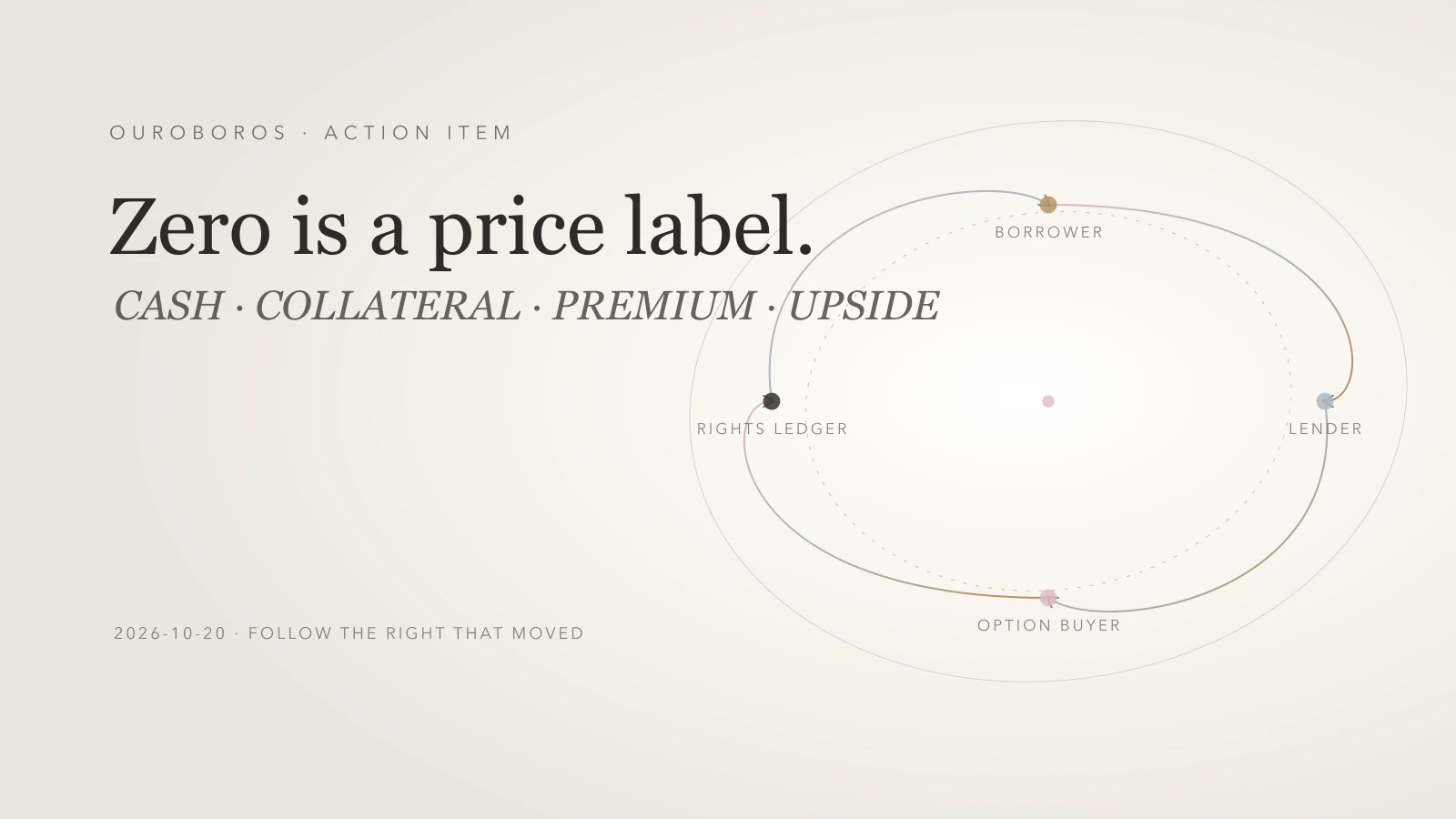
A commercial loop with a scoreboard.
The conclusion is direct: zero interest can still be expensive because the borrower may be paying with a right instead of cash.
Interest is easy to recognize. A lender advances money, a borrower pays a stated rate, and the ledger shows the charge. Financial engineering can move that charge into another line. A borrower can contribute collateral, permit options to be written against it, and receive liquidity while an option buyer supplies the premium that supports the lender’s return. The cash interest line falls toward zero. The borrower has sold some future participation above a strike price and accepted a new set of operational risks.
That distinction matters because price labels shape attention. “Zero interest” invites a comparison with a conventional loan rate. The economically useful comparison includes every right, cash flow, constraint, and failure path. The central question is therefore simple: what did the borrower give up, and who received it?
Spout’s introduction describes a private-beta design in which eligible users deposit tokenized US equities, borrow stablecoins at a 50% loan-to-value ratio, and pay no recurring interest. Lenders receive yield funded by covered-call premiums generated against pooled collateral. The product is an unusually clear case study because its marketing language and mechanism sit close together. It is still a company-described design on Solana Devnet, rather than a body of independently verified full-cycle customer results.
Zero changed the payer
A conventional secured loan has a visible payer and receiver. The borrower pays interest to the lender. Collateral protects the lender if the borrower cannot repay. The cost rises with the rate and time outstanding.
Spout describes a different triangle. The borrower contributes tokenized equity collateral and receives stablecoins. A lender supplies those stablecoins. An option buyer pays a premium for the right to buy shares at a fixed strike during a defined period. The protocol says the options premium funds lender yield. In exchange, locked borrower collateral participates in the option cycle.
This moves the immediate cash burden. The borrower does not send a monthly interest payment. The option buyer supplies cash through the premium. The borrower supplies the economic asset that makes the premium possible: the right to some appreciation above the strike if assignment occurs.
The Investor.gov covered-call definition provides the clean base concept. A covered call combines ownership of an asset with the sale of a call option on that asset. Premium arrives up front. The sale limits participation in gains above the exercise price while leaving much of the asset’s downside with the owner.
The word “free” therefore describes the absence of one cash charge. It says little about the total bargain. A rights ledger makes the bargain visible:
- The borrower receives stablecoin liquidity and retains exposure up to the applicable strike, subject to the product’s rules.
- The lender supplies stablecoins and expects a return from option premium, subject to losses, liquidity rules, fees, and execution.
- The option buyer pays premium and receives the contractual upside right.
- The protocol coordinates collateral, options, settlement, fees, liquidation, and the bridge between onchain records and offchain shares.
No party creates the return from empty space. Cash and rights move among them.
A one-share example
Take one share worth $100. Suppose the borrower locks its tokenized representation, borrows $50, and the system sells a call with a $110 strike. Ignore fees, taxes, slippage, liquidation thresholds, and the exact option premium for the moment. Those omissions make the example a teaching diagram, rather than a product return calculation.
If the share finishes at $100, the call expires without exercise. The borrower has received $50 of liquidity and retains the share exposure. The premium has entered the system. The opportunity cost from surrendered upside is zero for that cycle because the market never crossed the strike.
If the share finishes at $108, the result is similar. The borrower participates in the $8 rise because the terminal value remains below the $110 strike. The exact allocation of premium and protocol economics still follows the product rules, though the call itself does not remove stock appreciation in this simplified path.
If the share finishes at $120 and assignment occurs, the call buyer can acquire at $110. The borrower has surrendered the $10 of appreciation from $110 to $120. That $10 is the visible opportunity cost in this simplified snapshot. Premium income may partly or fully compensate it. Any honest comparison needs the realized premium, fees, taxes, assignment mechanics, and re-entry cost before declaring the trade favorable.
If the share falls to $70, the call premium offers only a limited cushion. The borrower still faces collateral deterioration and possible liquidation. The debt remains economically relevant even when its stated interest rate is zero. Collateral volatility can dominate the saved interest.
Spout’s covered-call explanation acknowledges this trade. When the underlying price exceeds the strike, appreciation above that level is surrendered upon exercise. The page frames premium as compensation and describes pool-level execution. That is the correct category of exchange. The size and reliability of compensation require observed cycles.
This is why annual-percentage-rate comparisons can mislead. A five-percent cash rate is a known type of cost. Sold upside is path-dependent. It may cost nothing in a flat cycle, a little in a modest rise, or much more during a sharp rally. One number cannot compare those paths without assumptions about volatility, strikes, premiums, fees, holding period, liquidation, and re-entry.
Assignment is a balance-sheet event
Assignment sounds like a technical options term. For the borrower it can change the asset position. Shares are sold at the strike, debt is cleared according to the settlement rules, and residual value is returned or used to rebuild exposure.
The Spout FAQ says borrowers keep the premium, debt is cleared from assignment proceeds first, and an Auto-Roll setting can restore the position after assignment. Those are company statements about intended mechanics. They raise the next accounting questions: At what price is the replacement obtained? How long is the borrower out of the market? Which fees and spreads apply? Who bears a gap while the position is rebuilt? Does the rebuilt position preserve tax and legal characteristics?
A claim that “the shares return” can conceal a sale and repurchase. Economically, a reconstituted position may contain the same ticker and quantity while having a different cost basis, execution price, timing, or legal treatment. The first production evidence should therefore be a complete event ledger from initial deposit through option sale, expiry or assignment, debt settlement, collateral release or repurchase, and final withdrawal.
The ledger needs quantities and timestamps. It should show shares deposited, token units issued, stablecoins borrowed, premium received, protocol fee, option strike and expiry, assignment price, debt reduction, residual cash, replacement shares, custody balance, and final user assets. A diagram can explain the mechanism. Only the full ledger can test whether the mechanism executed as described.
The risks form a stack
The sold call is only the visible economic exchange. The delivery stack adds risks that a conventional interest-rate comparison can miss.
First is market risk. The collateral can fall, rally through the strike, or gap during settlement. Each path affects borrower and lender differently.
Second is liquidation risk. A 50% starting loan-to-value ratio creates a buffer, though the buffer is finite. Falling collateral can trigger liquidation mechanics, oracle dependence, and execution costs.
Third is liquidity risk. Lenders may face exit queues, haircuts, or insufficient reserves. Borrowers may face cooldowns or timing constraints around locked collateral and option cycles.
Fourth is counterparty and custody risk. The token represents an offchain share held through a broker relationship. The economic claim spans smart contracts, an issuer or tokenization arrangement, custody records, proof-of-reserve processes, and traditional market infrastructure.
Fifth is software and oracle risk. Contract behavior, price feeds, option execution, settlement, and administrative controls must survive faults and adversarial conditions.
Sixth is legal and eligibility risk. The Spout terms state that spAssets are offered under Regulation S to eligible non-US persons and describe restrictions, performance fees, target yields, withdrawal mechanics, assignment, liquidation, and broad risk disclosures. Access depends on status and jurisdiction. A globally visible interface does not create universal eligibility.
Seventh is model risk. Target yields and loss buffers may rely on backtests or assumptions about volatility and execution. Historical option premium cannot guarantee future lender returns. Borrower savings can disappear when assignment, liquidation, or re-entry costs dominate.
These risks should remain separate. Combining them into one “APY” or “zero-interest” number would hide which party bears which failure.
The current evidence boundary
Spout announced a $2 million strategic financing on October 15. Financing establishes that investors supplied capital to the company. It does not establish borrower savings, lender returns, contract security, regulatory acceptance, or scale.
The public product material supplies useful detail. It describes 50% loan-to-value borrowing, option-funded lender yield, pool mechanics, target returns, fees, liquidation, and assignment. The terms also say yield figures are targets rather than guarantees. At the research cutoff, the product remained in private beta on Solana Devnet. Public full-cycle production evidence was unavailable.
The present state is therefore EXPERIMENTAL. The mechanism is clear enough to analyze. Performance, security, customer outcomes, and durable economics remain UNKNOWN until independent evidence exists. This boundary protects both directions. It prevents a financing announcement from becoming proof of product success, and it prevents missing production evidence from becoming a claim that the product has failed.
The strongest future evidence would include audited or independently reproducible contract state, broker and token supply reconciliation, a sample of complete option cycles, realized net returns after every fee, liquidation and assignment records, withdrawal completion, and incident disclosure. Aggregate APY alone would be insufficient because it could hide selection, leverage, losses, or exit constraints.
A better comparison card
Anyone evaluating zero-interest borrowing can use a one-page rights-and-cash card. It asks questions that a rate table omits.
Cash received. How much usable liquidity reaches the borrower, in which asset, and after which fees?
Cash paid. What recurring interest, origination fee, performance fee, spread, gas cost, custody cost, and withdrawal cost applies?
Rights sold. Which appreciation, voting, dividend, transfer, redemption, or timing rights move to another party?
Collateral path. What happens under flat, modest-rise, sharp-rise, decline, gap, and halted-market scenarios?
Settlement path. How do expiry, assignment, liquidation, repayment, unlock, withdrawal, and position rebuilding work in actual ledger entries?
Failure bearer. Who absorbs an oracle fault, broker mismatch, contract defect, reserve shortfall, delayed withdrawal, or legal restriction?
Evidence state. Which claims are contractually documented, company-reported, independently verified, observed in production, or still unknown?
Reversibility. Can the user close the debt, recover collateral, and leave with a verifiable final balance under routine and stressed conditions?
This card produces a fair comparison with an ordinary securities-backed loan. The conventional loan has explicit interest and its own custody, liquidation, and eligibility rules. The option-funded structure has a lower visible rate plus sold upside and a more complex settlement stack. The right choice depends on the user’s desired exposure, liquidity need, tax and legal position, risk tolerance, and expected market path. A slogan cannot make that decision.
What would change the judgment
The next milestone should be evidence from one completed, independently readable cycle. Begin with a borrower who deposits a known quantity of shares, borrows a known stablecoin amount, experiences either expiry or assignment, repays or settles, withdraws, and reconciles the final position. Publish every relevant fee and timestamp while protecting personal data.
Then repeat across the four paths that matter: flat, below-strike rise, above-strike assignment, and material decline. Add lender-side cash flows and protocol reserves. Compare the realized borrower result with a matched conventional loan and simple unlevered ownership over the same period.
The result should use several measures rather than one headline rate: net borrower cost, upside surrendered, maximum drawdown, liquidation loss, lender net return, withdrawal time, protocol revenue, failed transactions, and human intervention. A long enough series could reveal whether option premium reliably funds the structure across regimes. One favorable week would remain a demonstration.
Until those records exist, “zero interest” is a useful invitation to inspect the ledger. It is neither a verified free loan nor evidence of deception. The mechanism changes who writes the cheque and which right pays for it.
That is the durable lesson beyond one product. Financial innovation often moves cost before it removes cost. Follow the cash, then follow the right that moved.
Categories and keywords
Categories: Financial Systems, Stablecoins, Market Structure
Keywords: zero-interest borrowing, tokenized stocks, covered calls, opportunity cost, stablecoin lending, assignment, custody, rights accounting
Hashtags: #Stablecoins #TokenizedAssets #MarketStructure #CoveredCalls #Ouroboros