01 · AI Circularity Ledger
The Scarcity of No
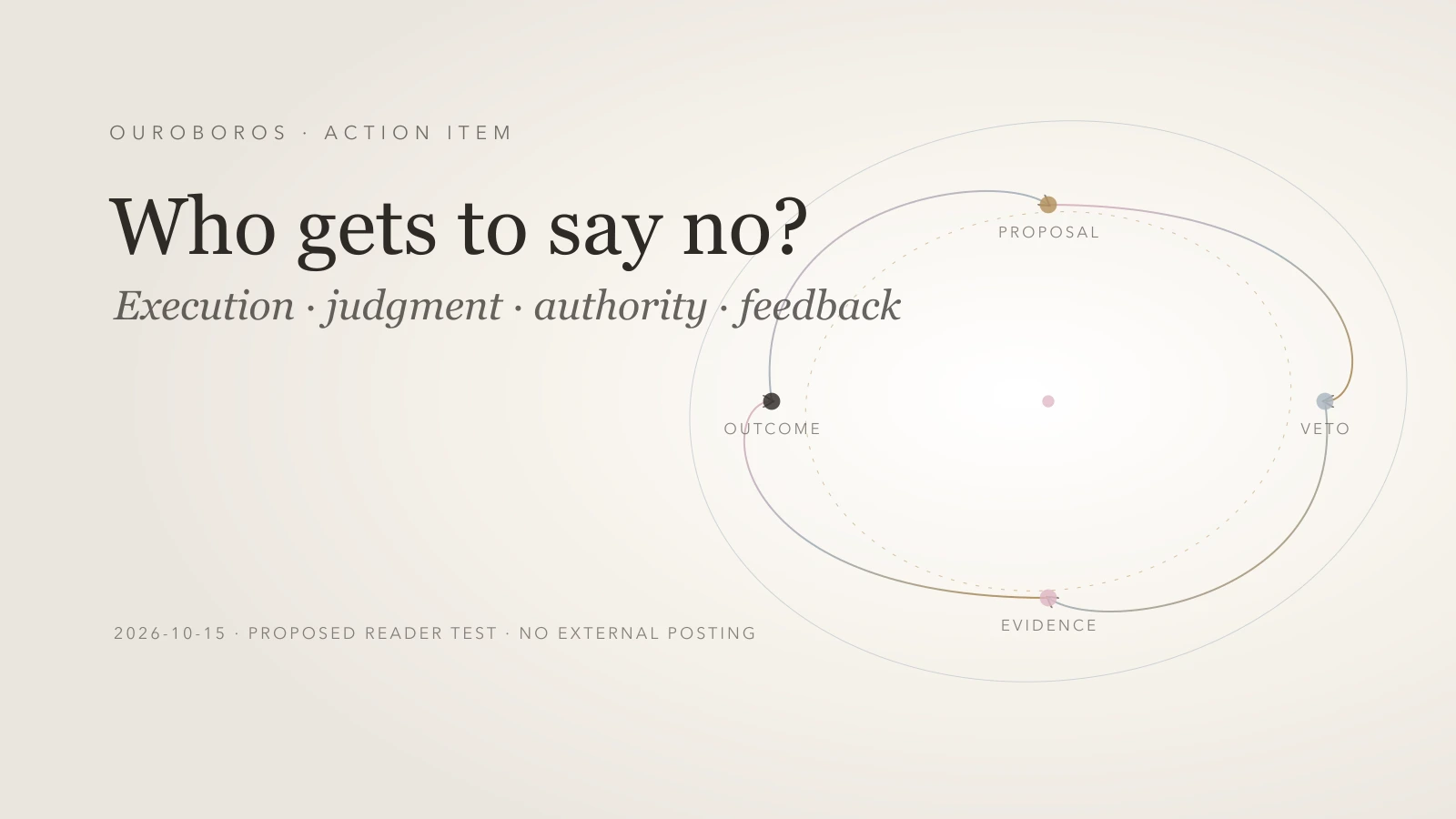
A commercial loop with a scoreboard.
The conclusion is uncomfortable and useful: when AI can produce the work, the scarce asset becomes the right to stop it.
That right sounds negative. In practice, it may be one of the most productive parts of an AI-native company. A strong operator rejects a shortcut that violates a system constraint. An editor removes an attractive claim that the evidence cannot carry. A capital allocator declines a project whose upside is vivid and whose recourse is vague. A founder tells an agent to pause because the objective is wrong, even when the execution is elegant.
These refusals create no celebratory demo. They often prevent the demo from becoming an incident.
Anthropic’s account of building its new source-control system, Scion, makes the shift visible. A seven-person team built Scion, a code-review surface, and related systems, then migrated a huge monorepo in five months. Claude accelerated the work. Engineers still reviewed the intent of every change request. They repeatedly told the agents “no” when a proposed solution violated a core constraint or overreacted to a hypothetical concern.
The story is easy to flatten into “seven people and AI replaced years of engineering.” The more interesting lesson concerns power. Claude supplied extraordinary execution. The engineers supplied the authority to define the system, refuse a locally plausible answer, and accept responsibility for what reached production.
As execution becomes abundant, the value of refusal rises. The question is who earns that authority and how the rest of us can tell whether a veto improved the outcome.
Execution, judgment, and authority are different assets
Execution turns a specified objective into an artifact. It writes code, drafts a contract, compiles a research packet, produces a translation, or builds a financial model. Modern agents can perform long chains of execution with increasing speed.
Judgment decides whether the objective, method, evidence, and tradeoffs make sense. It notices that a customer metric lacks a denominator, a financing headline excludes recourse, a robot demo omits intervention rates, or a translated paragraph quietly changes uncertainty into certainty. Judgment can admire the work and still reject it.
Authority determines who may make that rejection binding. A reviewer can spot a problem without possessing the right to stop a release. An agent can identify a risky payment without having the right to cancel it. A founder can hold formal authority while lacking the information needed for a sound decision. These three assets overlap, yet they are never interchangeable.
This distinction matters because AI lowers the cost of execution faster than it lowers the cost of accountable judgment. More output produces more review surfaces. Faster code generation creates more changes to test. Cheaper research creates more claims to verify. More autonomous workflows create more moments where a system must decide whether to continue, escalate, or stop.
Anthropic reported that Scion’s environment was unusual: code merges had risen from roughly 2,500 per day in May to more than 30,000 by September, its main-branch history approached 100 GB, and internal token spending exceeded what ordinary companies would realistically tolerate. Those figures warn against copying Scion as a general replacement for Git. They also reveal the future bottleneck. When production expands by an order of magnitude, approval can no longer mean reading every line. Review moves upward toward intent, constraints, and consequence.
The NIST AI Risk Management Framework frames AI risk through governance, context, measurement, and management. It does not prescribe a “veto officer.” Its structure still points toward the same operating need: a system requires named responsibility, measurable risk, and feedback across its lifecycle. Someone or something must have the ability to interrupt a trajectory when the evidence no longer supports the intended use.
A veto earns value through the counterfactual
Saying no is easy. Proving that no was valuable is harder.
A veto can protect a real constraint. It can also defend habit, status, or fear. A senior person may reject a better design because it challenges familiar architecture. A compliance process may block a harmless experiment because nobody owns the exception. An agent may generate endless warnings and make useful work impossible. Refusal has value only against a credible counterfactual: what would probably have happened if the work continued?
That counterfactual rarely appears immediately. A rejected change might have failed in production, or it might have worked perfectly. A rejected article might have damaged trust, or it might have sparked a useful debate. A rejected investment might have preserved capital, or it might have missed a great company. Certainty is unavailable at decision time.
We can still improve the record. Every material veto should carry four small fields:
- Proposal. What exactly was going to happen?
- Reason. Which evidence, constraint, or uncertainty justified stopping it?
- Prediction. What failure or tradeoff did the reviewer expect?
- Outcome. What later evidence supported, weakened, or reversed the decision?
This turns refusal from a personality trait into a learning event. It also allows an organization to distinguish three kinds of no.
A hard-boundary veto protects permissions, safety, law, security, identity, or irreversible assets. It remains binding until authority or evidence changes. A quality veto rejects work that fails an acceptance test. It can be repaired and resubmitted. A strategic veto rejects an objective because resources belong elsewhere. It should be revisited when the opportunity cost changes.
Without these labels, all refusals look alike. The team learns to route around the reviewer or to ask for permission repeatedly. With them, a successor can see whether the stop is permanent, repairable, or time-bound.
The previous essay, The Handoff Test, argued that a task should carry its goal, evidence, failure record, permission boundary, and acceptance state across an agent replacement. A veto belongs inside that package. The successor needs the stop condition and its evidence, not a vague note that “Robin didn’t like it.”
Cheap execution creates a review debt
AI output feels inexpensive because the marginal draft arrives quickly. The review cost often appears elsewhere.
Imagine an agent that produces ten code changes while a human engineer previously produced one. If each change requires only a fifth as much review, total review demand still doubles. If the changes interact, the cost can rise faster than the count. The bottleneck migrates from writing to integration, testing, and deciding which work deserves to exist.
The same pattern appears in publishing. Ten plausible articles create citation checks, translation parity reviews, visual QA, canonical routes, and distribution decisions. A publisher who celebrates draft volume while ignoring review debt has converted cheap generation into expensive uncertainty.
The lesson from Autonomy Needs Acceptance Tests was that activity cannot substitute for an accepted result. A moving agent, a green local command, and an uploaded artifact can each coexist with a failed outcome. Acceptance tests give refusal a clear object. The reviewer can point to the unmet condition instead of relying on taste alone.
This is where one-person companies face a trap. The founder becomes the universal review queue. Every agent returns for approval, every exception waits, and every piece of output competes for the same attention. The system has automated execution while preserving human serialization.
The answer is not unlimited autonomy. It is a hierarchy of refusal.
Routine quality vetoes can be encoded as deterministic checks: source hashes, schema validation, budget ceilings, test results, publication routes, and reversible deployment gates. Hard-boundary vetoes remain explicit and narrow. Strategic vetoes stay with the owner because they allocate scarce attention and define the company. The founder sees fewer decisions, and the decisions that remain are genuinely founder-shaped.
An AI Coworker Must Survive Losing Permission described safe degradation when authority disappears. The same logic applies here. An agent facing a binding veto should preserve state, continue independent safe work, and identify the exact evidence needed to resume. It should never interpret frustration, delay, or capability as permission.
The person who says no also needs feedback
Veto authority without feedback becomes ceremony. The reviewer can accumulate power while losing calibration.
Suppose an editor rejects five ambitious claims. Two were unsupported, one was later proven true, and two were never revisited. If the record shows only “rejected,” the editor appears perfectly cautious. The organization learns nothing about missed opportunity. A complete record needs reversals and regret.
This is why the outcome field matters. After a suitable interval, revisit the prediction. Did the feared failure occur elsewhere? Did new evidence remove the uncertainty? Did a repaired version pass? Was the opportunity lost? A high-quality reviewer should sometimes reverse a prior decision and explain why.
The ability to change one’s mind is part of veto quality. A reviewer who never reverses may be exceptionally accurate. More often, the system has stopped measuring the cost of refusal.
Your AI Should Remember Less proposed provenance, confidence, expiry, permission scope, and correction paths for operational memory. Apply the same fields to refusals. Record the source that justified the veto, the confidence level, the date on which it expires, the action it blocks, and the evidence that can overturn it. A permanent no requires a permanent boundary. Everything else needs a recheck condition.
Feedback also protects the people being reviewed. When a veto includes a reason and a repair path, the creator can improve the work. When the reason stays hidden, refusal becomes arbitrary power. AI agents will expose this weakness quickly because they can resubmit variations endlessly. A vague reviewer will either drown in near-duplicates or approve something merely to end the loop.
The operating rule is simple: every repairable no should teach the next attempt how to become yes.
Run the refusal ledger as a small public experiment
The thesis can be tested without exposing private systems or granting production authority.
Publish a simple invitation: document one AI recommendation you rejected. Describe the proposal, the reason for refusal, the expected failure, and what happened later. Ask whether the decision was reversed. Do not request confidential prompts, customer data, medical details, credentials, or financial account information.
Classify each voluntary submission as hard-boundary, quality, or strategic. Record whether the evidence was contemporaneous or reconstructed later. Preserve the limits: participants are self-selected, outcomes may be incomplete, and the sample cannot represent all AI use.
The first goal is qualitative. Look for mechanisms that repeat across cases. Did the agent optimize the visible metric while violating a hidden constraint? Did the human protect a real boundary or merely a habit? Did an acceptance test make the disagreement easier to resolve? Did the reviewer revisit the decision after new evidence?
The second goal is operational. Use the cases to improve a refusal template for RobinOS:
- exact proposal and requested authority;
- veto class and accountable owner;
- evidence and uncertainty;
- predicted harm or opportunity cost;
- expiry or recheck condition;
- eventual outcome and reversal.
The experiment succeeds when it produces a reusable template and at least three evidence-rich cases whose later outcomes can be checked. Likes, impressions, and generic agreement are weak measures. A thoughtful case with a documented reversal carries more learning than a thousand reactions.
No external social posting is part of this publication. The LinkedIn derivative is archived for human review. Reader participation begins only when Robin separately chooses a distribution channel. The website can publish the framework now without pretending the experiment has run.
Who should hold the right to refuse?
There is no universal answer. Authority should follow consequence and evidence.
Deterministic systems should refuse malformed inputs, failed tests, missing translations, exceeded budgets, and unauthorized actions. Domain reviewers should refuse claims or designs where expertise changes the risk. Owners should refuse objectives that conflict with identity, strategy, or irreversible commitments. High-impact decisions may require more than one independent veto because the cost of a single blind spot is too high.
The allocation should remain inspectable. A veto holder needs a named scope, a reason standard, and a feedback loop. The person with the loudest voice cannot become the default owner of every stop decision. Neither can the most capable model.
This changes the image of an AI-native leader. The leader’s output is not the number of tasks approved. It is the quality of the system that decides which tasks deserve completion. Good leadership creates fast yes paths for routine work, clear no paths for dangerous work, and honest maybe paths for missing evidence.
The scarce asset is therefore larger than judgment. It is legitimate judgment connected to consequences.
AI can draft the plan, implement the change, generate the alternatives, and monitor the result. Someone still defines the game, protects the boundary, and learns when the refusal was wrong. That role can be shared with machines in bounded ways. Accountability stays visible.
When execution becomes cheap, saying no gets expensive. Treat that expense as an investment. Record the reason. Predict the consequence. Revisit the decision. Reward the reviewer who prevents damage and the reviewer who changes their mind when the evidence changes.
The future belongs neither to people who approve everything nor to people who block everything. It belongs to systems that can produce quickly, refuse precisely, and learn from both.
Categories and keywords
Categories: Agentic AI; Governance; One Person Company; Systems.
Keywords: AI veto authority; human judgment; agent governance; acceptance tests; review debt; refusal ledger; RobinOS.
Hashtags: #AgenticAI #AIGovernance #HumanJudgment #OnePersonCompany #RobinOS