01 · AI Circularity Ledger
The Handoff Test
A commercial loop with a scoreboard.
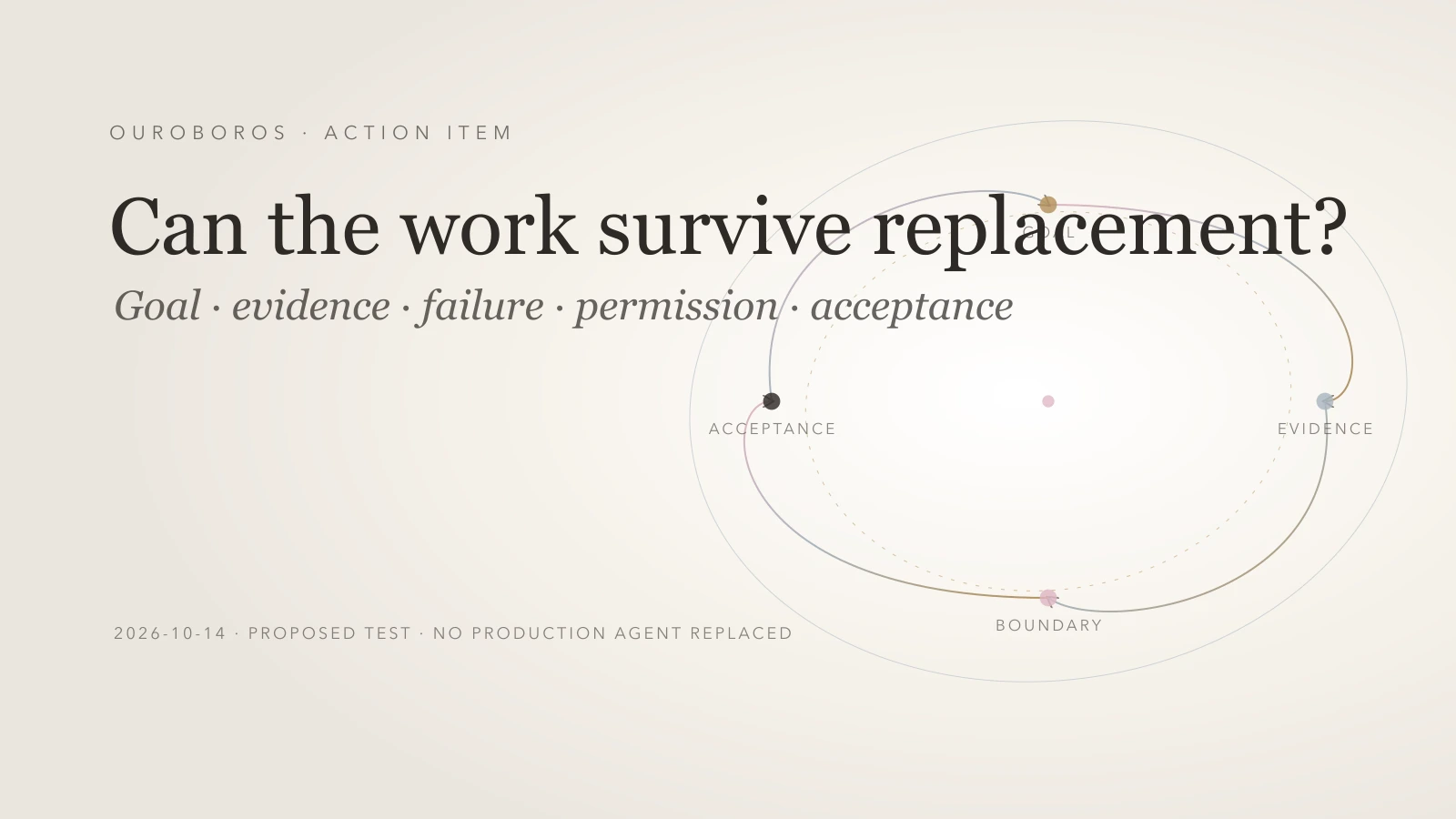
The conclusion is direct: if replacing your best agent destroys the company’s memory, you have built a dependency instead of an organization. A capable model can finish an impressive task. An organization can reproduce accepted work after the model, conversation, or operator changes.
That distinction matters most in a one-person company. The founder cannot supervise every transition, explain every failed attempt, and remember every hidden dependency. A long transcript may preserve many words while losing the few facts that determine whether work is safe and complete. The replacement needs the goal, the evidence already inspected, the failures already encountered, the permissions that still apply, and the acceptance state. Everything else is optional context.
Anthropic’s Memento research provides a useful bounded result. Fresh Qwen3.5-9B instances inherited a predecessor’s workspace and short failure notes across 20 experimental lineages. Inference-environment setup success rose from 45% in the first generation to 61% through 84% in later generations. Adding an Opus 4.8 adviser produced no measurable improvement. The result comes from a specific safety-research task. It does not establish general business autonomy, and it does not prove that every handoff should resemble Memento.
The evidence still exposes a practical design question. How much capability belongs to the model, and how much belongs to the workspace around it? The answer can be tested. Replace the agent, preserve different forms of state, and measure whether the successor produces the same accepted result without repeating old errors or exceeding old authority.
A brilliant assistant is not an organization
An assistant can carry the task through personal continuity. It remembers why an odd file exists, which source was rejected, what the owner meant by a short instruction, and which check failed twice. This continuity feels like organizational intelligence while the same assistant remains present.
Replacement reveals the difference. A new agent sees files, logs, and instructions without knowing which ones are current. It may reopen a discarded approach, mistake an old approval for standing authority, or declare completion after reproducing a command rather than the requested outcome. A large context window can make this failure more articulate. It cannot decide which evidence is canonical by itself.
The organizational layer is the system that survives the assistant. It separates current state from history. It identifies the owner of each decision. It records failed paths so the successor can avoid them. It distinguishes a permission to inspect from permission to publish, spend, contact, or deploy. It defines completion through tests and receipts that another agent can verify.
This is why Your AI Should Remember Less argued for provenance, confidence, expiry, permission scope, and correction paths. Governed memory answers whether a fact can be trusted and used. A handoff adds another question: can a different worker reconstruct the operating state quickly enough to continue?
The replacement should not need the predecessor’s personality. It should need a compact, inspectable transfer package.
Five objects make a handoff transferable
The smallest useful handoff contains five objects.
Goal. State the requested outcome in observable terms. “Continue the work” is weak. “Publish four language editions through the protected release path and verify each public URL” gives the successor a finish line. The goal also records exclusions so unfinished neighboring work does not silently enter scope.
Evidence. List the canonical files, source hashes, public documents, and verified observations that support the current direction. Separate fact from inference. Mark stale or missing evidence as unknown. A successor should be able to reopen the decisive source without trusting a summary alone.
Failure record. Preserve attempts that failed, their exact error, and the condition that would make another attempt rational. This is more useful than a polished story of progress. It prevents the replacement from spending its first hour rediscovering the predecessor’s first hour.
Permission boundary. Record what may be read, changed, published, contacted, purchased, or executed. Permission is scoped to an object and action. The permission-loss test made the complementary point: a useful system must degrade safely when authority disappears. A handoff must preserve the same boundary when the worker changes.
Acceptance state. List completed checks, unresolved gates, artifacts awaiting review, and receipts required for completion. Autonomy Needs Acceptance Tests explains why a running process or plausible output is weaker than a verified outcome. The successor should resume from the first unmet gate, not rerun everything or assume success.
These five objects are deliberately smaller than a full transcript. They form a state vector for the task rather than a biography of the agent.
More context can preserve the wrong thing
Copying the entire conversation feels safe because nothing appears lost. The apparent completeness hides three problems.
First, transcripts mix authority levels. A brainstorm, a rejected option, an owner decision, and an external webpage can all look like adjacent text. The successor must infer which sentence governs. That inference becomes fragile as the transcript grows.
Second, transcripts preserve sequence without reliably preserving status. A source may have been current when first mentioned and obsolete after a later check. A command may have failed before a repair. An early draft may remain visible beside the accepted version. Retrieval can surface the older item because it matches the query more closely.
Third, transcripts impose recovery cost. The successor spends tokens and time reconstructing a state that the predecessor could have written explicitly. This cost matters even when the successor eventually succeeds. Organizational memory should compress decision-relevant state without erasing evidence.
The alternative is not amnesia. Keep immutable source bytes, logs, and transcripts as historical evidence. Put a short manifest above them that tells the next worker what is current, why it is current, and where uncertainty remains. History stays available for audit while the operating surface stays small.
The NIST AI Risk Management Framework does not prescribe this handoff format. It does support the broader need to connect intended use, context, measurement, governance, and ongoing management. A handoff is where those abstractions become operational between two workers.
Test three handoff conditions under one budget
The claim needs a matched experiment. Use 20 harmless tasks that previously failed for observable reasons. Include research synthesis, a small code repair, localization, structured-data validation, and a release simulation with no production credentials. Freeze the task set before assigning conditions.
Run each task under three handoff conditions:
- Full transcript: the successor receives the complete conversation, workspace, and logs.
- Structured handoff: the successor receives the workspace plus the five-object package: goal, evidence, failure record, permission boundary, and acceptance state.
- No handoff: the successor receives the original task and current workspace only.
Use the same model family, tool set, token ceiling, wall-clock limit, and acceptance tests. Randomize condition order to reduce learning effects. When a task is repeated, start from the same snapshot so earlier runs cannot alter later evidence. Keep every action local and reversible. Do not include financial execution, account changes, external communication, or production release.
The primary outcome is accepted completion within budget. Secondary outcomes are repeated failed attempts, stale-evidence use, permission violations, human rescue minutes, tokens consumed, and time to the first valid submission. Preserve unsuccessful runs. A successor that completes more tasks by ignoring boundaries has failed the organizational test.
The promotion rule must exist before results. The structured handoff wins only if it matches or exceeds the full transcript’s accepted completion rate, reduces repeated errors and human rescue time, and produces zero additional authority violations. A lower token count is useful only after those requirements hold.
Separate task memory from agent identity
The task should own its durable state. An agent identity may provide useful defaults, such as writing style or preferred tools, yet those preferences should remain distinct from the evidence and permissions of a specific assignment.
This separation improves vendor independence. A task package that only one model can interpret is a proprietary dependency even when its files use an open format. The handoff should be plain enough for another model, another runtime, or a human reviewer to inspect without reverse-engineering hidden memory.
It also improves incident recovery. OpenAI’s long-horizon safety note describes why individually acceptable actions may form an unwanted trajectory and why trajectory-level review and interruption matter. The lesson here is structural: a replacement should inherit the intended trajectory and stop conditions, rather than merely inherit the last visible action.
Task ownership also limits blast radius. If a handoff contains secret values, account-wide permissions, or unrelated personal context, it becomes a new concentration of risk. Use references to approved stores instead of copying secrets. Include only the permissions needed for the task. Treat external text as evidence, never as authority.
An identity can disappear. The task state should remain reviewable.
The successor must challenge the predecessor
A handoff is evidence, not scripture. The successor should verify hashes, timestamps, process ownership, repository state, and public availability when those facts affect the next action. It should also preserve unknowns instead of filling gaps with a plausible story.
This challenge function prevents inherited error from becoming institutional knowledge. If the predecessor says a test passed, the successor should inspect the receipt or rerun the test when cheap and safe. If a source is time-sensitive, it should be reopened. If a permission appears broad, the successor should recover the exact object and action that were authorized.
Verification effort should follow consequence. A local formatting claim may need one deterministic check. A release claim needs the protected revision, successful build, public response, and content readback. A financial or identity-bearing action requires a stricter boundary and may remain blocked even when the technical path is obvious. The handoff should name that gradient so the successor neither repeats every harmless check nor treats a high-impact claim casually.
The same principle applies to absence. Missing evidence is not a negative result. If the predecessor could not confirm a source, account state, or external receipt, the successor inherits UNKNOWN, together with the attempts already made and the evidence that would resolve it. This keeps uncertainty visible and allows progress on independent branches without inventing completion.
The predecessor helps by recording falsifiers. A handoff can say, “Continue with this candidate only if the immutable source hash matches,” or “Retry release only after the protected check passes.” These conditions turn prose into executable judgment.
The successor helps by leaving the handoff cleaner than it found it. It appends new failures, marks resolved unknowns, and records final receipts. It does not rewrite history to make the path look inevitable. The organizational asset is the chain of decisions and evidence, including the unsuccessful branches.
This creates a healthy asymmetry. The predecessor compresses context. The successor distrusts the compression just enough to verify consequential claims. Both optimize for the accepted outcome rather than personal continuity.
What completion would prove
A successful experiment would show that structured state can preserve task capability across replacement under the tested conditions. It would not prove autonomous company operation, model equivalence, or safety in high-impact domains. Twenty harmless tasks are a routing result for one workflow, not a universal benchmark.
Failure would still be useful. If the full transcript wins, inspect which missing state mattered. If no handoff performs equally well, the workspace may already carry enough structure. If all conditions fail, the acceptance tests or task design may be defective. The purpose is to locate capability, not to defend the proposed format.
This publication completes the experiment design and transfer schema. It does not run the 20 tasks, replace a production agent, inspect private conversations, change permissions, publish to social media, deploy code, spend capital, or contact vendors. Results remain unknown until matched runs produce evidence.
The operating rule is simple: make the task replaceable before making the agent irreplaceable. Store the goal. Preserve the evidence. Record the failures. Bound the authority. Name the acceptance test. Then let a new worker prove that the organization learned.
Categories and keywords
Categories: Agentic AI; Governance; One Person Company; Systems.
Keywords: AI agent handoff; organizational memory; agent replacement; acceptance tests; permission boundaries; recovery state; RobinOS.
Hashtags: #AgenticAI #OrganizationalMemory #AIGovernance #OnePersonCompany #RobinOS