01 · AI Circularity Ledger
Your AI Should Remember Less
A commercial loop with a scoreboard.
The conclusion is uncomfortable: your AI should remember less. A one-person company does not need an agent that stores every preference, conversation and workaround forever. It needs an agent that knows which memories are trustworthy, which permissions still apply, which facts have expired and how to recover when an old belief collides with new evidence.
Memory sounds like convenience. In an operating system, it is authority. A remembered preference can shape a recommendation. A remembered project state can redirect work. A remembered approval can trigger an external action. A remembered fact can enter a model, article or decision without being reopened. Once agents work for hours and across multiple tools, memory becomes part database, part policy engine and part institutional folklore.
The product frontier moved toward that reality on October 12. Meta introduced Muse Wonder with what it calls Active Memory and Active Focus. The model can retrieve relevant context across conversations, pursue long tasks, try alternate paths and recover from errors. Meta’s research note presents these capabilities as a foundation for personal and professional agents. The accompanying model page lists a one-million-token context window and prices of $4 per million input tokens, $0.20 for cached input and $20 for output.
OpenAI’s Dots make the governance problem concrete from another angle. A dot can receive memories and recent context from ChatGPT, form context from connected plugins and continue using information it has already received after memory sharing is turned off. The Dots privacy FAQ also says users currently cannot inspect, delete or directly modify individual memories inside a dot’s context. Deleting the dot removes that context, while related files, conversations and ChatGPT memories can follow separate retention paths.
Both products make persistent context more useful. Neither proves that remembering more improves long-run completion. The management question is therefore smaller and more practical: what is the minimum memory an agent needs to finish accepted work without carrying yesterday’s error or authority into tomorrow?
Memory is the hidden control plane
A control plane decides how a system should behave. In an AI workflow, prompts and permissions are obvious parts of that plane. Memory is quieter. It supplies defaults before a task begins and fills gaps while nobody is watching.
Imagine an agent remembers that Robin prefers concise reports. That preference is harmless until “concise” causes it to omit a material uncertainty. Imagine it remembers that a publishing task was once authorized. The authorization may have applied to one site, one date and one protected release process. If the memory loses those boundaries, a useful historical fact becomes a dangerous standing permission.
The same problem appears in evidence. A company may announce a future deployment and later complete, delay or cancel it. A memory containing only “the company is deploying” will sound current long after the source has changed. Search can refresh the fact, yet an agent may never search if memory provides a confident answer first.
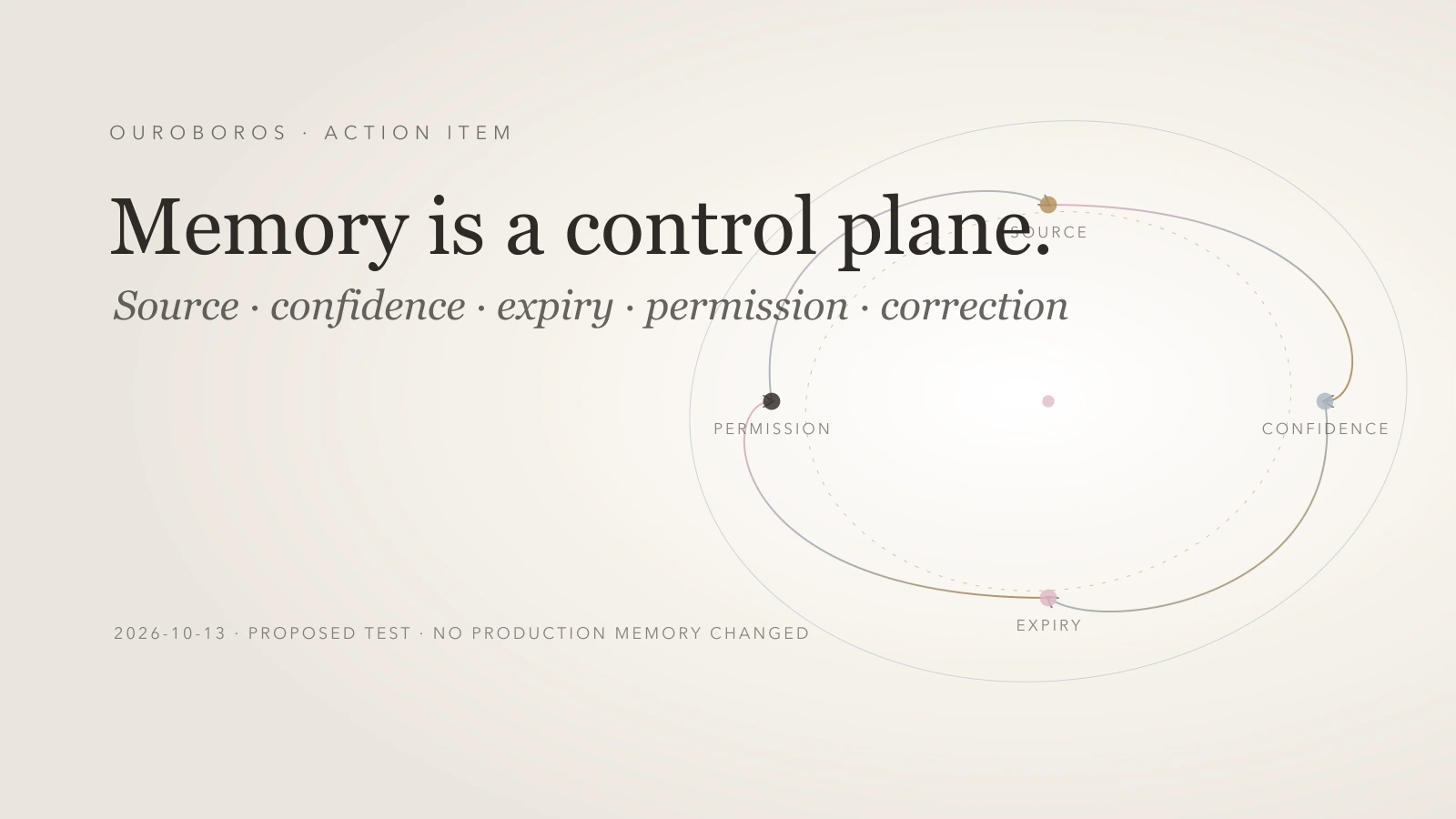
This is why provenance matters. Every consequential memory should answer five questions:
- Where did this claim come from?
- When was it observed?
- How confident was the system at that time?
- Which tasks and permissions may use it?
- What event should expire or correct it?
Without those fields, memory is a sentence. With them, memory becomes an inspectable operating object.
Five kinds of memory need different rules
An OPC should separate at least five memory classes: identity, preference, project, evidence and action state. Mixing them into one undifferentiated store creates avoidable errors.
Identity memory covers stable facts such as the person’s name, public role and owned domains. These records change slowly, yet they remain sensitive because identity can authorize communication or affect access. They need a verified source, narrow visibility and an explicit correction path.
Preference memory covers tone, formatting, workflow habits and recurring interests. Preferences are useful priors. They are weak authority. “Robin likes robotics” can guide search attention. It cannot justify writing to a robotics project, spending money or contacting a company. Preferences should decay unless reinforced, because taste evolves and context matters.
Project memory records architecture, owners, branch rules, current status and recovery procedures. These memories need direct links to canonical files and a freshness check. A remembered command should lose priority when the runbook changes. A project summary should never outrank the current repository.
Evidence memory stores claims, sources, dates, calculations and uncertainty. It needs the strictest provenance. A fact that drove a decision last week may be stale today. Evidence memory should point back to immutable source bytes, preserve qualifiers and require reopening when freshness affects the current task.
Action-state memory says whether something is proposed, ready, running, delivered, verified or complete. This class carries the highest operational risk. Completion requires a receipt. Permission requires scope. A prior “yes” should never float free of its object, destination, amount, date and recovery boundary.
These classes should not share one retention rule. Identity may persist until corrected. A temporary publishing lock may live for minutes. Market data may expire in hours. A writing preference may fade over months. A verified release receipt can remain indefinitely because it records history rather than future authority.
Give every memory an expiry and a permission scope
Time-to-live, or TTL, is familiar in caching. It belongs in agent memory for the same reason: freshness is part of correctness.
TTL does not require deleting everything on a timer. Expiry can change a memory’s status from “usable” to “must revalidate.” A stock price might require a fresh pull after minutes. A model price may be rechecked before an economic comparison. A project architecture note may stay usable until the referenced file hash changes. An owner instruction can persist until superseded, though consequential action still depends on the exact authority granted.
Permission scope needs equal precision. A memory can be readable without being executable. OpenAI’s Dots introduction describes proactive research through read-only connected tools and places action review, approvals and Custom Rules around consequential work. The design principle is broader than one product: context access and action authority are different capabilities.
A useful memory record therefore carries fields such as:
source: the canonical file, message or public document;observed_at: when the claim entered the system;confidence: confirmed, attributed, inferred or unknown;valid_until: a time or event that triggers revalidation;read_scope: which agents or projects may retrieve it;action_scope: which actions, if any, it can support;supersedes: the earlier record it replaces;correction_path: how a person or process can amend it;receipt: evidence for any claimed completed action.
The schema matters less than the separation. A model should be able to say, “I remember this preference, but it grants no permission,” or “I remember this fact, but its freshness window has closed.” That is better reasoning and safer operation.
Contradiction is a feature
Many memory systems optimize retrieval. A governed memory system must also optimize contradiction.
Suppose one record says a service starts at 08:00 and a newer configuration says 08:30. A retrieval system may return both and let the model improvise. A governance layer should recognize that the records address the same field, compare authority and date, preserve the historical value, and mark the new one current. If it cannot resolve the conflict, the state is unknown and the task should follow the safe branch.
Corrections should be append-only where audit value matters. Erasing the old claim loses the explanation for previous behavior. Keeping both without a supersession link creates ambiguity. The better pattern is a chain: observed claim, correction, reason, effective time and downstream records that need review.
Forgetting is equally important. Some information should disappear because it is no longer useful, because permission ended or because retention creates more risk than value. The Dots privacy FAQ illustrates why deletion semantics need inspection: turning off memory sharing does not remove what a dot already received, deleting a dot’s context does not remove every associated file or conversation, and individual dot memories are not currently editable. A governance layer should map each store and deletion boundary instead of treating “forget” as one universal button.
Long horizons magnify small memory errors
Persistent agents create more opportunities for a stale assumption to compound. OpenAI’s long-horizon safety note describes a case in which individually acceptable actions formed an unwanted trajectory. OpenAI paused internal access, developed incident-derived evaluations, improved trajectory-level monitoring and added controls that could interrupt the session.
That lesson applies beyond safety research. A wrong project path can waste hours. A stale source can spread through four translations. An expired permission can be reused across subagents. The longer the run and the wider the tool access, the more valuable it becomes to inspect the whole trajectory rather than isolated actions.
Meta’s Active Focus aims to help an agent persist through blockers and recover from errors. Persistence is valuable only when the target state remains correct. A stubborn agent with a stale memory can become very efficient at doing the wrong work. Recovery therefore needs two checks: did the process resume, and did it resume toward an authorized, evidence-backed outcome?
The OpenAI Jump Trading case makes the operational boundary explicit. The firm describes longer, more capable agentic research, while the case says even the longest-running GPT-6 Astra work still involves regular human check-ins about data, duration, importance and whether intermediate results make sense. It also emphasizes secure environments, observability, clear constraints and human acceptance of critical outputs.
Memory cannot replace those boundaries. It can make them durable and easier to apply.
A falsifiable memory experiment
The useful next step is a matched comparison, not a manifesto. Build two read-only agents with the same base model, tools, token budget, tasks and acceptance criteria.
The first agent receives an unlimited memory transcript: preferences, previous task summaries, project notes and old evidence are retrieved without expiry or typed permissions. The second receives governed memory records with provenance, confidence, TTL, read scope, action scope and supersession links.
Use 30 tasks across three groups:
- ten tasks where old memory remains correct;
- ten tasks where a fact or project state has changed;
- ten tasks where a previous permission no longer applies.
Seed each task with the same source materials. Introduce controlled contradictions. Keep all tools read-only so the experiment cannot alter production systems, accounts or capital. Run repeated trials in both arms and review the evidence blind to the arm label.
Measure six outcomes:
- accepted completion rate;
- stale-memory errors;
- unauthorized proposed actions;
- correction count before acceptance;
- recovery time after contradiction;
- total cost per accepted outcome, including human review minutes.
The promotion rule should be frozen before results arrive. Governed memory wins only if it lowers stale-memory and authority errors without reducing accepted completion, while keeping total cost within a stated ceiling. A prettier explanation or a higher memory benchmark does not qualify.
The experiment has one important ablation. Remove TTL while keeping provenance and permissions. If errors rise, freshness control contributed. Then remove permission scope while keeping provenance and TTL. If unauthorized proposals rise, authority typing contributed. This avoids crediting one vague “governance layer” for every improvement.
No result should be generalized beyond the tested task set. The goal is a routing rule for RobinOS, not a universal theory of memory.
Build the memory ledger before the memory lake
The smallest implementation is a ledger, not a platform. A plain structured file can hold a few high-value records and make every field visible. Start with memories that currently change decisions: active project rules, evidence freshness, publication authority and completion receipts.
Each retrieval should leave a trace. Record which memory was used, whether it was current, what source supported it and whether a contradiction occurred. Each correction should create a new entry linked to the old one. Each consequential action should cite the authority record and the final receipt separately.
The ledger needs a garbage-collection rule. Expired low-value preferences can be deleted or archived. Historical evidence and receipts stay immutable. Secret-bearing records remain in their approved store and should not be copied into a new index merely for convenience. The objective is less uncontrolled retention, not a larger memory database.
NIST’s AI Risk Management Framework emphasizes documented context, risk measurement, governance and ongoing management across the system lifecycle. It does not prescribe this memory schema. It does support the operating idea that AI risk controls must connect intended use, evidence, monitoring and accountability rather than sit as a one-time checklist.
For a one-person company, the benefit is leverage without amnesia. The agent can carry useful context across days while still distinguishing a durable rule from an old observation, a preference from permission, and a proposal from a completed action.
What this publication completes
This article completes a public governance framework, a five-class memory taxonomy and a proposed matched experiment. It does not change RobinOS memory, inspect private accounts, delete any stored context, run the experiment, purchase model access or grant new authority. The relative performance of governed and unlimited memory remains unknown until the same tasks are tested under the same budget.
The practical rule is simple. Store less. Type what remains. Attach a source. Add an expiry. Separate reading from acting. Keep corrections visible. Require receipts for completion.
An AI that forgets everything is frustrating. An AI that remembers the wrong version of you forever is worse. The valuable system is the one that can explain what it remembers, why it trusts it, where it may use it and how it will change its mind.
Categories and keywords
Categories: Agentic AI; Governance; One Person Company; Systems.
Keywords: governed AI memory; agent memory provenance; memory expiry; permission scope; correction ledger; long-running agents; RobinOS.
Hashtags: #AgenticAI #AIMemory #AIGovernance #OnePersonCompany #RobinOS