03 · Daily Special · Signal 1
The accepted result is the unit
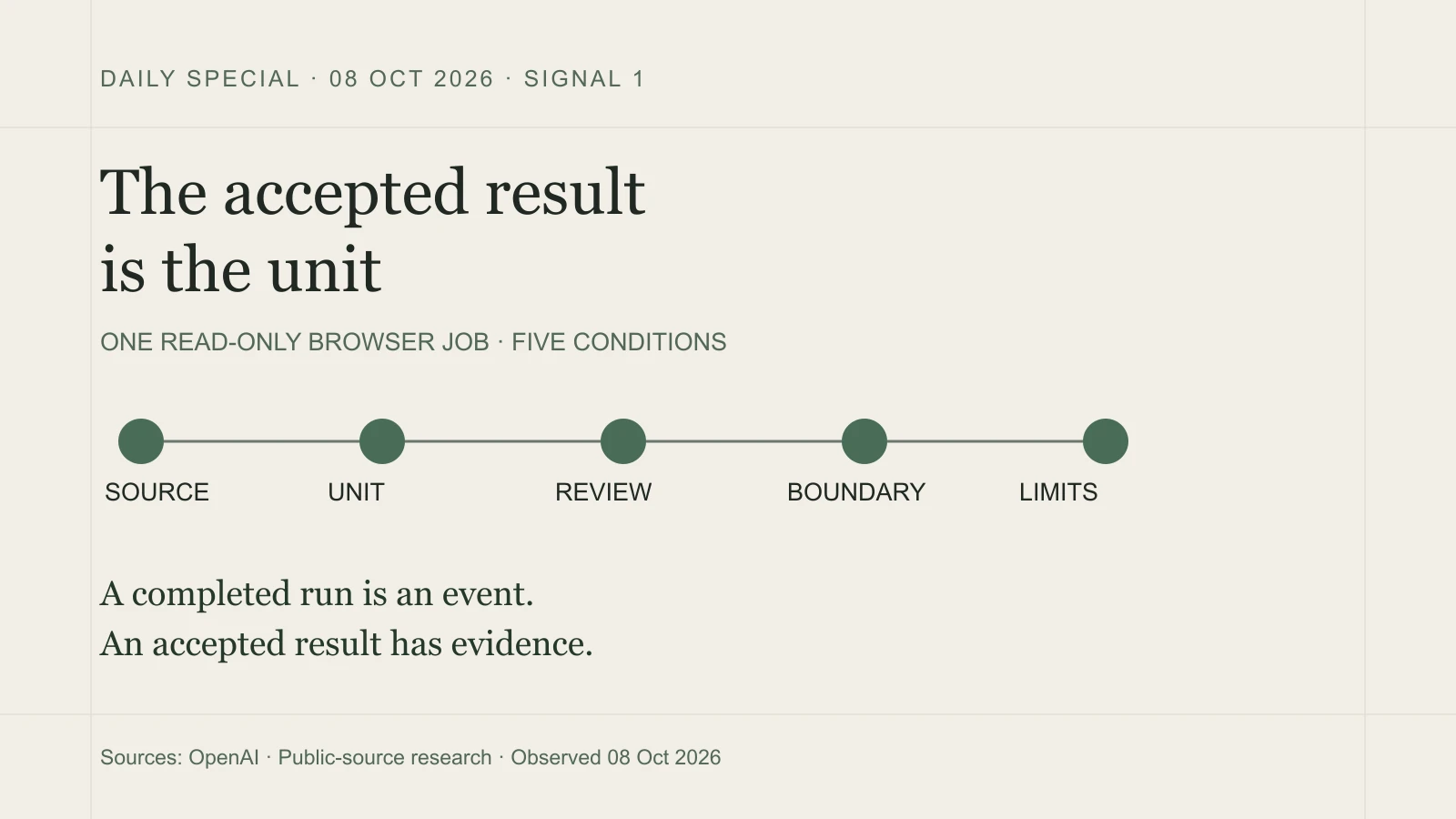
One read-only browser research job tested against five predeclared acceptance conditions, plus a bounded evidence map of OpenAI's Jump Trading case.
A browser agent can finish with great confidence and still leave me holding an empty bag. The page opened. The cursor moved. The run ended. But did the requested result arrive, and can someone else inspect it?
That is the small puzzle behind today’s test. I gave one read-only browser research job five conditions before it began: resolve the named source, identify the unit of work, find the human acceptance boundary, bound the autonomy claim, and preserve missing production measures as missing. No login, connector, transaction, message or account change was allowed.
The job passed all five. The more interesting result is that the selected source does not actually measure browser performance.
What Jump’s story says
OpenAI’s Jump Trading case describes agents taking on longer, more ambiguous research work. Researchers define a problem, a work environment and a way to judge the quality and significance of results. Agents may work for days, pull from several data sources and redirect their own effort as they evaluate intermediate findings.
This is a useful operating picture. It also keeps a human in the frame. Jump emphasizes secure and monitored environments, clear constraints, observability and final human review. Even the longest-running work still receives regular check-ins about which data to use, how long to run, what matters and whether intermediate results make sense.
The case makes an especially important distinction around trading signals: an agent-produced signal remains informative but potentially wrong, then enters a separately reviewed and controlled execution environment. Research output is not execution authority.
The missing denominator
The page does not publish a task count, acceptance rate, retry rate, intervention count, recovery time, latency or cost per accepted result. It offers no matched comparison with another model or a human-only process. And because it is a customer account published by the model provider, it is not an independent evaluation.
None of this proves the account wrong. It changes the size of the conclusion. We have evidence of a reported operating pattern and design philosophy. We do not have enough information to calculate productivity or autonomous reliability.
That gap is easy to miss because “ran for days” sounds like a measurement. It is a duration. The unit I care about is an accepted outcome: a result that meets a predeclared test and leaves evidence at its destination.
One tiny test, honestly sized
For this job, the destination evidence is the three reopened public pages and the hash-bound source note. Retrieval completed without human intervention. No failure occurred, so recovery time was not exercised. That is one accepted result, not a reliability rate.
Earlier OpenAI browser benchmarks show why one pass should stay small. The 2025 Computer-Using Agent report listed 58.1% on WebArena, 87.0% on WebVoyager and 38.1% on OSWorld. Those figures belong to an earlier system and different test environments; they do not measure GPT-6 Astra or Jump’s private harness. Their relevance is methodological: even a strong headline number needs a named task set and scoring rule. Benchmark report
“Browser job” is also too vague on its own. The ChatGPT agent release describes a system that can switch among a visual browser, text browser, terminal and APIs. It can ask for confirmation, be interrupted or taken over, and it can encounter prompt injection on third-party pages. So the record should name the tools and permissions, not merely the window we watched.
A five-line acceptance card
Before the next test, I would write down:
- the exact task, source set and destination;
- the allowed tools and whether the job is strictly read-only;
- the external evidence that makes the result acceptable;
- every human clarification, takeover or validation step;
- the failure point, resumed state and recovery time—or “not exercised” if nothing failed.
Add retries, latency and cost per accepted result when comparing systems. This is wonderfully unglamorous. It also prevents a smooth animation from impersonating delivered work.
The claim from today is deliberately narrow: one public-source browser job met five declared conditions and produced inspectable destination evidence. It says nothing about investment performance, production routing or autonomous trading. That restraint is not a footnote. It is what makes the result reusable.