01 · AI Circularity Ledger
The Weekend Settlement Gap
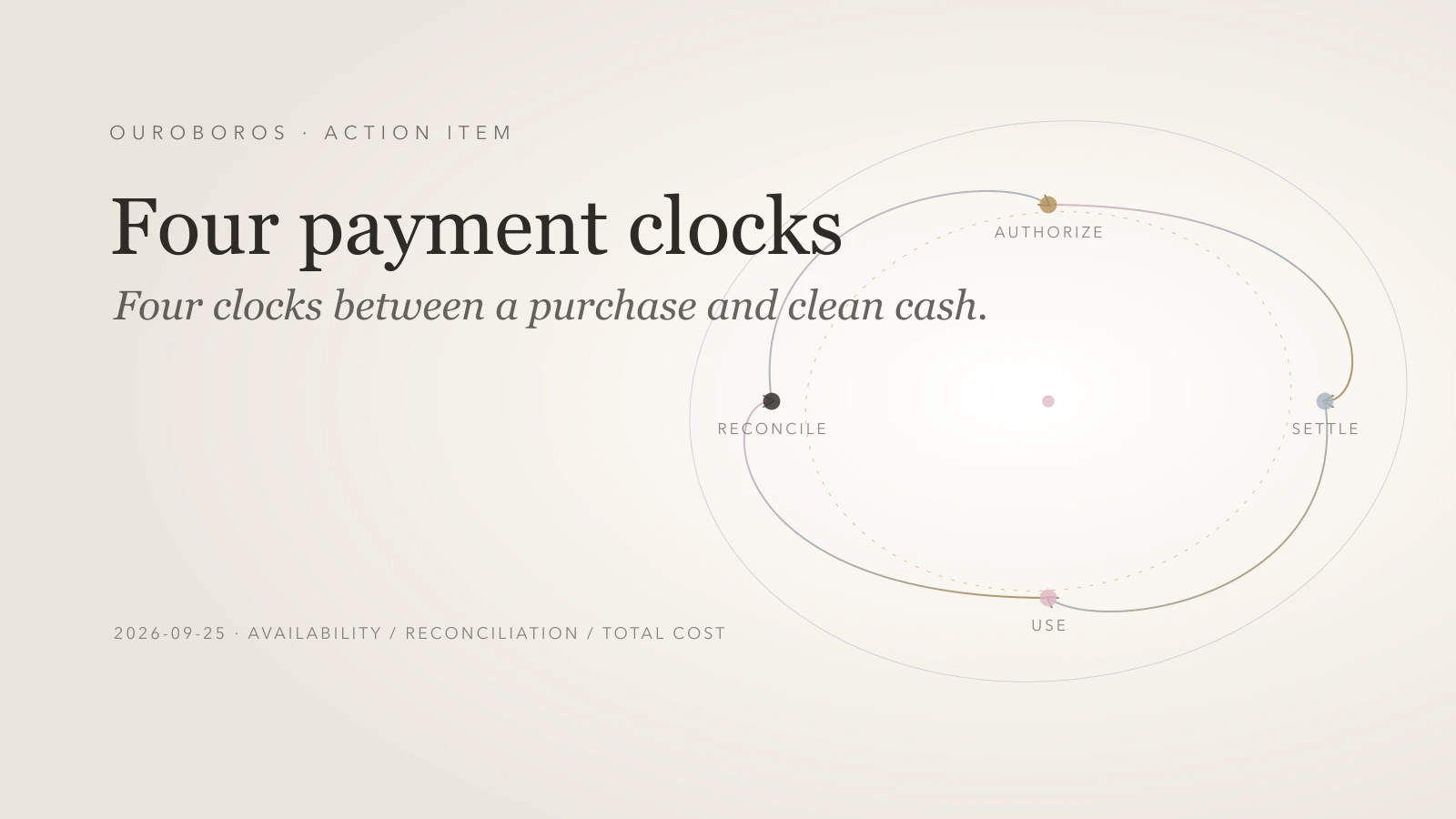
A commercial loop with a scoreboard.
Imagine a merchant closing the shop on Friday. The card terminal has approved the day’s sales. A blockchain explorer can show a completed transfer. The merchant opens the bank app to pay a supplier and asks a less glamorous question: can I use the money now?
That question separates a faster settlement mechanism from a better cash-management product. The conclusion is that stablecoin settlement earns its value when a business can use reconciled funds at the moment it needs them. A token moving quickly is one part of that journey. Someone still owns the obligation, provides liquidity and answers when the amounts fail to match.
SoFi and Mastercard supplied a useful new case on September 22. They announced live SoFiUSD settlement for SoFi Bank’s card program, with migration expected to support more than $25 billion in annualized volume. That is a company expectation for the program, not an independently verified amount already settled onchain. The interesting question is what changes between a card sale and spendable cash.
Follow one payment through four clocks
A useful diagram starts with the customer’s purchase, then follows the payment through authorization, settlement, availability and reconciliation. These are conceptual stages, and implementations can overlap them. Each stage answers a different business question. Authorization asks whether the purchase may proceed. Settlement asks whether the relevant financial obligation has been discharged. Availability asks whether the recipient can use the funds. Reconciliation asks whether the records explain the amount received.
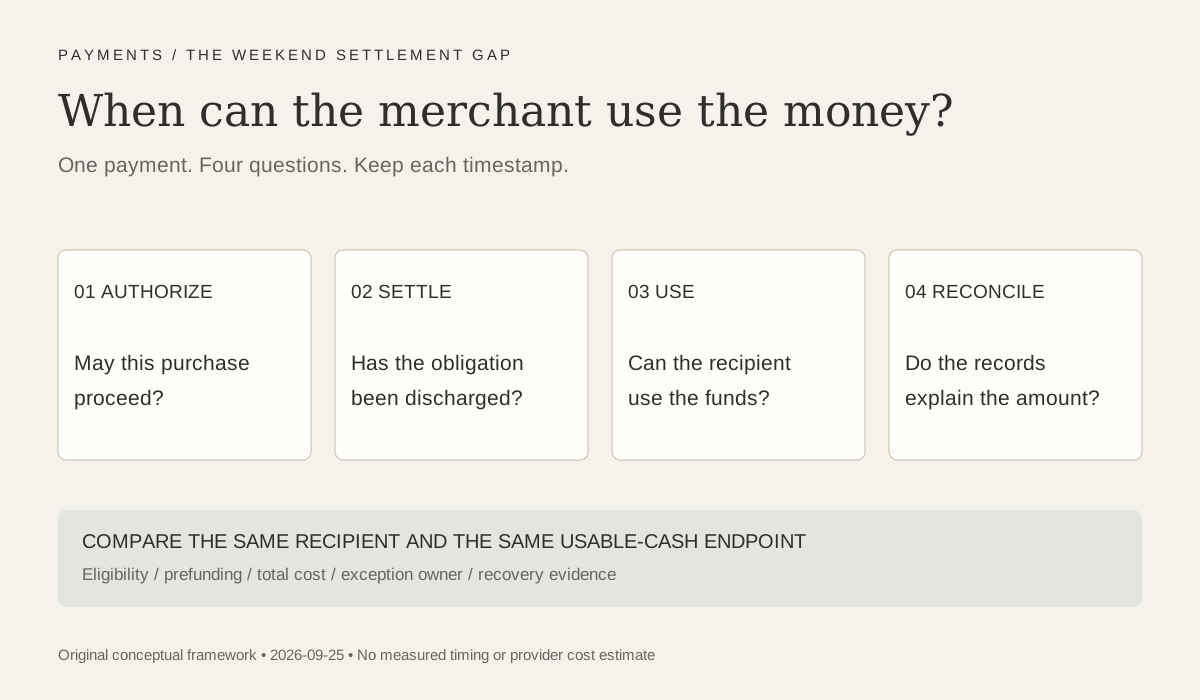
Suppose, purely as an illustration, a shop accepts a $100 card purchase. Showing $100 in an interface does not tell us which participant now owes whom. The shop may have a receivable, a provisional credit or available bank funds, depending on its arrangement. A useful product tells the merchant which of those it has, without expecting the merchant to become an expert in settlement architecture.
The same discipline applies when a token is involved. A successful transfer proves something about that transfer. It cannot by itself establish that a merchant’s account has been credited, that the merchant is eligible for immediate withdrawal, or that a later refund has been reconciled. Those require their own records. The word “instant” becomes useful only after the provider names the starting event and the endpoint.
This is why I would draw four clocks on the whiteboard before comparing networks. A faster second clock can improve the whole journey. It can also move the waiting room to the third clock. The proposed measurement is elapsed time from the agreed purchase event to usable, reconciled funds, with each intermediate timestamp retained. It is a research framework, not a test I have run against SoFi.
What changed between March and September
The March 3 partnership announcement described SoFiUSD as a prospective settlement option and said the parties would explore issuer and acquirer use. September’s announcement says transactions are live. That moves the evidence from a planned integration to a company-reported production launch. It still leaves us without a transaction-level public record of realized savings, failure rates or the amount completed over a representative period.
For an operator, this change is substantial enough to investigate. A working integration creates a place to ask practical questions: which participants can use it, how balances are funded, what happens outside business hours and which account receives the final credit. An announcement of intent cannot answer those operational questions through observed use. A live service potentially can, if the provider supplies the evidence.
For an investor, the distinction prevents an expensive spreadsheet mistake. An annualized program figure can describe expected throughput. It is different from token supply, revenue, profit or capital released. Applying a guessed fee to the headline volume would hide the commercial terms we still need. Even a correct multiplication would produce a precise answer to an unsupported assumption.
The public announcement is a starting point for an evidence request. It does not provide enough information to estimate SoFi’s incremental earnings from this route. The amount of business captured from competitors, the internal cost of liquidity and the division of economics among participants all affect that answer. I would leave those cells empty until a suitable disclosure fills them.
The weekend already has competitors
Stablecoins do not have exclusive rights to the calendar. In December 2025, Visa described USDC settlement for US participants, including seven-day availability and initial participation by Cross River Bank and Lead Bank. That is historical context for the competitive direction, rather than another September launch.
The Federal Reserve’s FedNow overview also describes instant payments through participating financial institutions around the clock, every day of the year. Its existence forces a fair comparison: the merchant’s alternative may already move bank money outside office hours. A proposal should compare the routes actually available to that merchant, with the same recipient and endpoint.
These services address different arrangements. A card network settlement option and an account-to-account payment service are not interchangeable products. Replacing a purchase flow may change customer behavior, acceptance, dispute handling and integration work. Improving the settlement behind an existing card program may leave the customer experience intact. The comparison needs to preserve those differences instead of putting every payment under a single speed label.
An operator should ask which problem is expensive today. Perhaps treasury staff pre-fund several places. Perhaps a merchant waits for access to funds. Perhaps the finance team spends Monday matching weekend transactions. Each problem suggests a different measure of benefit. If the expensive task is reconciliation, shaving transfer time alone may disappoint everyone except the person presenting the transfer-time slide.
A simple calculation keeps the promise honest
Consider a hypothetical business with $1 million tied up for two additional days. At an assumed annual funding cost of 8%, using a simple 365-day convention, the financing cost of that interval is about $438: $1,000,000 × 0.08 × 2 ÷ 365. These are invented scenario inputs, not SoFi operating data, a market funding quote or a forecast of merchant savings.
If a new arrangement really removes that interval, $438 is the gross financing benefit in this example. We would then subtract incremental fees, operating work and any other costs attributable to the change. If the provider merely advances its own money sooner, the business may still benefit, while the provider carries a funding cost. The economic question includes both sides of that arrangement.
Now change the assumption. Suppose the business still has to maintain the same prefunded balance elsewhere because its supplier cannot receive the new form of settlement. The apparent release of working capital may shrink or disappear. The token’s speed has not changed. The endpoint has. A treasury team needs evidence that it can reduce a balance it previously had to maintain.
This is the difference between a measurable benefit and a slogan about cheaper money movement. I would ask for comparable cash positions before and after the change, at the same business volume and with the same risk limits. The calculation above supplies a way to think; it supplies no estimate for the actual launch. A commercial case remains incomplete until someone can explain the additional costs and the cash genuinely freed.
Money can run all weekend while operations cannot
The Federal Reserve’s operating-hours documentation makes a useful distinction. FedNow processes instant payment messages across daily cycle changes without disruption, while some support activities depend on standard business hours. This is an operational distinction within a bank payment service, not a claim that FedNow transfers routinely wait for Monday.
I would apply the same question to a stablecoin arrangement. A ledger can operate continuously while an exception waits for a person with permission to resolve it. A participant may have funds in the wrong place. A reconciliation file may arrive late. The receiving business may need an account service with different availability. These are scenarios to investigate, rather than failures established for the SoFi service.
The customer contract should explain what happens at those boundaries. Who notices a missing credit? Who can stop a duplicate? Who has the authority to correct a mistaken allocation? How will the business learn that a payment requires attention? The answer should include a named operational owner and a recovery procedure. A support email address alone tells us little about recovery time.
Automation makes this more important. An agent initiating a proposed payment could receive a technical success response and mark the supplier paid. If the response only confirms submission, the agent has outrun the evidence. A well-designed workflow retains the distinction between submitted, settled, available and reconciled. This is an architectural recommendation; it grants no agent authority to spend money.
The merchant should need fewer explanations
The most useful innovation may be the one the merchant barely notices. A business wants to pay staff, buy inventory and close its books. If a new settlement route gives it reliable access to cash with less work, the underlying token can stay in the background. A provider that makes the merchant manage another operational system may have shifted work rather than removed it.
There is a commercial opening here for banks and payment companies that can translate several forms of money into a simple service. The hard part is keeping the promise across eligibility, funding, account credit and exception handling. Control over that customer relationship may matter as much as control over the transfer technology. That is my interpretation of the competitive opportunity, not a disclosed profit pool.
It also suggests a useful question about pricing. A service can have a low explicit transfer fee while requiring balances, integration effort or restrictions that matter to the customer. Conversely, a priced service may save enough staff time or funding expense to justify itself. A fair comparison measures the customer’s total cost for the same accepted outcome.
This is where payment experience helps. The exciting diagram describes how money moves. The operational diagram describes who gets a call when it does not. I want to see both. Providers that can show a consistent record of usable funds and clean reconciliation will have a stronger case than providers that show only the fastest successful transfer.
A bounded settlement evidence sheet
The next useful artifact is a one-page comparison, with one row per route and the same fields for each: eligible parties, obligation settled, funding requirement, usable-cash endpoint, reconciliation evidence, exception owner and disclosed cost. The accompanying sources should support each populated field. If a term is absent from the public material, the sheet should say that it has not been disclosed.
For this issue, the research dossier records the announced SoFi launch, the earlier Mastercard plan, Visa’s historical settlement example and FedNow’s service and operating-hours descriptions. They establish different pieces of the landscape. They do not form a controlled experiment, and they should not be ranked as though they do. A product score without comparable cases would make our ignorance look quantitative.
I would advance the assessment when a provider offers a representative record that connects settlement to available cash, identifies failures and recoveries, and shows the total cost for a defined customer. I would weaken the assessment if the faster route leaves the same liquidity trapped elsewhere, increases unresolved exceptions or moves work onto the merchant. These conditions describe what would change the conclusion.
A later authorized shadow study could use synthetic records to exercise that sheet. It would include an ordinary payment and exception cases, preserve each timestamp and identify the owner of every unresolved state. No live payment, customer-data access or production experiment has occurred in preparing this article. The completed work is the evidence framework and its source-backed explanation.
The Friday merchant gives us a practical closing test. Can the business use the money, explain the amount and resolve an error while the payment system is still open? A convincing answer would turn a fast transfer into a product worth paying for. Until the evidence connects those steps, the useful work is to keep asking where the cash is and who can make it usable.
Categories and keywords
Categories: Payments; Stablecoins; Financial infrastructure; Systems design.
Keywords: SoFiUSD, Mastercard, Visa, FedNow, merchant liquidity, settlement availability, reconciliation, working capital.
Hashtags: #Stablecoins #Payments #FinTech #Treasury #SystemsThinking