01 · AI Circularity Ledger
AI Infrastructure Enters Its Credit Cycle
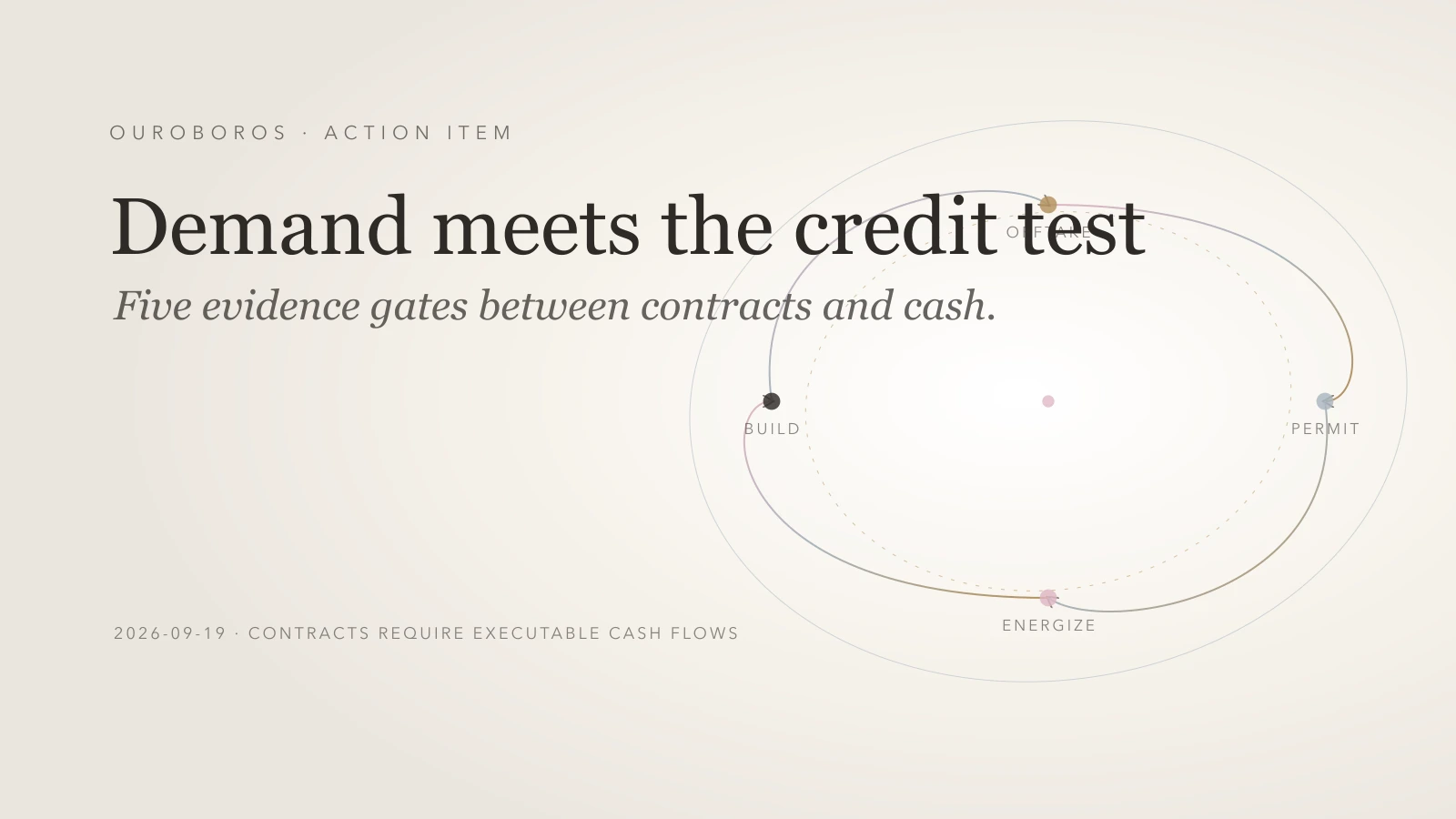
A commercial loop with a scoreboard.
The conclusion is straightforward: AI infrastructure has entered a credit test. A large customer agreement creates an opportunity; the investment earns its value through enforceable payments, permitted power, completed construction and a financing structure that survives delay.
Reuters, attributing its findings to the Financial Times, reports that roughly $18 billion of Project Jupiter loans were quoted at 89–91 cents by syndicate banks. That is a reported quote, not evidence of a completed trade, default or realized loss. The project belongs within Oracle’s broader OpenAI relationship. It does not own that relationship’s entire contract value. Reuters report.
This distinction changes the question investors should ask. “How much demand exists?” is a commercial question. “Which cash flows can this particular creditor collect, on which dates, after which conditions?” is the financing question. An AI campus can have a compelling answer to the first while its lenders struggle with the second.
A contract headline has several owners
OpenAI’s September 2025 announcement describes its Oracle partnership as exceeding $300 billion over five years and names Doña Ana County among multiple sites. That establishes the program’s announced scale and geography. It does not disclose Jupiter’s allocated revenue, cancellation schedule, lender security or payment waterfall. OpenAI announcement.
A useful underwriting file therefore keeps four quantities apart. Headline contract value is the commercial umbrella. Enforceable revenue is what a specific counterparty must pay under specific conditions. Project cash flow is what remains after delivering that service and meeting operating needs. Debt service is the portion available to lenders under their actual legal priority and schedule. Equity receives a residual after the relevant claims have been satisfied.
Moving between these quantities requires evidence. A presentation can place them on the same slide without supplying the bridge. A model can make the bridge look precise by adding dates and discount rates. Neither step supplies the missing contracts. Until those documents are available, cancellation rights, guarantees, cash traps and cross-default provisions remain UNKNOWN.
Customer concentration makes the distinction more consequential. A recognizable customer can reduce marketing uncertainty while increasing dependence on one payer, one workload and one renewal decision. A lender needs to know whether revenue survives a late facility, a change in hardware requirements or a customer’s decision to shift capacity elsewhere. The announced relationship alone cannot answer those questions.
Read the discount without inventing a loss
A quote of 89–91 corresponds to a 9–11% discount to face value. Applying that range mechanically to $18 billion produces $1.62–$1.98 billion. This is an illustrative face-value calculation. It is neither an observed portfolio mark nor an estimate of credit losses. Different tranches, funded amounts, commitments, fees and actual transaction prices could change the economic result substantially.
The useful signal is that transferring risk may have become more expensive. An arranging bank typically has a different problem when intended distribution slows: it must manage the retained exposure, its funding and the opportunity cost of its balance sheet. The project may still pay in full. The bank may still dislike holding more of it for longer than planned.
Reuters reports stalled distribution and greater retained exposure, again citing the FT. Its article says Oracle, Santander and Jefferies did not respond to requests for comment. That is reporting about market pressure, with limited public confirmation from the parties. The original FT article was unavailable for full inspection in this review, so a precise seven-month delay assertion from the supplied brief is not independently established here.
Credit stress also has several causes. A discount can reflect perceived repayment risk, liquidity, duration, uncertain documentation or an investor’s required return. Without coupon, maturity, amortization and security terms, converting this price range into a default probability would be false precision. A disciplined investor can recognize a warning without pretending to know the entire probability distribution.
Power plans move while interest keeps accruing
New Mexico’s State Land Office supplies a concrete constraint. Its July 15 release records rejection of reconsideration for rights-of-way and a business lease covering a 0.6-mile section of a proposed 17-mile pipeline. This is a specific land-access decision. It does not establish that every possible route or power design has been permanently prohibited. State Land Office record.
The technical baseline matters too. Oracle’s June 3 announcement says an updated application replaced the earlier gas-turbine and diesel-generator design with a Bloom Energy fuel-cell microgrid. It describes an application entering public review, not a completed permit or energized plant. The old turbine plan should therefore never be presented as the unchanged current design. Oracle power-plan update.
A fuel-cell redesign and a pipeline constraint belong in the same diligence file. Changing the generation technology can change emissions, equipment requirements and operating assumptions while leaving fuel access as a separate dependency. Neither an improved design nor an application deemed complete proves that the final system can operate on the required commercial date.
Delay is where engineering and finance meet. Construction interest, contractor mobilization, equipment storage, revised commissioning and expiring commitments can accumulate before service revenue begins. The party that pays those costs depends on contracts. A developer’s schedule contingency, a tenant’s delivery remedy and a bank’s funding condition may point in different directions. The underwriting job is to reconcile those directions before allocating capital.
Map the risk to an actual balance sheet
STACK’s September 2025 release identifies its delivery role and investment from funds managed by Blue Owl. That supports an institutional participation map. It does not establish that Blue Owl’s corporate balance sheet guarantees every project obligation or that a fund investor sits behind a particular loan. STACK project release.
The practical map has distinct actors. OpenAI is connected to compute demand and its agreement with Oracle. Oracle carries its own customer, tenant and corporate-credit relationships. Project entities and contractors carry the obligations in their documents. Arranging banks carry the debt they actually retain. Fund investors carry the risks of their particular vehicles. Their names do not create one combined guarantee.
Communities and taxpayers belong in the analysis for a different reason. They face questions about resources, infrastructure and public benefits. Their exposure is not automatically equivalent to a lender’s contractual claim. Oracle has made public commitments concerning local benefits and energy costs; realized benefits and enforceable remedies need their own evidence. An announced commitment should not become an assumed taxpayer guarantee in a spreadsheet.
For each actor, ask three short questions: what obligation exists, what triggers it, and what remedy follows nonperformance? Then request the source document. If the answer relies on reputation, strategic importance or an assumed rescue, record it as an assumption. Strategic importance can attract capital; it does not specify who absorbs the first dollar of loss.
Underwrite five gates in sequence
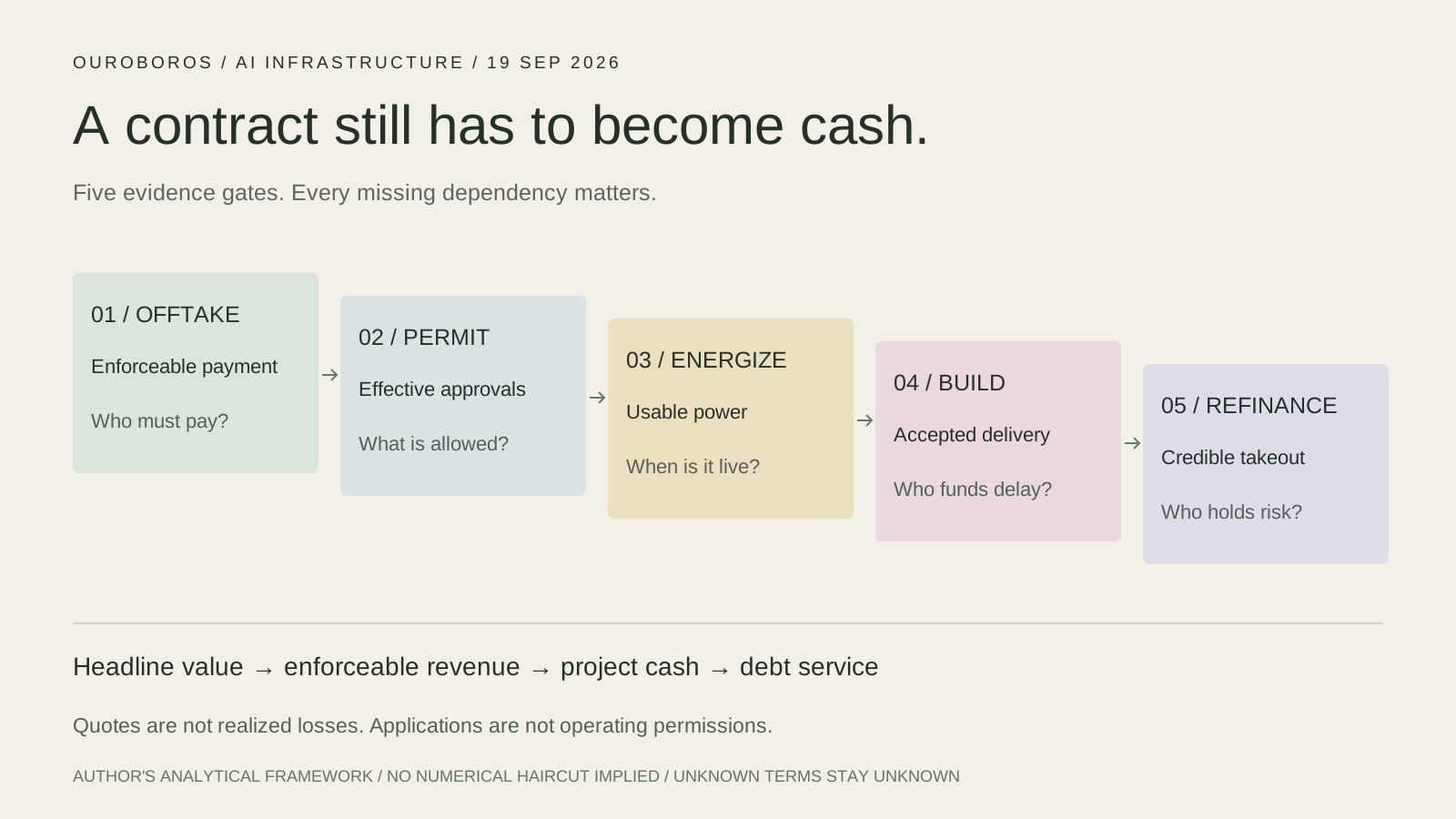
The diagram is an analytical workflow, not a measured conversion rate. Each gate requires distinct evidence; no numerical haircut is implied.
| Gate | Evidence required | Question that remains open |
|---|---|---|
| Offtake | Executed agreement, payer, payment triggers and remedies | Which revenue is enforceable for this asset? |
| Permit | Effective land, environmental and operating permissions | Which critical approval or appeal remains? |
| Energize | Fuel access, commissioned power and accepted capacity | When can usable power reach the load? |
| Build | Cost to complete, contingency and customer acceptance | Who pays when delivery slips? |
| Refinance | Debt terms, retained exposure and credible takeout | What happens if new capital costs more? |
The first gate is offtake. Start with the contracting entities and the conditions for payment, then test the relationship between those conditions and the asset’s delivery schedule. A take-or-pay label is insufficient without the exceptions and remedies. Assignment rights matter because a lender’s ability to collect or replace a counterparty can differ from the developer’s commercial relationship.
The second gate is permitting. Build an actual dependency map rather than a list of reassuring approvals. A campus can have permission to perform one activity and remain unable to complete another critical step. Record the decision, its scope, the relevant date and any unresolved challenge. Avoid collapsing application, review, conditional approval and final operating permission into a single green cell.
The third gate is energization. Name the usable capacity, delivery point, fuel or grid dependency, commissioning test and service date. Nameplate capacity measures equipment under specified conditions. Delivered capacity available to a customer is an operating result. A signed equipment order can be progress while the energization gate remains open.
The fourth gate is construction. Link the independent cost-to-complete estimate to committed funding and a realistic contingency. Check which milestones permit invoicing and which milestones trigger customer acceptance. Ask what happens if the building is ready while power is late, or if the electrical system works while the requested hardware configuration changes. These mismatches can consume liquidity without producing a billable service.
The fifth gate is refinancing. Identify contractual maturity, amortization, interest exposure, covenants and possible takeout providers. A plan that assumes an easy sale of debt needs a downside case in which investors demand a higher return or less leverage. The correct response might be more equity, smaller phases, stronger guarantees or a slower build. The documents determine which options exist.
Stress time before forecasting a boom
Consider an explicitly hypothetical facility, unrelated to Jupiter’s undisclosed loan terms. Suppose $1 billion is fully drawn at a constant 8% annual cash interest rate. A six-month delay adds $40 million of simple interest before fees, compounding or operating changes. A twelve-month delay adds $80 million. This arithmetic explains why schedule confidence has financial value even when eventual demand is unchanged.
A second hypothetical shows the effect on coverage. If cash available for debt service is $120 million against $100 million of scheduled service, coverage is 1.20 times. A 20% fall in that cash flow reduces it to $96 million and coverage to 0.96 times. Demand can remain substantial while the scheduled payment becomes difficult. These figures are teaching assumptions, not estimates for Oracle or Jupiter.
Use a small matrix: on-time delivery, six-month delay and twelve-month delay, each with ordinary and stressed refinancing assumptions. Separate lost revenue from deferred revenue. Separate costs paid immediately from amounts capitalized into an asset. Identify whether reserves are unrestricted cash, contingent commitments or amounts unavailable to meet the payment being modeled.
Then ask which party funds the worst month. Annual averages can hide a short period when the project cannot meet a cash obligation. Even a positive lifetime value does not prevent a liquidity shortfall. A bridge facility solves that problem only if it is available when needed and its own conditions can be satisfied.
Apply the framework to Token Factory
Token Factory is useful as a way to understand the production chain: electricity, compute, usable output and collected revenue. Its investment version needs one further chain: collected cash, operating obligations, maintenance, financing costs and residual returns. A technical throughput model and a financing model must describe the same asset and time period.
An allocator should therefore maintain separate columns for contracted capacity, accepted capacity, billed service and cash received. Differences between those columns tell a more useful story than a single contract total. Attach evidence dates so a commissioning announcement cannot silently become a full quarter of operating performance. Retain unresolved values as UNKNOWN instead of inserting a convenient zero.
The career implication follows directly. Valuable infrastructure work joins engineering schedules, commercial agreements and financing conditions. It requires enough technical understanding to challenge a delivery claim and enough capital discipline to identify its financial consequence. That is a role hypothesis grounded in the problem, not evidence of a job opening, an application or a hiring decision.
The bounded action today is to establish Jupiter as a credit-stress case and publish this five-gate worksheet. It does not authorize acquiring loans, changing a portfolio, contacting counterparties or assuming access to private documents. The first improvement is a more accurate diligence question, followed by a documented answer.
What would change the judgment
A stronger case would include effective permissions for the critical path, demonstrably available fuel and power, accepted construction milestones, and disclosed financing terms that allocate delays to parties able to bear them. Evidence of completed debt distribution would address a different uncertainty from evidence of physical progress. Both matter; neither can substitute for the other.
A weaker case would include repeated schedule slippage without funded contingency, increasing dependence on short-term capital, or a growing mismatch between payment obligations and accepted service. The appropriate action would depend on actual exposure and contractual rights. The public record reviewed here is insufficient to calculate Jupiter equity value or make a security-specific recommendation.
Update the case when a material document changes, recording its date, claim, affected gate and implication. Keep the previous version. This creates a history of what became knowable when, rather than a polished story assembled after the outcome. The thesis earns its keep only if that record improves a decision.
AI demand can be large and commercially durable. Financing still depends on who can deliver, who must pay and who can survive the interval between those events. The investable asset is the enforceable cash flow that survives that interval.
Categories and keywords
Categories: AI Infrastructure; Project Finance; Capital Allocation.
Keywords: Project Jupiter; Oracle; OpenAI; bankability; offtake; permitting; energization; construction risk; refinancing; Token Factory.
Hashtags: #AIInfrastructure #ProjectFinance #CapitalAllocation #TokenFactory