BUILD · Research → story
The megawatt had a deadline.
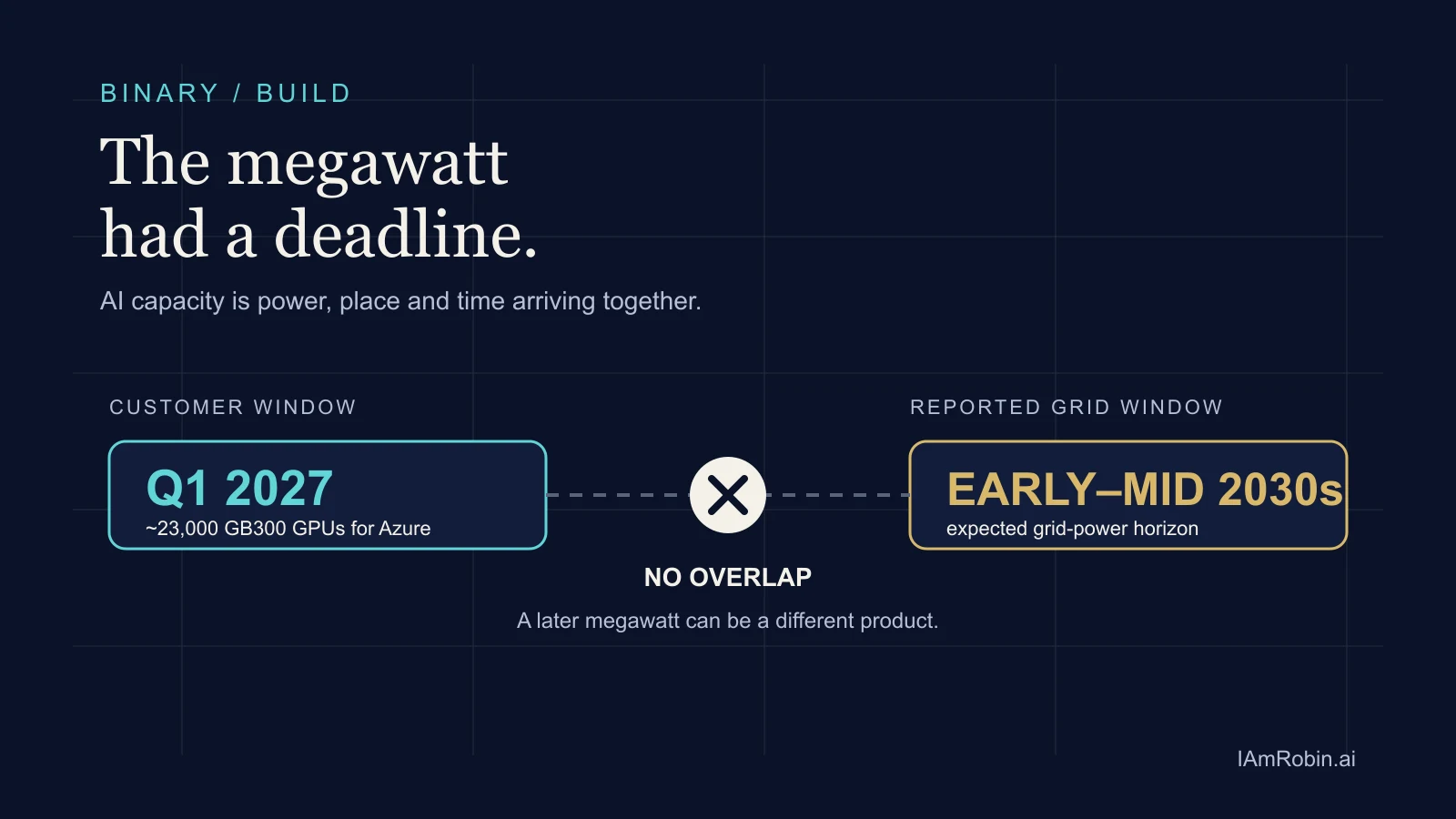
A megawatt in the 2030s is not the same product as a megawatt in 2027. AI capacity is a meeting of place, power and time.
A megawatt in 2033 is not a delayed version of a megawatt in 2027. If the customer needed it in 2027, it is a different product.
That distinction hides inside the story of a planned AI supercomputer at Loughton, outside London.
In September 2025, Microsoft announced a $30 billion UK investment programme and said it would build the country’s largest supercomputer with Nscale, using more than 23,000 Nvidia GPUs. One month later, Nscale gave the promise a shape: an initial 50-megawatt facility, scalable to 90 MW, with roughly 23,000 GB300 GPUs serving Microsoft Azure from the first quarter of 2027.
The numbers were impressive. The date was the product.
In October 2026, the Guardian reported that Microsoft had withdrawn from the Loughton agreement after the expected grid-power horizon moved into the early-to-mid 2030s. Nscale said it remained committed to the site and was exploring alternatives. But the original customer window and the reported electricity window no longer overlapped.
Capacity is a conjunction
We often speak about infrastructure as a noun: 50 MW, 23,000 GPUs, one campus.
But usable capacity is a conjunction:
the right power × at the right place × inside the customer’s window
Remove any term and the headline survives while the service disappears.
A GPU in a warehouse is not compute. A powered building without commissioned systems is not compute. Commissioned systems arriving after a customer’s roadmap has moved are not the same sale. The physical assets may still have value, but the economic path has changed.
This is why time cannot be treated as a footnote to capacity. Location and megawatts are not enough. The date belongs in the unit.
Five verbs, five different risks
The Loughton story becomes easier to read when one capacity headline is replaced by five verbs:
announced → contracted → powered → commissioned → revenue-producing
Each transition asks a different question.
An announcement asks whether there is a plan. A contract asks whether a customer has signed. Power asks whether electricity can reach the site at the required scale. Commissioning asks whether the electrical, cooling, networking and compute systems work together. Revenue asks whether the customer is receiving the service under the agreed conditions.
Skipping a verb does not make the next one arrive faster.
Nscale’s September 2026 filing makes the categories unusually visible. It described roughly 25,000 GPUs as active and about 461,000 as active plus contracted. It listed five active sites and twelve contracted sites. Active total contract value was $2.6 billion; active plus contracted TCV was $103.4 billion.
Those figures do not prove that the contracted projects will fail. They prove that “contracted” and “active” are different states. Nscale defined active capacity as online and revenue-producing. A signed customer is therefore evidence of demand, not evidence that the final electron has reached the final rack.
Four clocks belong on one page
The useful planning object is not a capacity total. It is a clock map.
For Loughton, the customer clock pointed to Q1 2027. The reported grid clock pointed to the early-to-mid 2030s. Nscale’s company-wide equipment and construction commitments were payable mainly in 2026 and 2027, while at least $3.1 billion of convertible notes were due in June 2028 unless converted or repurchased earlier.
Those company-wide obligations cannot be assigned to Loughton from the public record. They belong on the page only to show why time alignment matters. A site delay, a hardware order, a financing maturity and a customer deadline are not interchangeable dates. They are separate clocks that can collide.
That suggests four questions for any large AI-capacity announcement:
- When is grid power contractually available at the required level?
- When can the full system be commissioned, not merely delivered?
- How long will the customer’s workload and hardware plan wait?
- Which obligations can move if the first three dates separate?
The GPU count comes after those questions, not before them.
The site can survive while the sale expires
Nscale’s current infrastructure page still describes Loughton as a campus able to scale power allocation to 90 MW. The company told the Guardian it was exploring alternative power and other UK sites, and that its broader Microsoft relationship was unaffected.
That leaves open a future for the land, the design or a different customer. It does not restore the original 2027 overlap.
Infrastructure can be durable while demand is perishable. A site may remain useful for decades. A particular customer’s delivery window can close in quarters.
That is the reversal inside the Loughton story. The scarce object was not simply electricity. It was electricity arriving while the customer still wanted this configuration, in this place, on this schedule.
The next time an AI project leads with GPUs and megawatts, add the missing unit.
Ask: by when?
A capacity claim without a date is unfinished.
Sources: Microsoft’s UK investment announcement, Nscale’s October 2025 Microsoft announcement, Nscale’s September 2026 S-1, the Guardian’s October 18 report, and Nscale’s current infrastructure page. The grid horizon and withdrawal are reported facts, not a public contract record. Company-wide commitments are not allocated to Loughton. This is a dated infrastructure story, not an investment recommendation or a claim that the site has no future value.