03 · Daily Special · Signal 6
The customer arrived before the electricity.
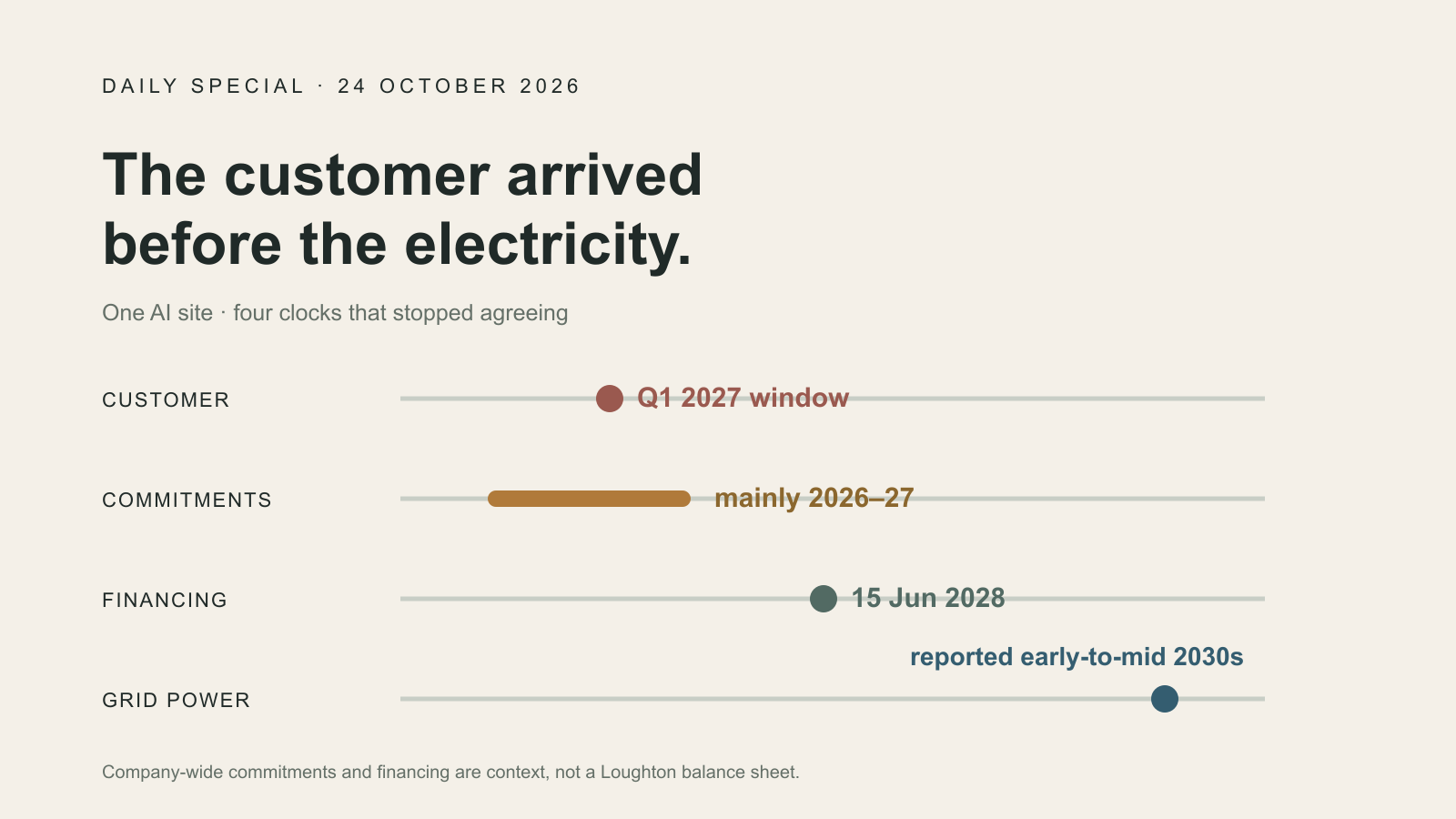
A dated public-source comparison of the customer, grid-power, company-wide commitment and financing timelines around Nscale's Loughton project; no site-level liability estimate, capital allocation or underlying decision.
The most important component in a 23,000-GPU supercomputer turned out not to be a GPU. It was a date on an electricity connection.
In September 2025, Microsoft announced a $30 billion UK investment plan and said it would build the country’s largest supercomputer with Nscale. A month later, Nscale put numbers around the promise: an initial 50 megawatts at Loughton, capacity to scale to 90 MW, about 23,000 Nvidia GB300 GPUs, and service for Microsoft Azure from the first quarter of 2027.
Then the clocks stopped agreeing.
On October 18, 2026, Reuters and the Guardian reported that Microsoft had withdrawn from the Loughton agreement after the expected grid-power date moved into the early-to-mid 2030s. The Guardian said Microsoft had been the site’s only publicly announced customer.
That is not a small construction delay. It is a customer window in 2027 meeting an electricity window several years later.
The useful question is not whether AI demand still exists. It plainly does. The useful question is whether demand will wait for this site.
Four clocks, one blank socket
Start with the customer clock: Q1 2027.
Move to the power clock: early-to-mid 2030s, according to the October reports.
Now add two clocks from Nscale’s September 18 SEC filing. As of June 30, the company had $24.0 billion of commitments for technology equipment not yet delivered and $3.5 billion for data-center construction and support, payable mainly during 2026 and 2027. In September, it also entered into at least $3.1 billion of unsecured convertible notes due on June 15, 2028 unless earlier converted or repurchased.
The sequence is uncomfortable: customer delivery in 2027; company-wide equipment and build commitments concentrated in 2026–27; a large financing maturity in 2028; and reported grid power in the 2030s.
But the distance between uncomfortable and proved matters.
Those commitment and financing figures belong to Nscale’s entire portfolio. The public filing does not assign a dollar of them to Loughton. It does not tell us whether GPUs for this site were ordered, paid for, cancellable or moved elsewhere. The Loughton contract, deposits, termination rights and remedies are not public in the sources I reviewed.
So I cannot build a site-level loss estimate. I can build a timeline—and the timeline already explains why the customer and the project parted company.
Contracted is a location on the journey
The same filing supplies a second, quieter lesson. Nscale reported about 25,000 active GPUs at August 31, against 461,000 active and contracted GPUs. It listed five active data-center sites and twelve contracted ones. Active total contract value was $2.6 billion; active plus contracted TCV was $103.4 billion.
The definitions do the real work. Nscale calls capacity active when it is online and revenue-producing. Contracted capacity is under development under a signed customer contract.
This does not make the contracted number false. It makes it conditional on a chain of verbs:
announced → contracted → powered → commissioned → revenue-producing
Each arrow contains a different engineering, legal and financial problem. A press release can cross the first arrow. A signature can cross the second. Neither energizes a substation.
The gap is especially important here because the filing was dated September 18, a month before the reported Microsoft exit. Its portfolio totals are a pre-exit snapshot, not a current answer to what remained after Loughton changed.
Demand has a shelf life
It is tempting to call this a story about scarce electricity replacing scarce chips as the AI boom’s bottleneck. That is close, but still too clean.
Power was decisive at Loughton because time was decisive. The customer did not merely need megawatts; it needed megawatts inside a planning window. A grid connection arriving in the 2030s could be valuable to someone, but it no longer answered a 2027 promise to Microsoft.
This is what it means for demand to have a shelf life. A signed customer is not a permanent fixture. Hardware generations move. Cloud roadmaps move. Financing dates do not volunteer to move with them. When physical infrastructure operates on a longer clock, “contracted demand” can expire before the electrons arrive.
The asymmetry is easy to miss in a capacity headline. A customer can require a particular place and date. A developer may own the longer-lived site opportunity while carrying a much narrower customer window. When those windows separate, the headline number stays large even as its economic path changes.
What remains alive
Nscale told the Guardian it remains committed to Loughton, is exploring alternative power sources and other UK sites, and that its broader relationship and other contracts with Microsoft are unaffected. Its current infrastructure page still describes Loughton as designed to scale to 90 MW.
That keeps the site alive as a possibility. It does not give the possibility a new date.
I found no public timetable, capacity or cost for alternative power. I also found no public allocation of the company’s equipment commitments or debt to Loughton. Those absences do not prove failure or zero value. They simply stop the public record from carrying the story any further.
The honest conclusion is smaller and more useful: put power on the same timeline as the customer. Then put equipment commitments and financing dates beside it, without pretending they belong to the site unless the company says so.
The full research artifact preserves the dates, definitions, portfolio figures and limits. Today’s work completes a bounded public-source research action. It does not allocate capital or decide what should happen to Loughton.
The next time a data-center announcement leads with GPUs and megawatts, look for five verbs: announced, contracted, powered, commissioned, revenue-producing. The missing verb may be the whole story.