BUILD · Research → story
A faster transfer, a longer wait
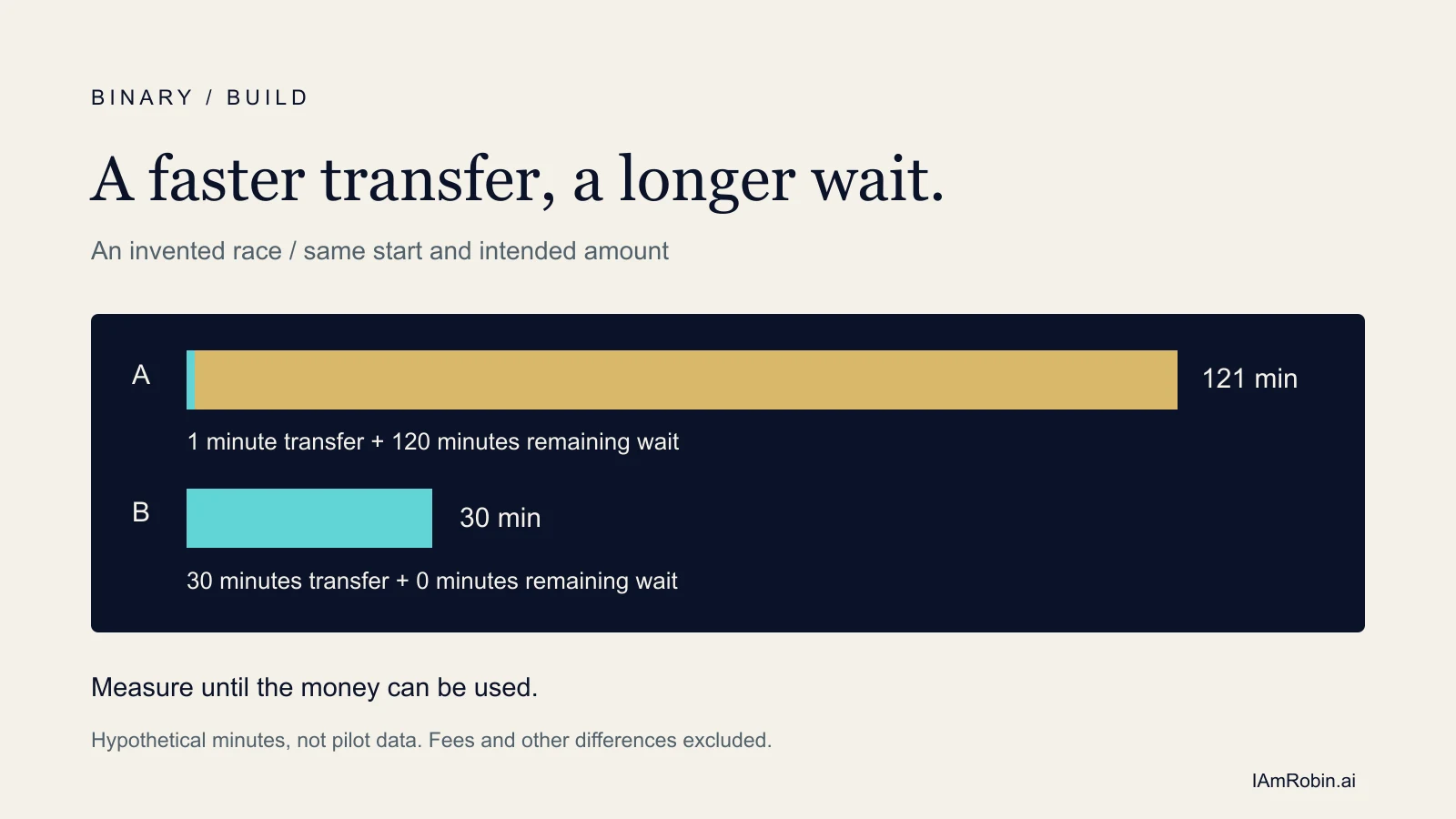
A one-minute transfer can lose a delivery race. A small thought experiment shows where to stop the clock.
Imagine two aid payments starting at the same moment. One reaches a digital wallet in a minute. The other takes half an hour. The person on the faster route gets usable money last.
There is no technical miracle here. In this invented example, the first person needs cash and waits another two hours after the wallet credit. The second can use the money as soon as it arrives. The stopwatch on the transfer screen and the stopwatch in somebody’s day have measured different things.
The September 27 Daily Special asks how to evaluate humanitarian payments. I want to pull out one engineering problem: a component can win its speed test while the whole service loses.
Two clocks on the same payment
There is a real reason to draw a withdrawal step. UNHCR’s December 15, 2022 announcement described a Ukraine pilot delivering USDC into a Vibrant smartphone wallet, with MoneyGram as a route to cash. That is a historical description of the route. It does not tell us today’s availability or how long any recipient waited.
Now return to the invented race. Assume the same intended amount and a common starting point. Count the remaining wait only after the transfer finishes, so the intervals do not overlap.
| Hypothetical route | Transfer | Remaining wait until usable | Total |
|---|---|---|---|
| A | 1 minute | 120 minutes | 121 minutes |
| B | 30 minutes | 0 minutes | 30 minutes |
These numbers are chosen to explain the mechanism. They are not pilot data, forecasts, or a comparison of named providers. Fees and other delivery differences are held outside this toy calculation.
Route A wins the transfer test by 29 minutes and loses the usable-money test by 91. Both statements are arithmetically correct. Only the second answers the recipient’s timing question.
Speed up the part that is still waiting
Suppose the team halves A’s transfer time. The total falls from 121 to 120.5 minutes. Thirty seconds saved. If the remaining wait instead falls from 120 to 20 minutes, with the original transfer unchanged, the total becomes 21 minutes. A now wins this imaginary race.
That does not prove the second improvement is cheap, feasible or safe. It identifies the part worth investigating. For someone who needs cash, an evaluator might examine outlet opening hours, available cash or the journey to the outlet. Those are possible constraints to check, not findings about the UNHCR pilot. Someone able to pay digitally may have no withdrawal step at all.
Let the recipient choose the endpoint
Circle Foundation’s September 25, 2026 announcement describes support for UNDP and WFP payment work. It sets out programme development, not a matched result proving faster usable aid. A transfer benchmark cannot fill that gap.
For a builder, I would put two timestamps beside the payment: transfer complete, and intended amount usable. Define that second event with the people the programme intends to serve. Keep cases that never reach it in the report, with their observation deadline, instead of giving them a duration of zero or dropping them from the average.
A faster network could still help. The small calculation tells us where to look before celebrating: at whatever the person must do after the success message.