03 · Daily Special · Signal 4
When Aid Becomes Spendable
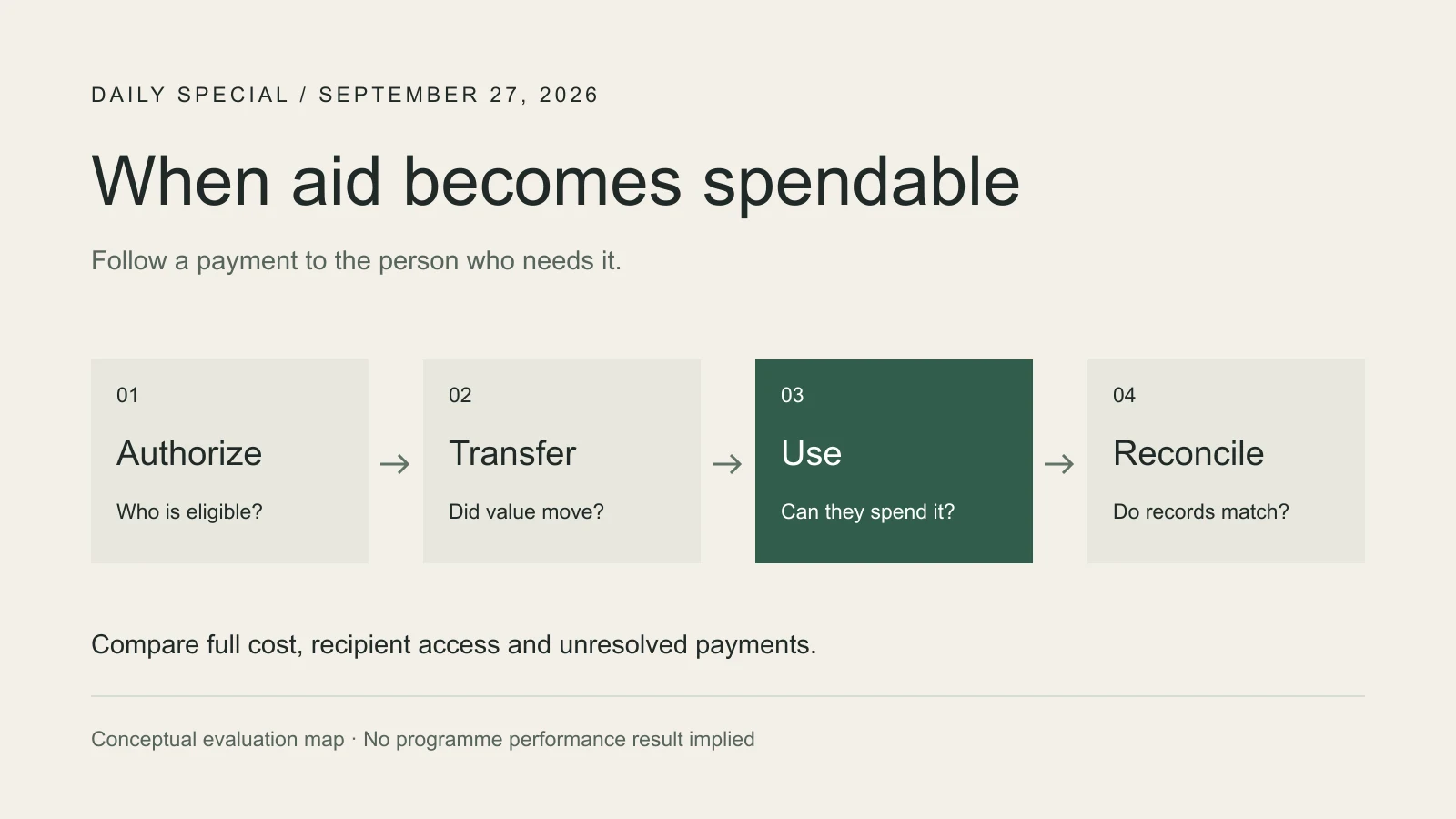
From transfer to usable aid: a comparison of cost, recipient access and reconciliation.
Imagine an aid payment whose transfer is complete while the recipient is still looking for somewhere to withdraw it. The ledger has finished its part. The person has another journey to make.
That gap is where I would examine Circle Foundation’s September 25 announcement of support for UNDP and WFP. It describes programme development, with WFP planning two to three country corridors over three years. Comparative delivery results are still ahead of us.
The useful question is small enough to fit on one sheet: does the new route make the promised money easier to use, at a lower full cost, with fewer unresolved payments?
Follow the money one stop further
There is a concrete historical example. In UNHCR’s December 15, 2022 Ukraine pilot description, recipients receive USDC in a Vibrant smartphone wallet and can convert it to cash through MoneyGram. The description explains a route; it does not establish its current availability or comparative performance.
Now put yourself at the withdrawal end of that route. A wallet balance is useful if you can spend it, or convert it when and where you need to. A comparison that stops at the wallet would miss the extra steps for someone who needs cash. Equally, someone who can spend digitally may have no reason to withdraw. The evaluator needs to define the intended use before starting the clock.
I would draw the journey like this: authorize assistance, transfer value, make it usable, reconcile delivery. Each arrow deserves its own evidence. This is an analytical map, not a report that the new programmes have already completed those steps.
Keep the people who could not start
A demonstration can look excellent if its denominator includes only people who managed to enrol. To evaluate access, I would begin with the eligible population the programme intended to serve. Then count invitations, enrolments, attempts and recipients able to use their money by a stated deadline.
Suppose a future pilot recruits people who already have compatible phones. Its results could tell us something useful about that group. They would tell us much less about people without those phones. That is a hypothetical design problem, not a finding about either announced programme.
The same discipline applies to price. A small network fee leaves plenty of other possible costs to inspect: conversion, withdrawal, programme staff, support and failed-payment recovery. Recipient charges and travel time belong beside the programme’s costs. Otherwise we could celebrate a saving that someone else paid for.
Temporary subsidies need their own line. I want to know what operating the route would cost when the launch budget stops helping.
The payment still needs a matching record
WFP’s SCOPE manual describes reconciliation against the financial service provider’s transaction report, using references from the original payment instructions. That is a useful reminder of the work after a transfer.
For this comparison, I would track unmatched payments by count, value and age, alongside the staff time needed to resolve them. A fast batch with one unresolved case can look different to the programme and to the person in that case. An average alone smooths away the part we most need to examine.
There is also a category error to avoid. WFP describes Building Blocks as a privately managed blockchain network that coordinates assistance across organizations. That provides context for shared records. It does not supply performance results for the newly announced stablecoin routes. Putting the word “blockchain” on both systems does not make their evidence interchangeable.
Give the old route the same test
The downloadable programme card puts three questions next to an existing payment route:
| Question | What would make the comparison useful? |
|---|---|
| What does delivery cost? | The same cost boundary, visible subsidies and a completed-delivery denominator |
| Who can use the money? | The intended population, a common deadline and reasons for exclusion |
| Can the programme close its books? | Matched records, unresolved value and time spent resolving exceptions |
The comparator needs a fair hearing. Different locations, recipient groups or observation periods can explain a difference without the payment technology causing it. Publish those conditions alongside the result, including failures. Public aggregate results would be enough for this research; recipient identities and wallet addresses have no place in the sheet.
This adds a recipient-access question to the earlier card-settlement comparison. The finish line here is a person able to use the aid. I would change the delivery judgment when published results compare that endpoint, full cost and reconciliation on common terms. The reviewed sources do not yet offer that matched result for the new programmes.
The research card is complete. The programme outcome remains to be measured, and completing the card makes no investment decision. I would like the next report to follow the payment all the way to the person who needs it.
Sources and method
Four public primary sources were reopened on September 27, 2026, Hong Kong time. The UNHCR example is historical; the WFP pages explain existing systems and have no established publication date in this review. Institutional descriptions are attributed accounts. The journey map and proposed comparison are authored analysis, not field results.