Daily Action Item
Software That Knows How to Wait
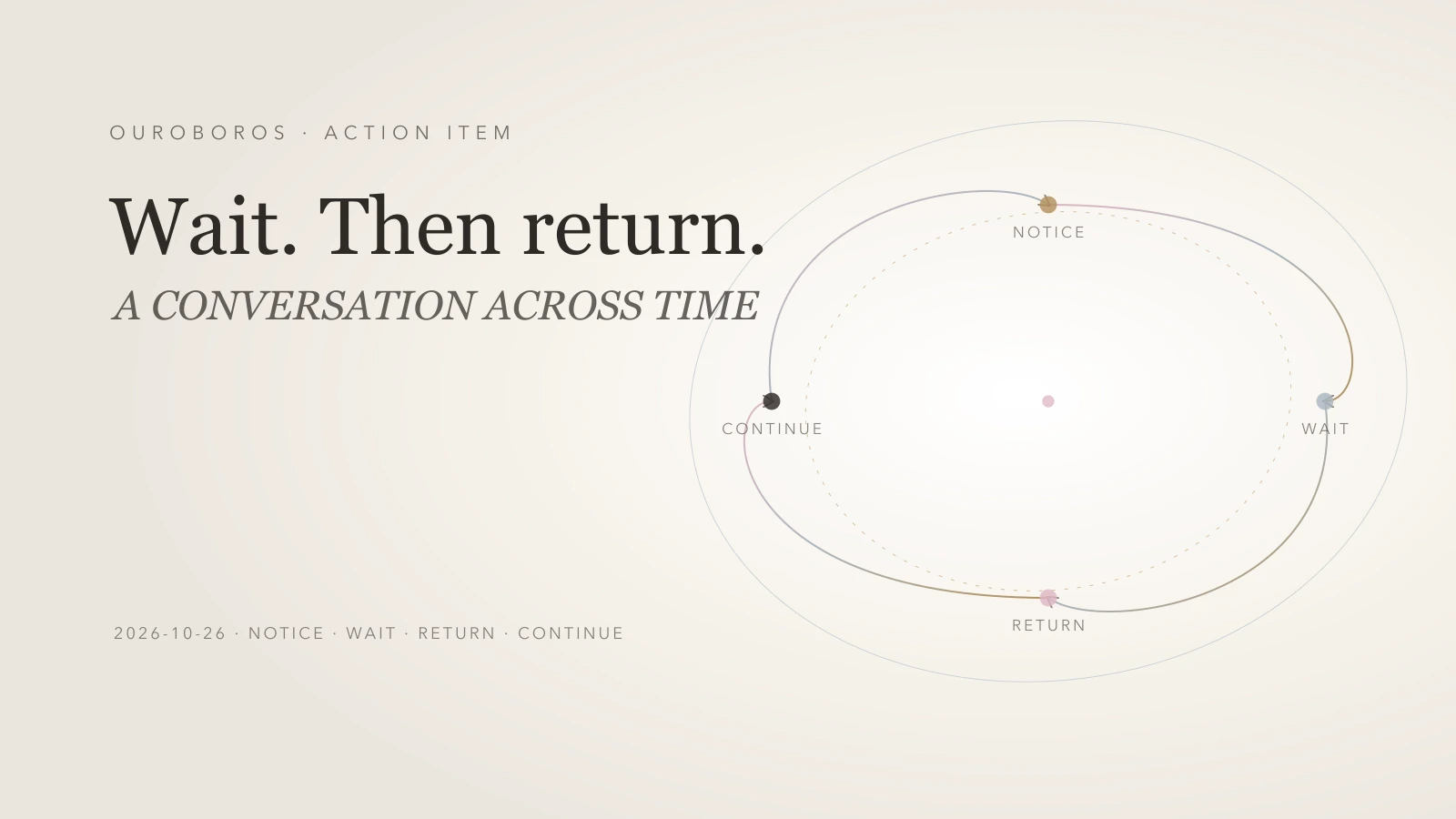
The rhythm of chatting with computers has almost always been impatient. You hit enter, the cursor stutters, the screen fills. The contract between human and chatbot often feels synchronous: you sit in the chair because the moment you step away, the software stops caring.
On October 23, OpenAI quietly posted an update to its Developer Community introducing scheduled automations to the Agents API. On its face, it looks like standard engineering plumbing. We’ve had cron jobs and scheduled scripts for decades; telling a server to wake up at 3:00 a.m. to run a database backup is hardly news.
Except this isn’t quite a cron job.
The new feature allows scheduled runs to either spin up a fresh session or send a message directly into an existing one, handling both one-off future triggers and recurring loops. The detail that catches your attention, though, is tucked a little further down: when an agent has the automations tool enabled, it can create, update, or cancel schedules itself, directly from natural language.
Think about that loop for a moment. An agent running inside an active session can evaluate a problem, realize it has hit a wall until something in the outside world changes, and decide on its own: I’ll check back on this in seventy-two hours, right here where we left off.
Still, the ability for an agent to schedule its own next turn within an ongoing conversation gives software something it has rarely possessed: patience.
To see why this matters to someone building a business outside the venture-capital slipstream, forget about code generators and customer-service chatbots for a minute. Picture an independent architectural salvage scout in the Pacific Northwest—someone hunting down old-growth Douglas fir beams, hand-cast bronze hardware, and vintage fixtures from commercial buildings slated for demolition.
It is the kind of one-person business where the margins are great, but the logistics are exhausting. Demolition permits, municipal zoning boards, regional bankruptcy dockets, and estate liquidation notices don’t align with your calendar. They move on the sluggish, erratic timelines of city bureaucracies and court clerks.
Today, a solo scout spends hours every week babysitting tabs. You check a county portal on Monday. Nothing. You check again Thursday. Still pending. If you set up a crude web scraper, it can scream at you when a web designer changes a CSS tag in the footer. If you ask an AI assistant in a one-off chat, it gives you a brilliant summary of what exists right now, and then waits for you to pick up the thread.
Now imagine running that search through an agent that can hold a train of thought across time.
On a Monday morning, you hand it a brief: track down unlacquered 1920s mortise hardware and heavy timbers from three historic warehouse parcels currently working their way through city permits.
The agent queries the public filings, finds that the demo permit was submitted, but notes that the public comment period doesn’t close for eleven days. Instead of dumping a useless “nothing found” in your inbox or running a loop of hallucinated updates, it schedules a one-time run to revisit that specific municipal portal in twelve days.
Twelve days later, it wakes up. It doesn’t start cold. It is still in the same session, looking at its own prior notes. It sees that the permit cleared, but a local historical board requested an environmental assessment, pushing the contractor’s site access out another week. The agent updates its own schedule and goes back to sleep.
When it finally pings your phone three weeks later, it isn’t an alert that text changed on a webpage. It’s a single, contextual sentence: The salvage contractor just posted the asset catalog for the Tacoma warehouse; Lot 14 has twenty matching brass rim locks from 1924, and the sealed bids close tomorrow at noon.
That is not just an automation. It is continuity.
We caught a brief, messy glimpse of what unattended processes look like in our own lab notes on October 23. In an automated, paper-only market-making experiment running on LTC/USDT in a virtual wallet, the test ran into unexpected friction and crossed just over its 2% inventory-loss threshold.
A pre-set safety boundary tripped, followed about a minute later by a conditional exit. It didn’t prove the trading strategy was brilliant, nor did it prove money was saved—especially with a lingering bit of inventory and over a hundred ambiguous fill intervals left behind in the logs.
What it did demonstrate, however, was how strange it feels when code acts on its own internal clock. It didn’t wait for a human to hit enter. It monitored, it crossed a line, it pulled the brake, and it left the aftermath on the desk for review. When machines run unattended, they don’t eliminate the mess of the real world. They just change who encounters the friction first.
For an entrepreneur, the most scarce resource has never been raw compute; it has always been working memory.
The weight of running a solo venture is rarely the main craft—the design, the writing, the sourcing, the building. The weight is the invisible web of loose ends you have to hold in your head while trying to get through the day. Follow up with the supplier in Tokyo on Friday. Check if that trademark filing published. See if the shipment cleared customs in Long Beach.
For the past two years, the AI industry has treated language models like sprinters. One very visible race was about latency: who could generate fifty tokens per second, who could answer the prompt before the user finished blinking.
Scheduled sessions shift the axis from speed to endurance. They invite us to wonder what happens when an assistant can step away from the desk, wait for reality to catch up, and return to the conversation only when there is something genuine to say.
Whether that frees us to focus on better questions, or simply leaves us waking up to more sophisticated digital clutter, remains to be seen. But the door has cracked open to something quietly different: software that doesn’t just respond when you call it, but knows how to wait.
Notes and sources
- The announcement. OpenAI’s Developer Community post displays October 23, 2026. The official scheduling documentation supports recurring or one-time messages in new or existing sessions and agent-managed scheduling with the tool enabled. Scheduled computing itself is much older; “patience” is the essay’s metaphor for the conversational experience, not a claim of the first autonomous software.
- The salvage scene. “Picture…” and “Now imagine…” introduce a constructed entrepreneurial example, not a reported customer deployment. The scout, warehouse, permit sequence, asset lot and bid are illustrative. The workflow would need access to the relevant filings, browsing tools and a notification channel. The article does not establish margins, working hours, reliability or commercial returns for an actual salvage business. The statements about scarce attention and industry priorities are the essay’s perspective, not survey findings.
- Gemini’s qualification, moved intact from the story:
A quick reality check is worth keeping in your back pocket: in the API documentation, an invocation marked “completed” simply means the platform successfully delivered the prompt to the session—not that the work itself is finished or that the results are any good. The system knows it rang the doorbell; it has no idea what happened inside the house.
Here “system” refers to the invocation’s delivery status, not everything that could be learned from session logs or results. 4. The lab passage. Robin’s October 23 public account reports a paper-only LTC/USDT test, inventory loss just over the 2% boundary, a conditional exit about a minute later, residual inventory and 134 ambiguous fill intervals. This draft did not rerun or independently audit the experiment. “Pulled the brake” refers to the recorded stopping condition, not proof of a fully liquidated live position or money saved. The passage’s emotional language is narrative commentary, not a transcript of Robin’s private feelings.
Sources above were checked October 26, 2026. No test, trade or publication was performed for this review.