01 · AI Circularity Ledger
A Quant Lab Must Deliver Evidence
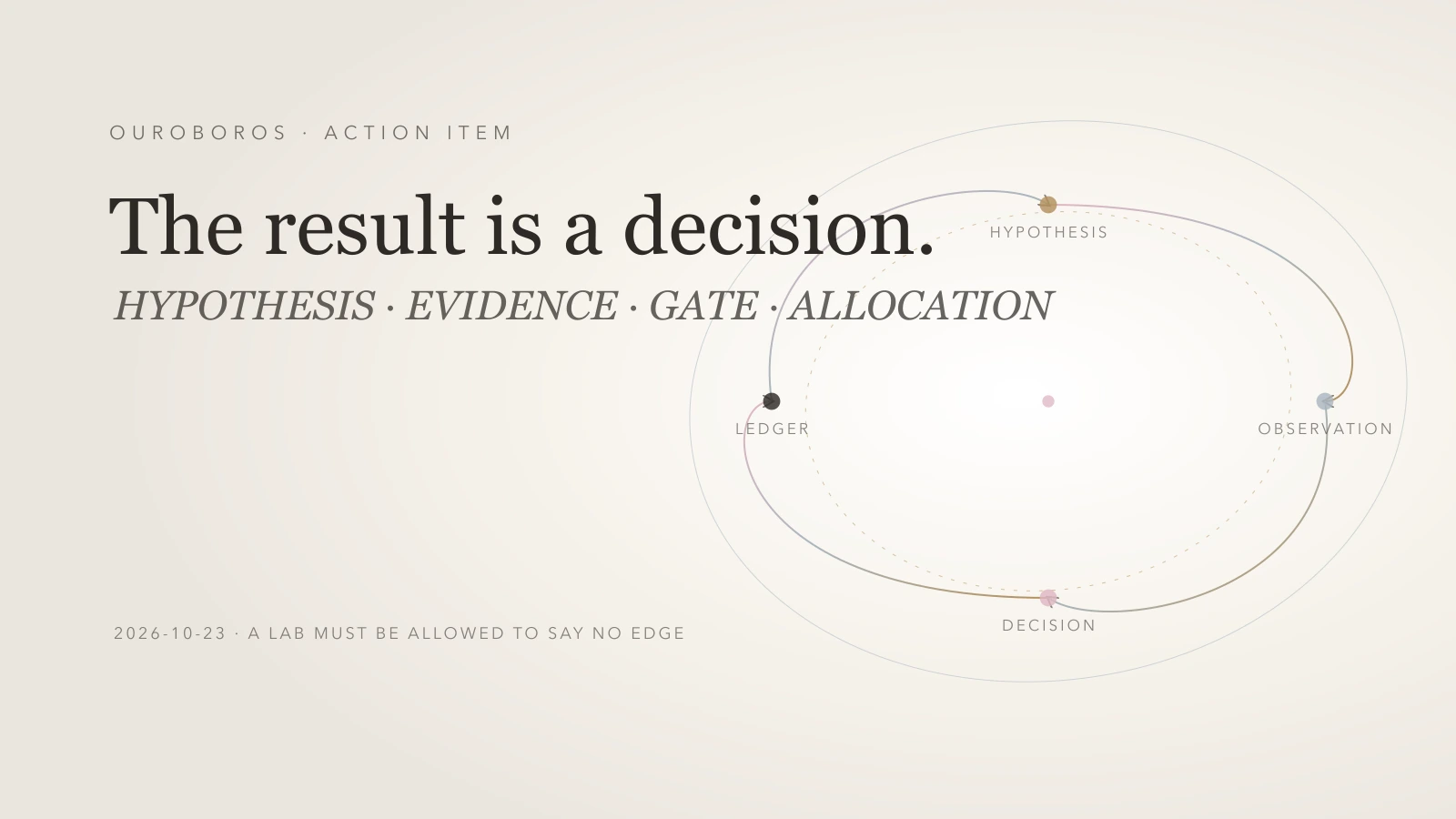
A commercial loop with a scoreboard.
The conclusion is simple: a quant lab must deliver evidence that changes a decision.
A profitable strategy is one possible output. A stopped experiment, a rejected mechanism, a measured data gap, or a result too fragile for promotion can be equally valuable. The lab earns its place when each bounded run leaves the operator better able to allocate time, compute, attention, and capital.
That definition matters because quantitative research can look industrious while producing little usable knowledge. Dashboards update. Parameters multiply. Simulations complete. Agents write summaries. A system can perform all of this activity while delaying the sentence that matters: continue, repair, or stop.
An autonomous lab makes the risk sharper. Software can create hypotheses, collect data, run tests, diagnose errors, and launch another variation faster than a human team. Speed compounds insight when the evidence contract is strong. Speed compounds self-deception when the system receives credit for experiments run, charts generated, or attractive backtests.
The operating goal should be decision-changing evidence per bounded unit of research budget. That goal protects the lab from the demand to discover an edge every day. It also prevents “no edge” from becoming a vague excuse. A negative result earns value only when the hypothesis, rules, costs, uncertainty, and stopping conditions were defined well enough for another reader to reproduce the decision.
A stopped paper test can still succeed
Consider one recent paper-only LTC/USDT test. It used a 1,000 USDT virtual wallet, fixed quote widths, a fixed observation interval, and explicit loss controls. The run had no exchange key, no live order, no borrowed capital, and no inference of real execution.
The control boundary was concrete. A 5% wallet drawdown rule protected the broad experiment, while a 2% inventory-loss rule governed the immediate strategy. The inventory rule fired. At the stop, the observed inventory loss was -2.075341% under the test’s conditional accounting.
The record did not end with a clean fictional exit. A conditional taker exit appeared 64.745 seconds later. A tiny inventory tail remained. Across the observation window, 134 intervals had ambiguous fill status. Those details are awkward. They are also the most valuable part of the run.
If the purpose had been to produce an attractive return chart, the operator could have assumed immediate fills, erased the tail, or treated ambiguous intervals as favorable. The preserved record blocks those moves. It says the mechanism reached its kill condition, liquidation timing was conditional, and fill certainty was inadequate for an economic claim.
That is a successful research outcome. The experiment enforced a predefined boundary and retained the evidence that limits its interpretation. It changed the next decision from “keep searching inside this run” to “stop, preserve, and diagnose.” No live loss was created. No paper profit was promoted into a trading claim.
The result still says nothing about whether every patient-liquidity strategy fails. It does say this configuration, under these assumptions and this evidence quality, failed its inventory-loss gate. That narrower sentence is actionable.
The lab needs an evidence contract before a test
The easiest time to manipulate a research question is after seeing the answer. A credible lab therefore writes its evidence contract before the run.
First, state the hypothesis as a falsifiable mechanism. “Market making may work” is too loose. A usable hypothesis names the instrument, holding horizon, quote logic, inventory behavior, cost model, and the condition expected to create an advantage.
Second, freeze the acceptance and rejection gates. Acceptance might require positive net expectancy after fees, bounded drawdown, stable results across untouched periods, and an intervention rate below a preset limit. Rejection might occur when a loss boundary fires, data freshness falls below the contract, or results depend on ambiguous fills.
Third, define the budget. The budget includes elapsed time, compute, data cost, number of variants, and permitted human intervention. Research without a budget can convert every rejection into another parameter search. A bounded budget makes stopping an ordinary outcome.
Fourth, specify the accounting authority. A controller can supervise a run and issue commands. It cannot become the source of truth for fills, positions, or returns. The journal should preserve the observations and transformations used to calculate each claim. Conditional fills remain conditional. Missing prices remain missing. Residual positions remain visible.
Fifth, name the promotion boundary. Paper evidence can justify another paper test, a better simulator, or a data-quality repair. It cannot silently authorize capital, credentials, or live execution. Each expansion needs its own evidence and authority.
These rules make the result useful before anyone knows whether it will be positive. They turn “failure” from an embarrassment into a pre-priced research outcome.
Multiple testing can manufacture confidence
Quantitative research has a structural temptation: enough trials can produce something that looks significant. Bailey and colleagues’ work on the probability of backtest overfitting describes how selecting the apparent winner from many strategy variants can elevate an in-sample accident. Harvey, Liu, and Zhu make the related point for factor research: the threshold for accepting a discovery should rise when many alternatives have been tested.
An autonomous agent can intensify this problem because variation is cheap. It can try more windows, thresholds, instruments, features, and exit rules in an hour than a manual analyst might test in a week. If only the winning lineage survives, the lab creates a polished selection-bias machine.
The remedy begins with lineage. Every variant needs a parent hypothesis, reason for change, prespecified gate, and outcome. Rejected branches stay in the ledger. An improvement discovered after looking at the result becomes a new hypothesis for a future untouched period. It never repairs the old result retroactively.
The second remedy is separation between exploration and confirmation. Exploration can be creative and broad. Confirmation should be boring: frozen code, frozen data rules, untouched evaluation periods, and a fixed decision procedure. A lab may learn from the evaluation set after the decision is recorded; any subsequent claim needs new evidence.
The third remedy is an honest denominator. Reporting one attractive backtest without the number of attempts hides the search process. The ledger should show how many ideas, variants, and reruns preceded the candidate. A discovery selected from 200 attempts carries a different burden from one predicted before the first test.
Evidence quality is part of the result
Research systems often separate the strategy result from data and execution quality. That creates false precision. A return estimate derived from stale quotes, unsynchronized clocks, conditional fills, or missing costs should carry those limitations inside the decision.
The LTC/USDT paper test illustrates the principle. The -2.075341% inventory-loss reading is precise as an accounting output under the test rules. Its economic meaning is constrained by conditional exits and 134 ambiguous intervals. More decimal places cannot repair uncertain execution.
A useful evidence record therefore stores at least six things:
- the immutable input or a content hash and retrieval time;
- the hypothesis and versioned rules used before observation;
- every assumed cost, latency, fill, and missing-data treatment;
- the complete journal of positions, decisions, stops, and residuals;
- the acceptance or rejection gate and its observed value;
- the decision made, with the exact evidence that could reopen it.
This resembles the discipline behind the NIST AI Risk Management Framework: governance, mapping, measurement, and management surround the model or system. For a quant lab, measurement is inseparable from custody. The system making a claim should never gain permission to delete the failed trials that weaken it.
NIST’s TEVV work adds another useful frame: evaluation needs validity, reliability, and context of use. A paper strategy can be internally consistent and still lack validity for live execution. The correct response is a narrower claim and a new evidence gate.
Continue, repair, or stop
Every completed run should end with one of three allocation decisions.
Continue means the hypothesis passed its current gate and deserves a bounded next test. It does not mean deploy. The next step should test the largest remaining uncertainty, such as untouched dates, a second venue, latency sensitivity, or a stricter cost model.
Repair means the experiment could not answer the question because an input or method failed. Examples include stale data, a broken clock, an invalid control, or excessive fill ambiguity. Repair is justified when a specific correction can restore decision value within a bounded budget. The original result remains in the ledger.
Stop means the mechanism failed its rejection gate, the expected value of another test is too low, or the remaining evidence would cost more than the decision warrants. Stop preserves time and attention for a better hypothesis. A laboratory with no stopped lines is probably hiding its denominator or avoiding hard gates.
The patient-liquidity test belongs in the stop category for its frozen configuration. Inventory loss crossed the preset boundary, the exit remained conditional, and residual exposure survived the simulated unwind. The next useful work is a diagnosis of mechanism and evidence quality, rather than an immediate parameter search intended to rescue the same run.
Score the lab by decisions, not motion
A practical monthly scorecard should count evidence outcomes rather than activity alone.
Track the share of experiments that end with a reproducible continue, repair, or stop decision. Track time from hypothesis freeze to decision. Track how often a claimed result survives an untouched replay. Track the number of retroactive rule changes, ambiguous fills, stale inputs, and missing costs. Track compute and human review minutes per decision. Track whether later evidence reverses a prior conclusion and whether the ledger makes that reversal understandable.
Profit remains important at the appropriate stage. Before live authority exists, paper profit is a model output. The lab should report it alongside uncertainty, cost assumptions, control results, and promotion status. Once live authority exists, realized account records become the accounting authority. The two records should never be blended.
The best lab will sometimes produce a candidate strategy. More often, it will remove weak paths, improve the measurement system, and identify which uncertainty deserves the next dollar of research. That is valuable compounding. Each clear rejection reduces the future search space.
A minimum operating card
One compact card can force each run to answer the right questions:
- Hypothesis: What mechanism should create the edge, and under what conditions?
- Budget: How much time, compute, data, and human rescue may the run consume?
- Evidence: Which immutable inputs, journals, and code versions support the result?
- Costs: Which fees, spreads, latency, slippage, and financing assumptions are included?
- Gate: What numerical condition means continue, repair, or stop?
- Uncertainty: Which missing or conditional observations limit the conclusion?
- Decision: What changes now, and which exact evidence could reopen the question?
- Authority: Is the work research-only, paper-only, shadow, or live, and who can change that boundary?
The card is intentionally small. A laboratory should spend its sophistication on the market question and keep its truth contract easy to inspect.
The earlier Ouroboros control-plane essay argued that the worker cannot own the alarm. A quant lab adds a companion rule: the researcher cannot own the definition of success after seeing the result. Independent gates, retained failures, and an external accounting record protect both principles.
The conclusion remains simple. A quant lab earns autonomy by returning a decision with evidence. “No edge under these rules” can be a first-class result. It protects capital, narrows the search space, and tells the next experiment exactly what it must learn.
This standard also improves communication outside the lab. An investor can see which claim is measured and which remains hypothetical. An engineer can identify whether the next constraint is data, execution, or method. An agent can resume work from a frozen decision instead of replaying the same search. A future reviewer can challenge the calculation without reconstructing the experiment from a polished summary. Each audience receives the same evidence boundary. That shared boundary is what turns an isolated run into institutional knowledge, even when the institution is one person supported by software.
Categories and keywords
Categories: Quantitative Research; Agentic Systems; Evidence Governance.
Keywords: autonomous quant lab, paper trading, negative results, backtest overfitting, multiple testing, conditional fills, decision gates, research ledger.
Hashtags: #QuantResearch #AIAgents #PaperTrading #ResearchOps #Ouroboros