03 · Daily Special · Signal 3
The total turned green. The rails did not.
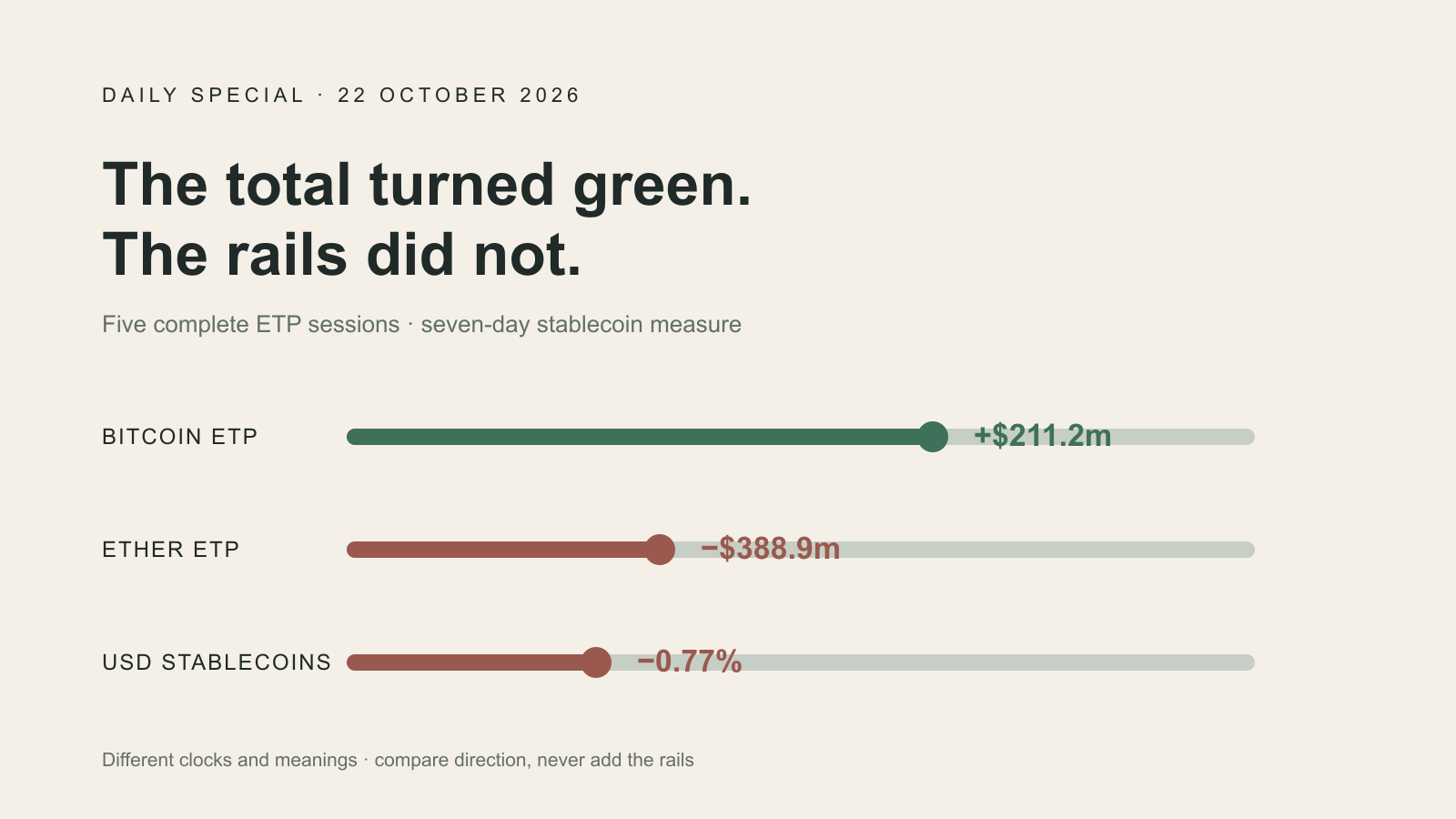
A dated breadth check across five fully reported U.S. spot-Bitcoin and spot-Ether ETP sessions and an aligned seven-day USD-stablecoin circulation measure; no trade, transfer, portfolio change or causal claim.
A green total can be made from one green pipe and two red ones.
That sounds like a defective traffic light. It is also what the latest complete crypto-flow window looks like.
Across the five fully reported U.S. sessions through October 20, Bitcoin products took in $211.2 million. Ether products lost $388.9 million. Place the two columns together and the matched ETP total is still -$177.7 million.
Then widen the view by one rail. DefiLlama’s stablecoin series shows the U.S.-dollar value of circulating USD-pegged tokens falling from $306.106 billion on October 13 to $303.738 billion on October 20. That is a seven-day contraction of $2.368 billion, or 0.77%.
One gauge is green. Two are red. The improvement is real; the confirmation is not broad.
The unfinished day that looked finished
Why stop at October 20 when the tables already show October 21 totals?
Because a total can arrive before all of its ingredients.
When I reopened Farside on the morning of October 22 in Hong Kong, its October 21 Bitcoin row showed +$289.8 million. But the IBIT and HODL cells were still dashes. The Ether row showed +$44.2 million while ETHA, ETHB and ETHV were dashes.
Perhaps those dashes eventually become zero. Perhaps they become something else. I do not know, so I did not lend them a number.
The latest five sessions with numeric entries across every displayed fund column in both tables are October 14, 15, 16, 19 and 20. They are less fresh by one day and more useful by one denominator: completeness.
This is not pedantry. If I include the partial October 21 headline totals, the combined ETP window flips positive. If I exclude the incomplete day, it remains negative. A missing cell is doing enough work to change the adjective.
Bitcoin changed sign; breadth did not
The Bitcoin column deserves its green light. Its five-session sum moved from the negative window I examined on October 19 to +$211.2 million.
But most of that turn came through one doorway. October 19 alone contributed +$526.7 million. The other four complete Bitcoin sessions together contributed -$315.5 million.
Ether never crossed zero. Its five complete sessions were negative every day, ending at -$388.9 million.
That is why I would not use the combined number as the headline. Adding +211.2 and -388.9 is mathematically legal and editorially mischievous. It turns two different signals into one smoother shape, then asks the smooth shape to speak for both.
The more honest sentence is slightly longer: Bitcoin ETP flows turned positive in the latest complete five-session window; Ether ETP flows remained negative.
The third rail is not another ETF
Stablecoin circulation belongs beside these flows, not inside their sum.
The DefiLlama historical endpoint records a stock: the estimated U.S.-dollar value of circulating tokens in its peggedUSD category. The Farside tables record daily flow estimates around listed products. One uses calendar days; the others use U.S. trading sessions. One covers dollar tokens across many networks; the others cover fund creations and redemptions around two crypto assets.
They are different instruments measuring different rooms. That is the point.
If all three signs agree, we have a reason to ask whether appetite is broadening across rails. We still would not have proof that the same dollars moved between them, or that network use improved, or that price must rise. If the signs disagree, we learn something simpler: the word inflow is carrying too much luggage.
This week, the stablecoin measure fell 0.77% through the same end date. That does not mean $2.368 billion fled crypto markets. Minting, burning, bridging, provider classifications and small moves around the peg can all affect the dollar-valued stock. It also says nothing about where each token sits or what its holder plans to do.
But it does refuse to confirm the broad story. Bitcoin’s fund pipe improved. Ether’s did not. The dollar-token reservoir became smaller on this provider’s measure.
Three clocks, no regime machine
The SEC’s in-kind framework helps explain the ETF pipe. Authorized participants can create or redeem crypto ETP shares using the underlying asset rather than only cash. That connects the listed product to a specialized primary market.
It does not turn a daily flow table into a census of investors. Fund shares also trade between people on exchange. Nor does it reveal why an authorized participant created or redeemed shares. The row gives us arithmetic, not motive.
Stablecoin circulation has the same humility problem in a different costume. A larger supply can support more settlement capacity, sit idle, move between chains or finance activity unrelated to Bitcoin and Ether. A smaller supply can reflect redemption, migration or a data revision. The aggregate is useful precisely until we ask it to be a biography.
So this is not a three-input machine that spits out risk-on or risk-off. It is a refusal to let one strong number impersonate breadth.
My conclusion is deliberately small. The Bitcoin five-session sign turned positive. The matched Ether sign and the aligned stablecoin sign did not. October 21 may later improve the picture, but its fund rows were unfinished when this research was locked.
The full research artifact contains the five daily rows, stablecoin series, formulas and source limits. Today’s work completes a dated public-source comparison. It does not change a portfolio, place an order, transfer funds or execute the underlying decision. The neutral label survives—not because nothing happened, but because the rails did not agree on what happened.