01 · AI Circularity Ledger
The Archive Must Answer Back
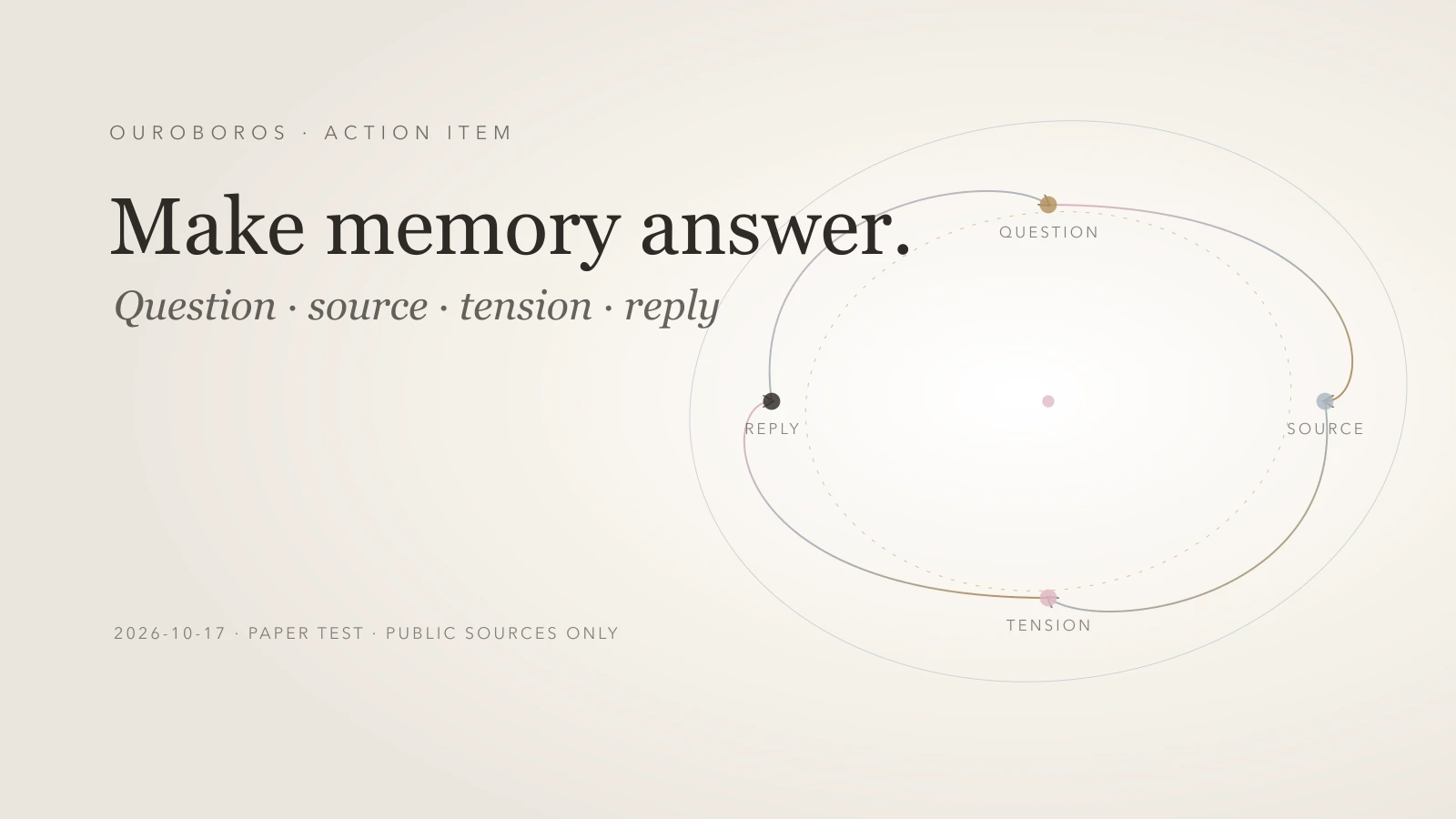
A commercial loop with a scoreboard.
The conclusion is direct: an archive becomes a product only when it can answer a question that matters now.
Storage preserves material. Search retrieves material. An answerable archive does something harder. It assembles a bounded answer from attributable sources, shows where the evidence conflicts, names what remains missing, and gives the reader a useful next move. That is the difference between a warehouse and a living system.
The timing matters because distribution is moving inside the workflow. OpenAI’s Stack Overflow case study reports that a product inside ChatGPT tripled overnight registrations and increased agent creation by as much as tenfold. The company did not publish base counts, retention, or revenue conversion. The result therefore supports one narrow claim: people respond when relevant knowledge appears where they are already working. It does not establish a durable business by itself.
For iamrobin.ai and SunTV, the opportunity is larger than another search box. The archive contains essays, interviews, project decisions, failures, revisions, and relationships across time. A reader rarely arrives wanting “the archive.” A reader arrives with a question: How did someone receive a decisive opportunity? Which infrastructure promise survived contact with delivery? When did an AI system become genuinely autonomous? What evidence changed an investment judgment?
The archive should answer that question without pretending that retrieval is understanding.
The unit is a question, not a document
Most archives inherit the structure of their production process. A newspaper stores issues. A video operation stores episodes. A personal site stores posts by date. Those structures help preservation and provenance. They are rarely the shape of a reader’s curiosity.
A question-led archive starts with a decision object. “What made this project work?” is still too broad. “Which early constraint changed the project’s outcome, and what contemporary evidence shows that?” is usable. It defines an event, an evidentiary burden, and a boundary for the answer.
This changes how material is indexed. A document remains intact as the canonical source. Around it, the system records claims, actors, dates, decisions, contradictions, and links to later updates. The source stays whole; the answer uses only the portions needed for the current question.
The IIIF Presentation API offers a helpful design lesson from cultural heritage systems. It separates a digital object from the way a viewer presents and navigates that object. The same principle can apply to Robin’s archive. The original interview, essay, or project record remains authoritative. A question-led view becomes a reversible presentation layer over those sources.
That separation protects against two failures. The first is fragmentation, where the archive is chopped into context-free snippets that travel farther than their meaning. The second is reconstruction, where a smooth answer silently fills gaps that the source never resolved. A durable archive keeps the source, the claim, and the generated answer as distinct objects.
The practical object is an answer card with five fields:
- the exact question;
- the current answer in one paragraph;
- the source claims that support it;
- the strongest tension, exception, or missing evidence;
- the next source or reader contribution that could change the answer.
The card is compact enough to distribute and strict enough to resist confident improvisation.
Provenance must survive compression
An answer becomes dangerous when its confidence rises faster than its evidence. Archives make this tempting because they contain many related fragments. Retrieval can find five documents that repeat the same claim, even when all five trace back to one unverified assertion.
Provenance needs a graph rather than a source count. The W3C PROV-O recommendation describes entities, activities, and agents in a form that can express where an object came from and how it changed. A lightweight archive does not need to implement the full ontology. It can borrow the discipline: every public claim should point to the source entity, the person or institution responsible, the relevant date, and the transformation that produced the current answer.
This matters for interviews. A quotation proves that a person said something in a given context. It does not prove the event happened exactly as remembered, that another participant agrees, or that the explanation survived later evidence. A good answer can say, “In the 2019 interview, the founder described the introduction as decisive; the contract record confirms the date, while the counterparty’s account is unavailable.” The sentence stays useful because each layer keeps its proper weight.
Provenance also makes correction cheaper. When a date changes or a source is withdrawn, the system can identify which answers depend on that claim. Without dependency links, every correction becomes an archaeological expedition through prose.
The C2PA specification addresses media provenance through signed assertions and a record of edits. An editorial archive can use a simpler version of the same instinct. Keep the immutable source hash, the extraction record, the editor’s answer, the publication date, and every material correction. Readers do not need to see an audit dashboard. They should be able to reach the source and understand why the answer says what it says.
This structure is especially important when an AI system helps assemble the answer. The model can propose relationships, surface conflicting passages, and draft a readable explanation. It cannot promote an inference into a source fact. The final answer should expose meaningful uncertainty in ordinary language: “The interview establishes the speaker’s view; the commercial outcome remains undocumented.”
Contradiction is part of the interface
Traditional content products reward clean narratives. Archives often contain the opposite: memory changes, participants disagree, plans fail, and later evidence alters an earlier conclusion. Hiding that tension makes the archive flatter and less trustworthy.
An answerable archive should treat contradiction as an interface element. Each card needs one visible “tension” field. This may be a disagreement between sources, a missing denominator, a later reversal, or a limit on what the source can prove.
Consider a hypothetical question: “Did the first important opportunity come from capability, relationships, or timing?” One interview may credit preparation. Another may recall a family introduction. A dated calendar may show that the opening appeared only after a regulatory change. A polished profile would choose one cause. A useful archive would show the interaction: capability made the person ready, a relationship made them visible, and timing created the slot.
That answer is richer because it refuses a false single cause. It also invites a reader to add a counterexample. The contribution request can be precise: “Share a dated source showing that the opportunity was already under discussion before the introduction.” Precision turns engagement into evidence rather than applause.
The NIST AI Risk Management Framework provides a broader governance principle: context, measurement, accountability, and ongoing management belong together. For an archive, the practical translation is simple. Define what the answer is for, measure whether its evidence supports that use, name who approves it, and retain a path for correction.
Contradiction also creates better editorial voice. Robin does not need to sound omniscient. The memorable line may be the honest turn: “I expected the technology to be the constraint. The dated records point to distribution.” That kind of correction reveals judgment in motion, which is far more valuable than a static victory story.
Distribution should carry the question
The Stack Overflow case points toward knowledge inside a workflow. The lesson is easy to flatten into “build a plugin.” The deeper lesson concerns the entry point. People engage when the product meets a live job.
For iamrobin.ai, each derivative should carry one question, one surprising source-backed answer, and one open edge. A LinkedIn post can ask, “Was your first decisive opportunity created by capability, relationships, or timing?” The canonical page then shows evidence and tensions. The social post invites experience; the archive converts useful replies into candidate sources after permission and verification.
This is different from distributing a summary. A summary closes the loop. A strong question opens a bounded loop. It tells the reader what kind of contribution would improve the answer.
The canonical page should remain the evidence home. Social platforms are discovery surfaces. Search engines and assistants are routing surfaces. The archive owns the source graph, revisions, and acceptance record. That division keeps the durable asset under Robin’s control while allowing questions to travel.
The existing Google and Marvell action item demonstrates a reusable principle: relationships become more legible when they are drawn as a system of actors, commitments, and constraints. An answer card can use the same visual grammar. Put the question at the center. Place sources around it. Draw solid lines for direct support, dashed lines for inference, and a break where evidence is missing.
The visual should help a reader challenge the answer. Decorative certainty is the wrong goal. A useful map makes the weak edge easy to see.
Measure answer yield, not archive size
An archive can grow every day while becoming harder to use. Page count, transcript hours, and embedding volume are inventory measures. They reveal storage, not decision value.
The better unit is answer yield: how often can the archive produce a useful, attributable answer to a real question within a bounded amount of work?
Five measures are enough for a first test:
Accepted answer rate. How many questions produce an answer that passes source, scope, and editorial checks?
Source-open rate. How often do readers open at least one original source from the answer? This indicates whether attribution remains functional rather than ceremonial.
Useful follow-up rate. How often does a reader ask a sharper next question, identify a contradiction, or supply a verifiable source?
Correction latency. How long does it take to update every dependent answer after a material source correction?
Human minutes per accepted answer. This is the coordination cost that determines whether the archive can become an operating system rather than a handcrafted exhibit.
Registrations, likes, and raw traffic remain secondary. They can help distribution. They do not prove that the archive answered anything well.
The measurements should retain denominators. “Readers opened sources” is incomplete. “Nine of 40 qualified visits opened a source” can be compared. A quiet answer with three strong corrections may create more durable value than a popular answer with no evidence interaction.
A twelve-question paper test
The first experiment should avoid private interviews, new permissions, production integrations, and external posting. Use twelve already public iamrobin.ai pages across AI infrastructure, payments, agent autonomy, Physical AI, and publishing. Freeze the source set before evaluation.
Write twelve real questions that a reader or Robin might use for a decision. Six should be direct retrieval questions, such as “What payment responsibility remained unresolved?” Six should require synthesis across two or more pages, such as “Which autonomy failures were actually recovery failures?”
Compare three modes under the same time budget:
Document search. A reader receives titles and keyword search.
Generated summary. A system retrieves pages and produces a conventional answer.
Answer card. The system produces the five fields: question, current answer, supporting claims, tension, and next evidence.
Use a sealed evaluator who sees the outputs without knowing the mode. Score factual support, correct scope, usefulness, source reachability, contradiction handling, and time to acceptance. Record every unsupported claim and every source that fails to open.
The primary metric is accepted answers per human hour. Supporting measures are source-open rate, unsupported claims per answer, correction time after one planted source update, and the share of questions that generate a useful follow-up.
The experiment is currently NOT_RUN. Its results, effect size, reader behavior, and economic value are UNKNOWN. The design is a proposal, and a polished framework cannot substitute for observed use.
If the answer-card mode wins, publish the smallest interface over public material. If it fails, keep the source graph and discard the presentation layer. The archive remains intact in either outcome.
The product is a maintained answer
The archive does not need to become a chatbot that speaks about everything. That design would create pressure to answer beyond the evidence. It needs a narrower promise: for selected questions, provide the best maintained answer the sources currently support.
“Maintained” is the crucial word. A question has an owner, a source set, a last verification date, a visible tension, and a condition for revision. New material can strengthen, weaken, or retire the answer. Silence can remain an honest result when the archive lacks the evidence.
This turns editorial work into compounding infrastructure. An interview contributes claims to several questions. A correction updates multiple answers. A reader contribution improves the graph after verification. A new article can begin where the archive’s unresolved edge already points.
The product boundary stays clear. Public sources can support public answers. Private interviews remain private until permission and editorial review exist. A reader response becomes a lead before it becomes evidence. AI assistance accelerates retrieval and drafting; the publication owner remains responsible for acceptance.
An archive earns attention when it gives the reader a useful answer and a reason to inspect the evidence. It earns trust when it shows the weak edge. It compounds when each correction improves more than one page.
Start with twelve questions. Keep the original sources whole. Publish the tension beside the answer. Measure accepted answers per human hour. Let readers add evidence rather than merely react.
Memory becomes a product when it can answer back and still show its receipts.
Categories and keywords
Categories: Knowledge Systems; Distribution; Agentic AI; One Person Company.
Keywords: answerable archive; source provenance; evidence graph; question-led retrieval; contradiction interface; answer yield; correction latency; accepted answers; iamrobin.ai; SunTV.
Hashtags: #KnowledgeSystems #AgenticAI #DigitalArchives #Provenance #OnePersonCompany #iamrobin