01 · AI Circularity Ledger
Who Gets the Wallet
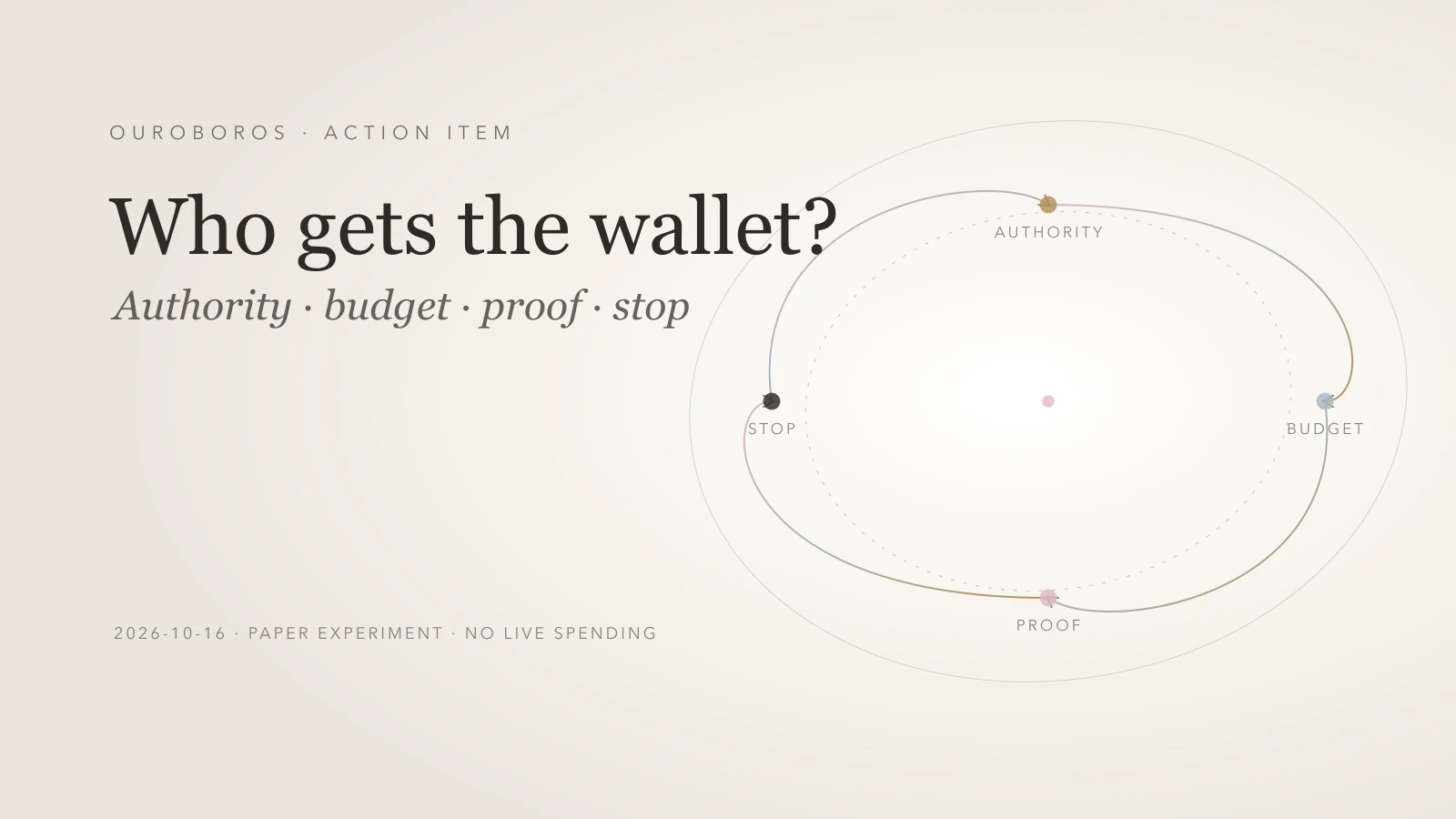
A commercial loop with a scoreboard.
The conclusion is simple: an AI agent should never receive a wallet without also receiving a constitution.
A payment rail answers how money can move. It does not answer why a purchase is allowed, who owns the consequence, what proof counts as delivery, or when the agent must stop. Those questions become more important as the mechanical cost of paying falls toward zero.
This is already more than a thought experiment. Chainalysis describes x402 as an HTTP-native payment protocol that lets software agents discover prices and pay for digital services without a conventional checkout flow. Cross River says it has embedded Ripple USD settlement into its core banking infrastructure for business payments. The interface between computation and money is becoming programmable.
That creates a seductive story: give the agent a small balance, set a task, and let it buy the data, compute, APIs, and distribution it needs. The small amount makes the risk feel small. Yet a five-cent transaction can still reveal a credential, violate a contract, purchase the wrong license, create an irreversible account relationship, or multiply across a loop. Price is only one dimension of consequence.
The question is therefore larger than “can an agent pay?” The useful question is “which agent may spend whose money, for which objective, under which evidence standard, with what recovery?”
A wallet is an authority surface
In a human company, spending authority arrives through a messy combination of roles, budgets, procurement rules, cards, invoices, approval chains, and social accountability. The friction can be excessive. It also encodes accumulated lessons about fraud, conflicts, delivery, tax, privacy, and recourse.
An agent wallet compresses that stack into an API call. Compression removes waiting time. It can also remove context.
Consider a research agent asked to compare ten software tools. It finds a metered endpoint that charges one cent per query. The endpoint works, and the total expected cost is below one dollar. A narrow budget check says yes. A fuller authority check asks more:
- Is external purchasing within this task’s permission?
- May the agent disclose the query to this vendor?
- Does the response license permit publication or reuse?
- Is the quoted price the whole cost, including retries and subscriptions?
- What evidence proves that the returned data satisfies the task?
- Can the payment or the resulting relationship be reversed?
The agent needs a signed answer to each relevant question before payment. “Affordable” is insufficient. “Technically possible” is insufficient. “The model recommended it” is insufficient.
This is where the NIST AI Risk Management Framework is useful even though it is not a payment specification. Its govern, map, measure, and manage functions force the operator to connect a system to accountable roles, context, evidence, and ongoing response. An agent wallet should inherit that structure. The spending act belongs inside a governed system, rather than floating as a clever feature beside it.
The spending constitution
A spending constitution can be compact. It needs enough structure to make a payment inspectable before and after it occurs.
Authority names the principal, the agent, the permitted objective, and the exact action class. “Research” is too broad. “Purchase up to ten read-only API responses from approved public-data providers for this dated comparison” is closer to useful.
Budget sets a ceiling per transaction, per task, and per time window. It also defines whether retries, fees, subscriptions, deposits, and foreign-exchange costs count. A ceiling without aggregation invites a loop to remain locally compliant while becoming globally expensive.
Counterparty rules identify approved vendors, jurisdictions, data-handling terms, and conflict restrictions. A valid endpoint can still be an invalid recipient.
Acceptance defines the artifact or state that earns payment. A successful HTTP response proves transport. It does not prove that the data is current, licensed, complete, or useful. Whenever the protocol permits, payment should follow a verifiable acceptance event. When prepayment is unavoidable, the constitution should cap exposure and define a dispute path.
Evidence records the quote, request, response hash, timestamp, approval basis, receipt, and final disposition. This makes duplicate charges and silent substitutions visible.
Stop and recovery specify how the agent loses permission. Exhausted budget, changed price, repeated failure, stale evidence, an unknown counterparty, a revoked credential, or an owner instruction should stop the payment path. The agent must then preserve state and continue any safe work that requires no spend.
These fields turn a wallet into a scoped capability. They also make the authority portable. If one agent fails and another resumes the task, the successor can inherit a precise envelope instead of guessing from a transcript.
The previous essay, The Handoff Test, argued that a successor needs the goal, evidence, failure record, permission boundary, and acceptance state. Money adds a sixth object: the economic ledger. A task is incomplete when the artifact transfers but its commitments disappear from view.
Cheap payments amplify loops
Micropayments change the shape of operational risk. Traditional procurement concentrates attention on a few large decisions. Agent payments can produce thousands of tiny decisions, each individually plausible.
Suppose a data call costs $0.01. An agent tries three sources, retries twice, expands the query, asks a second model to adjudicate, and repeats the process for twenty items. The nominal unit cost stays tiny while the chain reaches hundreds of calls. More important, each call may send data to a new counterparty or create a new dependency.
The relevant unit is therefore the accepted outcome. A workflow that spends $2 and produces one accepted result may be cheaper than a workflow that spends $0.20 ten times and produces none. The ledger should connect every cost to an acceptance state: accepted, rejected, duplicated, disputed, expired, or unresolved.
This mirrors the financing lesson in CoreWeave’s October 2026 debt announcement. Contracted demand and access to capital can support expansion, while the maturity schedule, interest burden, and concentration of commitments still determine resilience. Scale does not erase structure. An agent can have a valuable objective and adequate funds while carrying a fragile payment design.
Cheap execution also increases review debt. If an agent can evaluate one hundred paid options before lunch, the human owner cannot inspect one hundred purchasing decisions in the old way. The constitution must encode routine refusals as deterministic rules and escalate only the decisions whose consequence requires judgment.
The goal is neither universal approval nor universal human review. It is selective autonomy with an auditable boundary.
Three regimes reveal the tradeoff
The idea can be tested safely with a paper experiment. No real wallet, payment credential, account change, purchase, or vendor contact is required.
Create ten fixed digital tasks. Each task offers several simulated services with different prices, quality, latency, licensing, privacy, and refund conditions. Freeze the service cards and expected answers before the run. Then compare three regimes under the same model, tools, information, and total budget.
Regime A: open sandbox. The agent may make any simulated purchase under the aggregate budget. It sees prices and service descriptions but has no structured authority template.
Regime B: item-by-item approval. Every simulated purchase waits for a human decision. This establishes the control cost of maximum review.
Regime C: constitutional wallet. The agent receives explicit permitted objectives, per-item and aggregate ceilings, counterparty classes, acceptance tests, evidence fields, and stop conditions. Only exceptions escalate.
Run each task more than once with a fresh state. Randomize task order. Use a sealed evaluator who sees outputs and receipts but does not know which regime produced them. Record model calls, simulated spend, intervention time, retries, rejected purchases, and unresolved states.
The primary measure should be total simulated cost per accepted outcome. Supporting measures should include accepted completion rate, useful spend ratio, unauthorized purchase attempts, duplicate charges, human interruption minutes, time to accepted result, and recovery rate after a simulated revocation.
The experiment should include adversarial service cards. One vendor offers a very low price with a subscription renewal. Another returns fast data under a restrictive license. A third changes its quote after selection. A fourth delivers a valid response whose content fails the task’s freshness requirement. These cases test whether the agent optimizes price or respects the full constitution.
The run remains a proposal until it happens. Its current status is NOT_RUN. Results, effect size, sample adequacy, and economic value are UNKNOWN. A compelling framework cannot substitute for measured outcomes.
Acceptance must govern payment
Most payment systems are good at confirming settlement. An autonomous operating system needs a second proof: acceptance.
A receipt says that value moved. An acceptance record says that the purchased input contributed to the intended result under the agreed conditions. Those records should remain linked without becoming identical.
For a data purchase, acceptance might require a source timestamp, schema match, coverage threshold, license record, and successful use in a verified output. For compute, it might require a completed job, artifact hash, runtime record, and error-free replay. For distribution, it might require a public URL, correct destination, persisted body, and readback after reload.
The separation protects both sides. A vendor may deserve payment after valid delivery even when the buyer’s larger project fails. An agent may produce a polished result even though the purchased data violated the permitted terms. Economic settlement and task acceptance answer different questions.
The Cross River and Ripple announcement illustrates why this matters. When stablecoin settlement becomes part of core banking infrastructure, the rail becomes easier to integrate into ordinary workflows. Governance has to travel with that integration. Faster settlement strengthens the need for precise identity, purpose, reconciliation, and exception handling.
An agent should never infer acceptance from the absence of a complaint. It needs a positive gate or an explicit unresolved state. Missing evidence remains missing. A timeout does not become approval. A low dollar amount does not become permission.
Revocation is part of the product
A wallet is safe only when permission can disappear cleanly.
The revocation test should be designed before the first transaction. Remove the payment capability midway through a simulated task. Change the approved counterparty list. Reduce the remaining budget. Revoke one data permission while leaving the research objective intact. Then observe whether the agent stops the affected action, preserves evidence, reroutes safe work, and asks for only the exact authority it lacks.
An AI Coworker Must Survive Losing Permission proposed this principle for general agent autonomy. Money makes the test sharper because a retry can create a real commitment. The safe behavior is a state transition: ACTIVE becomes HOLD, pending economic actions stop, completed receipts remain immutable, and independent non-economic work continues.
Revocation also needs idempotency. If a network failure leaves settlement uncertain, the agent cannot blindly retry. It needs a stable transaction identifier and a reconciliation path. The honest state may remain UNKNOWN until the counterparty or ledger resolves it. Operational pressure cannot manufacture certainty.
The same discipline applies to refunds. “Refund requested” differs from “funds returned.” “Cancellation submitted” differs from “subscription terminated.” An autonomous system should record the final economic state through readback, rather than treating an outbound request as completion.
Who owns the decision
The principal owns the objective and the risk appetite. The agent owns routine execution inside the granted envelope. The counterparty owns its delivery claims. The acceptance system owns the deterministic checks. A human reviewer owns exceptions whose consequences exceed the envelope.
This division prevents two common failures. The first is ceremonial approval, where a human clicks yes on a stream of low-context requests. The second is authority laundering, where the agent treats a broad business goal as permission for any affordable intermediate action.
A one-person company needs this distinction more than a large enterprise. There is no procurement department to absorb ambiguity. Every unnecessary escalation reaches the founder, while every vague delegation exposes the same founder to the consequence.
The best constitution makes routine yes decisions fast, routine no decisions automatic, and uncertain decisions legible. It should be short enough to travel with the task and strict enough to survive a model replacement.
That is the real opportunity in agent payments. The breakthrough is not software that can spend. Software has triggered payments for decades. The breakthrough would be an agent that can connect spending to purpose, prove what it received, stop when authority changes, and report the unresolved remainder without hiding it.
Give the agent a wallet only after giving it a constitution. Bind every unit of cost to an accountable objective. Measure cost per accepted outcome. Test revocation before production. Keep the ledger complete, including rejected and uncertain transactions.
Money makes autonomy concrete. It also makes governance observable. That is useful: once authority has a price, weak assumptions become much harder to ignore.
Categories and keywords
Categories: Agentic AI; Payments; Governance; One Person Company.
Keywords: AI agent payments; spending constitution; x402; stablecoin settlement; budget authority; acceptance tests; revocation; cost per accepted outcome; RobinOS.
Hashtags: #AgenticAI #AgentPayments #AIGovernance #OnePersonCompany #RobinOS