01 · AI Circularity Ledger
Google’s New Brain Has an Access Problem
A commercial loop with a scoreboard.
Google has published a price for a model most of us cannot yet hire. That is a surprisingly useful way to understand the next phase of AI.
The conclusion for an operator is straightforward: prepare a fair test while today’s system keeps working.
On September 30, Google announced Gemini 4 Argon, initially rolling it out to trusted cyber defenders through Fairwind. Its introductory price will be US$2 per million input tokens and US$10 per million output tokens. Broader access is planned, without a dated public launch in the announcement. Google’s announcement
The interesting gap lies between those two statements. A price tells me what a unit of computation might cost. Access tells me whether I can buy it for the job I actually need done. Until both line up, a very capable model belongs in the planning file. The delivery schedule still needs someone who can show up.
For a small company, this distinction can decide whether an ambitious project moves forward or spends another month admiring its future employees. A founder can be excited about Argon and keep today’s working system. There is no contradiction. Research asks what has become possible. Operations asks what can finish by Friday.
A capability arrives before the service
Google reports that Argon agents helped free more than 300 TiB of memory across its data centers. It also describes an optimization that made a Rust video decoder 2.7 times faster than the existing Rust port, bringing it closer to optimized C++. These are Google’s reported internal results; I have not reproduced them. The comparison baseline matters as much as the multiplier. Google
Those examples are more revealing than a leaderboard. They describe a chain of useful work: find a problem, make a change, test the result and fit it into a real environment. They also raise the questions an operator should ask. How much context did the system receive? Who checked the change? What counted as a failed attempt? What infrastructure made the result possible?
An internal engineering success cannot answer every one of those questions for an outside buyer. Google controls its own code, telemetry, evaluation systems and deployment process. Another organization starts with a different arrangement. Even if the underlying reasoning transfers perfectly, the surrounding work may transfer unevenly. The part between an impressive result and a repeatable service deserves its own budget.
That is why I would resist describing this launch as an immediate productivity gain for everyone. It is a concrete reason to prepare an evaluation. Preparation has value, especially when a model may change what is technically feasible. Claiming the gain before access and acceptance would spend the same evidence twice.
Access is a property of a particular job
Fairwind is a controlled program. Google’s published terms restrict partner access to eligible defensive teams and prohibit reselling or redistributing access. The program gives selected partners access to Argon, including through CodeMender. An organization’s admission therefore does not imply permission for every employee or every use case. Fairwind Program
This makes the familiar question, “Do we have the model?”, too vague. A more useful question is whether a named team can use a particular version, through a supported interface, with the required data and tools, for this exact class of work. A yes to one part does not complete the sentence.
Imagine a company that can use a frontier system to inspect its own code, while another department wants that system to reconcile customer invoices. Both tasks involve reasoning over messy information. Their permissions, data handling and allowed outputs may differ substantially. Moving from the first task to the second requires an actual access path and an appropriate operating agreement.
The same distinction appears inside the workflow. Reading a document, proposing a change and making that change are different steps. A team may have permission for the first two while the third requires a separate control. The model’s ability to explain all three does not remove the boundary. Operational planning should price the complete permitted route to the result.
Count work that survives the handoff
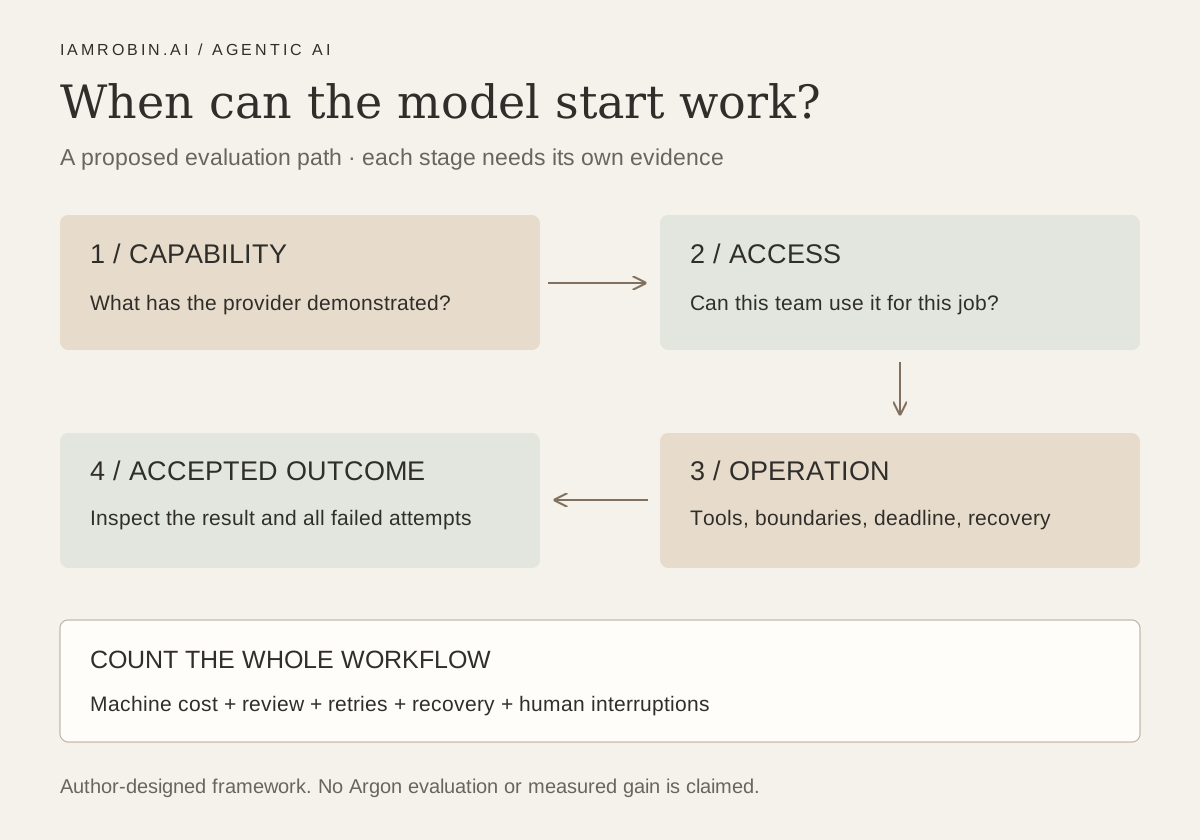
I would measure a model through accepted work within a fixed time window. That sounds almost disappointingly ordinary. It is also much harder to fool than an impressive transcript.
Consider a hypothetical comparison. A familiar system completes 8 of 12 matched tasks within the deadline. A new system completes 10. That looks promising. Now suppose the familiar system needed 20 minutes of human review and recovery, while the new one needed 80. Neither total tells us which system wins until we know the value of the extra completed tasks and the cost of that attention.
A missed deadline also changes the comparison. Ten correct answers tomorrow may be less useful than eight correct answers before today’s decision. Conversely, a difficult research task may justify waiting longer for a substantially better result. Define the delivery window before looking at the outputs. Otherwise the finish line will quietly move to accommodate the model we want to like.
The denominator must include the inconvenient cases. If access fails, a tool times out or the agent needs a person to rescue it, that attempt remains part of the job. A team can separately diagnose whether the cause was the model, the integration or the service. The customer still experienced one unfinished task.
This is a proposed measurement frame, not a report of a completed Argon trial. Its purpose is to keep future enthusiasm attached to observable outcomes. The useful surprise might be fewer interventions, better recovery or one previously impossible task becoming routine. Token speed alone will not tell us which of those happened.
The price tag covers one layer
OpenAI’s September 29 API changelog provides a helpful contrast in release state: GPT-6.1 Sol is released, multi-agent support is in beta, and hosted browser computer use is available in the Agents API. Those are documented building blocks. They do not establish our own completed-task economics. OpenAI API changelog
A buyer has to assemble a larger bill. Count model usage, tool usage, environment costs, retries, review and recovery. Include the effort required to maintain the connection when an interface changes. A cheap successful call can sit inside an expensive unsuccessful workflow. An expensive call can be economical if it reliably closes a valuable task with little supervision.
Take another hypothetical example. A workflow costs US$12 in machine usage and US$30 in human review, for a total of US$42. A second costs US$20 in machine usage and US$10 in review, for US$30. If both deliver the same accepted result, the apparently more expensive model supports the cheaper workflow. The arithmetic is simple; collecting honest inputs is the work.
No hourly value for Robin’s time is assumed here. It belongs in the eventual evaluation specification, along with a consistent way to count interruptions. Five short questions scattered through an afternoon can be more disruptive than one scheduled review. Record both elapsed attention and the number of times the human must re-enter the task.
A small company cannot copy Google’s environment
There is an appealing fantasy in which a solo operator gets the same model as a large lab and immediately inherits the lab’s engineering productivity. The missing character in that story is the environment around the model.
Useful context has to be findable. Tests have to say something meaningful. Documents need an owner and a current version. A result needs somewhere to go, and a failed run needs a way to stop, retain its work and resume. These requirements sound like administration until they become the reason a brilliant agent cannot finish an ordinary task.
For a small team, the sensible response is to choose one workflow whose boundaries are already understandable. A source-backed research note, a narrow code change or a reconciliation using synthetic data could qualify. The goal is to learn whether the new capability removes a real bottleneck. Building a grand universal agent platform before that test would make the experiment harder to interpret.
Keep the input package, acceptance rule and output artifact portable. That does not mean pretending every model or tool interface is identical. It means knowing which parts of the job belong to the business and which parts belong to a provider. A replaceable adapter is useful; an abstraction that hides important differences is a new source of confusion.
More autonomy changes the review problem
Google’s June 18 AI Control Roadmap describes layered controls, including detection, prevention and response. It distinguishes delayed review for lower-risk reversible actions from the need to prevent high-risk actions before they occur. This is background context for the operating problem, rather than a new September announcement. Google DeepMind
That distinction gives an operator a practical design question. Which mistakes can be repaired after the fact, and which require an earlier stop? The answer should shape the workflow before increasing the agent’s unattended duration. A draft with an incorrect paragraph and an unauthorized external action have different consequences even if both came from the same reasoning error.
A useful evaluation therefore includes a case where the right result is an explicit, well-supported stop. The agent should preserve enough state to explain what remains missing. It should also continue any independent work that is still possible. Refusing everything demonstrates little; silently crossing a boundary demonstrates the wrong thing.
Recovery deserves a separate case. Interrupt the proposed test in a reversible environment, then check whether the system can distinguish completed work from work merely attempted. The artifact should make that distinction inspectable. These are specifications for a future test, with no claim that a model has already passed them.
Freeze the comparison before access arrives
My proposed next step is a twelve-case evaluation packet. Use four straightforward tasks with clear expected outputs, four tasks requiring several tools or documents, and four recovery or boundary cases. Keep the task values comparable within each group. The packet should be small enough that a person can inspect every outcome and explain a disagreement.
For each case, save the exact inputs, allowed operations, time limit, acceptance conditions and evidence required to certify completion. Record the existing system’s version and setup before running a comparison. If a case depends on unavailable information, mark that dependency; do not quietly remove the case once it becomes inconvenient.
The first access check should establish that the specific intended use is available through a supported route. It should not become an application campaign or an excuse to expand permissions. Until that condition is met, the packet is ready for a future evaluation and the current workflow continues. A waiting list is an access state, not a failed intelligence test.
When comparison becomes possible, run the same packet under the same boundaries. Report accepted outcomes, missed deadlines, machine costs, human minutes, interruptions and recoveries. Preserve failures alongside successes. Any conclusion about productivity should name the workload and the observed conditions, rather than graduate into a claim that one model is universally better.
The useful asset is readiness
There is an economic benefit to preparing without switching. The team learns what it wants the new capability to accomplish. It can identify a missing test, an ambiguous permission or an undocumented dependency before paying for a more capable model to discover the same problem. The preparation remains useful if another provider reaches the relevant threshold first.
There is also a limit. A twelve-case packet is a sample, with a narrow task distribution and imperfect acceptance rules. Passing it should justify the next bounded trial. It cannot justify handing over every workflow. Keep the scale of the conclusion close to the scale of the evidence, then expand only where observed results support it.
I would keep a compact review card beside the model watchlist: access for this job, supported tools, accepted output, total cost and recovery behavior. Review it when a release changes one of those fields. A new score without a usable route may update research interest. A newly available interface may justify a test. A repeatable accepted result may justify a change in operations.
Google’s new brain is a reason to pay attention. The date on which it can do our work, under our boundaries, is a separate fact to establish. Until then, the most valuable thing to build is a fair way to recognize the improvement when it arrives.
Categories and keywords
Keywords: Gemini 4 Argon, model access, agent autonomy, accepted outcomes, human intervention, evaluation design.
Categories: Agentic AI, AI Infrastructure, Operating Systems.
Hashtags: #AgenticAI #Gemini #AIInfrastructure #IAmRobin