01 · AI Circularity Ledger
Who Owns the Data Layer of Onchain Markets

A commercial loop with a scoreboard.
The conclusion is that the next durable onchain business may sit inside the market’s operating budget. Every trade needs a venue, yet institutions also pay to establish what an asset represents, price it consistently, monitor abuse, and reconcile ownership. My investment question is which of those jobs produces revenue that survives when speculative turnover cools.
Two announcements sharpen that question. Payward’s September 10 announcement describes Nasdaq Ventures’ agreement to invest $100 million, work on Nasdaq Equity Tokens, and a surveillance agreement. NETs are expected in the second quarter of 2027. Kaiko’s September 14 announcement says S&P Global led an extension bringing its Series B to $110 million, alongside a strategic industry working group.
These are different amounts attached to different transactions: an investment agreement and the total of an extended financing round. Adding them into a supposed $210 million demand measure would obscure the economics. Neither announcement establishes sustained tokenized-equity settlement revenue. Both provide a reason to investigate the businesses institutions expect to need.
Follow the operating budget
Imagine an investment committee considering a tokenized fund. The trading screen is attractive: balances move quickly, ownership appears legible, and the product can connect to software. Then the operations director asks which record controls the claim, what happens during an outage, and who supplies the valuation used in tomorrow’s client statement. This is a hypothetical scene, yet it describes the questions my framework is designed to ask.
The strongest commercial position could belong to the supplier whose service becomes necessary across competing venues. An exchange earns from activity on its own market. A data or reconciliation supplier might earn whenever a client must account for positions across several markets. The second model deserves attention even if its product never trends on social media.
That is a hypothesis about customer budgets, not a ranking of current companies. A quiet infrastructure vendor can also be a low-margin contractor. I would require evidence of customer retention, contractual rights, pricing power, and the cost of replacing the service. An impressive shareholder list establishes none of those four measures by itself.
Read the two transactions separately
Payward’s release combines capital, distribution infrastructure, and surveillance. The commercial attraction is a connection between existing market relationships and a proposed tokenized product. An expected launch date creates a future checkpoint; it does not create current product revenue. The investment’s closing status, detailed economics, and future product margins are UNKNOWN in this review.
Kaiko reports coverage of more than 150 exchanges and protocols. Its announcement describes investors helping shape data infrastructure for tokenized markets. My inference is that institutions see a coordination problem worth funding. Whether that coordination becomes paid software, recurring data contracts, or a slow standards exercise remains open. Kaiko’s valuation, revenue, customer concentration, and incremental round proceeds are UNKNOWN here.
The comparison therefore has two separate research files. One asks whether a venue partnership converts into usable, legally coherent products. The other asks whether shared data infrastructure converts into recurring customer expenditure. Their development paths can reinforce each other while their shareholders receive very different economic outcomes.
Map the claim before the market
An onchain asset begins with a claim. The SEC staff’s January 28 statement distinguishes issuer-sponsored and third-party tokenization, including custodial and synthetic structures with different rights and counterparty risks. It is a staff statement without legal force, rather than an approval of a particular product. The useful research lesson is to examine the specific instrument and its governing records.
My market map has six jobs. Issuance defines rights and eligible holders. Liquidity and execution let holders transact. Data and indices establish consistent identifiers and valuations. Surveillance and risk controls identify problematic activity. Custody and settlement connect asset and payment records. Corporate actions carry dividends, voting, splits, and other changes through the system.
Each job can have a different owner and a different revenue model. A token might give exposure to one company’s share while its trading venue, reference-price provider, and custodian collect the operating fees. Buying the tokenized asset would not automatically provide ownership of any of those suppliers. The instrument under consideration must match the economic claim being analyzed.
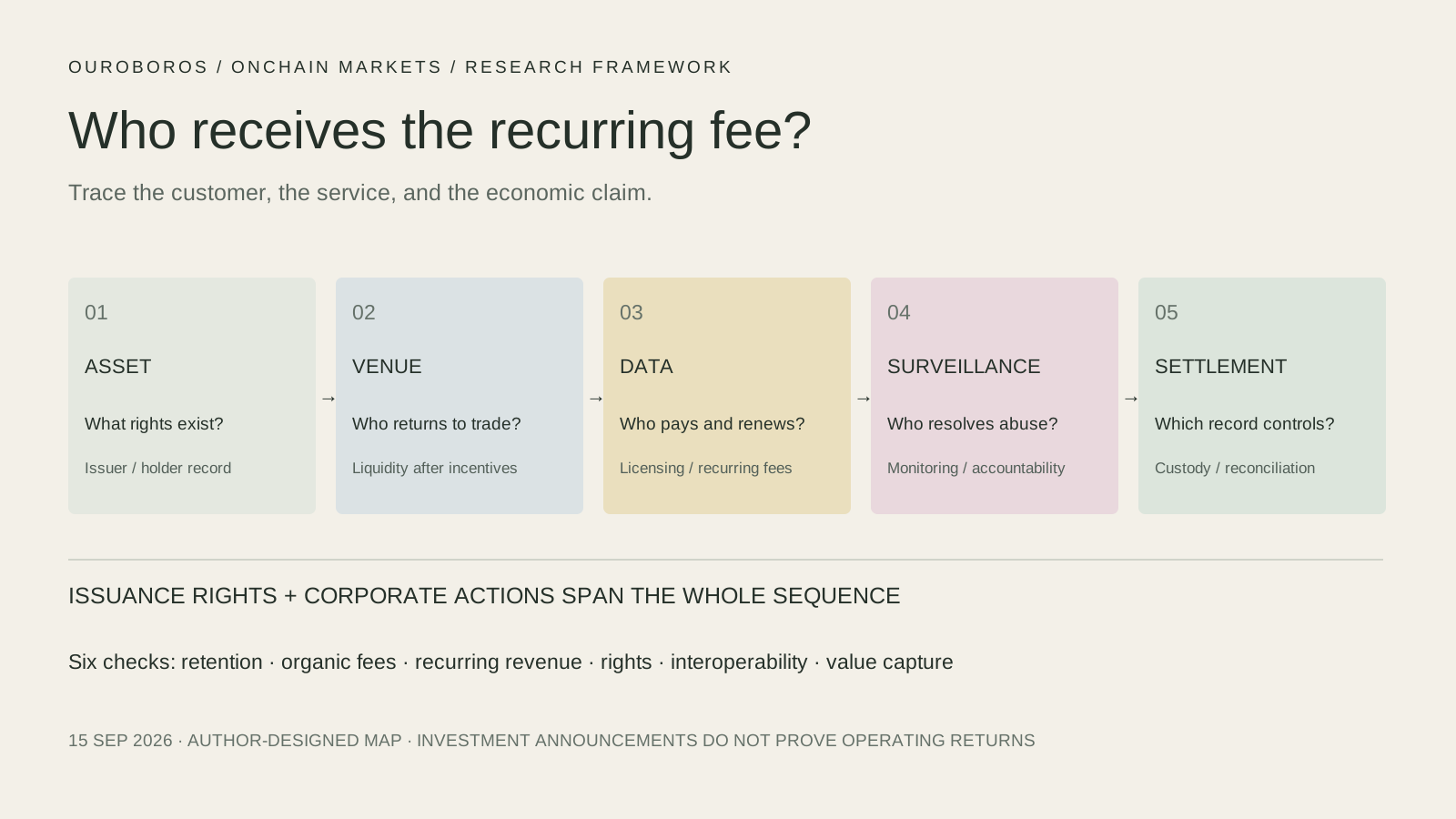
Author-designed market map: Asset → Venue → Data → Surveillance → Settlement. Issuance rights and corporate actions span the sequence. This is an analytical framework, not measured market share or a claim that every supplier controls every layer.
Understand Hyperliquid’s economic loop
Hyperliquid’s fee documentation describes volume-based fee tiers, maker rebates, and allocations to HLP, the assistance fund, and deployers. It says the assistance fund converts trading fees into HYPE through L1 execution and burns the acquired tokens. Those rules make the route from trading activity to token supply unusually inspectable. They do not establish a guaranteed return to a buyer at any price.
The integration is the interesting mechanism: trading, liquidity incentives, execution infrastructure, and a defined fee destination operate within one system. For this research, I would follow the sequence from retained users to completed trades, fees after incentives, and the actual destination of value. A large volume number only illuminates one part of that sequence.
Another distinction comes from the funding documentation: perpetual funding is exchanged between counterparties, and Hyperliquid collects no fee on those payments. Counting funding transfers as protocol revenue would inflate the business. The same accounting discipline should apply when a tokenized venue mixes customer collateral, asset income, settlement movements, and service charges in one dashboard.
Integration has a boundary
The transferable lesson is to identify the complete economic loop. Replicating a token, fee percentage, or trading interface would reproduce only its surface. A new market needs customers willing to return, liquidity that remains useful during stress, and a service whose costs can be covered without endlessly subsidizing demand.
Regulated equities add a different set of dependencies. A project must explain how the instrument’s stated rights connect to issuer or intermediary records, how distributions are handled, and who resolves discrepancies. A technically successful transaction can still leave an operations team with an unresolved economic claim. That possibility belongs in diligence before assigning a network-effect premium.
Vertical integration also creates a tradeoff. A tightly connected system can reduce coordination costs, while an institution may prefer independent valuation or multiple suppliers for resilience. I would test whether customers value an integrated bundle or pay for an independent control layer. The winning structure could vary by customer and asset class; no universal architecture is assumed.
Build a scorecard that can reject the story
I would add an institutional data layer to the Next Hyperliquid research scorecard. Its purpose is to compare evidence, including missing evidence, across venue and infrastructure candidates. A single blended score would conceal too much at this stage. Six separate questions make disagreement visible and allow a candidate to fail without rewriting the thesis.
First, retained demand: identify paying institutions or returning traders within a defined observation window. Separate affiliated users and promotional campaigns. Second, revenue after incentives: reconcile fees with rebates, token rewards, referral payments, and customer acquisition spending. A provider should explain both the service revenue and the cash expense required to keep it.
Third, recurring enterprise economics: ask for contracted revenue, renewals, gross margin, and customer concentration using consistent definitions. Fourth, data rights: inspect the right to collect, transform, redistribute, license, and retain information. Fifth, regulatory interoperability: establish what the specific product may do, with which counterparties and jurisdictions. Sixth, value capture: identify whether cash reaches equity owners, token holders, operators, or a separate entity.
Missing figures remain UNKNOWN. A partnership announcement can support the relationship column while leaving the revenue column empty. A working group can support evidence of coordination while leaving the product column empty. This is how the scorecard resists a familiar mistake: rewarding the same press release several times under different headings.
Price the service without inventing revenue
Consider a deliberately hypothetical data supplier with 20 customers paying $50,000 annually. That produces $1 million in annual contracted revenue. If five customers leave and nothing else changes, the figure falls to $750,000, a 25% decline. These inputs are invented to illustrate concentration and retention; they are not estimates for Kaiko or any other named business.
Now suppose annual data licensing and delivery cost $400,000 before the departures. The starting contribution is $600,000 before other operating expenses. If those costs stay fixed after the loss, contribution falls to $350,000. Revenue declines by a quarter while contribution declines by approximately 41.7%. Contract structure determines how much apparent recurrence translates into resilient economics.
The same questions apply to a venue. Fees should be measured after the incentives needed to retain useful liquidity. Trading volume purchased through subsidies can disappear when the budget changes. I would compare cash generation over consistent periods and disclose which costs remain outside the measure. An attractive gross fee figure deserves a reconciliation before it deserves a valuation multiple.
Data can be defensible and still disappoint
A data supplier’s potential advantage comes from solving a problem customers struggle to replace. That could involve reliable normalization, licensed distribution, useful history, operational integration, or accountability when a valuation is challenged. This is my proposed diligence checklist; it is not evidence that a particular vendor already possesses each advantage.
Open data can reduce the scarcity of raw observations. Customers may nevertheless pay for consistency, timeliness, rights, and service. The underwriting question is whether those benefits command a durable price after competitors reproduce the basic feed. I would ask which customer workflow breaks during a replacement and how long a credible migration actually takes.
There is also a bargaining problem. Large institutions can support a common provider while demanding low prices and broad interoperability. A working group may expand a market’s usefulness without concentrating profits in its organizer. Institutional adoption and supplier pricing power therefore require separate evidence. Both can grow together, but one cannot be assumed from the other.
Put falsifiers ahead of catalysts
The first falsifier is a mismatch between advertised exposure and documented rights. If the instrument cannot substantiate the claim being sold, the attractive interface does not repair it. The second is unusable liquidity: spreads, depth, or exits that deteriorate precisely when customers need them. The third is dependence on incentives that exceed the service’s sustainable revenue.
The fourth concerns enterprise conversion. A sequence of pilots and working groups that produces no identifiable paid product should weaken the commercial thesis. The fifth is value leakage: an ecosystem can become important while the security or token being evaluated receives little of its economics. These are reasons to reduce confidence, not merely footnotes to a bullish story.
Catalysts come afterward. I would watch for confirmed investment completion, dated product delivery, named paying customers where disclosure is permitted, renewal evidence, and published definitions of operating metrics. Each event should update one field in the research record. A new headline cannot silently resolve unrelated questions about ownership, margins, or access to an investment.
The smallest useful next step
Create three research rows: a vertically integrated trading system, a tokenized-market venue partnership, and an institutional data provider. Record the observation date, primary document, legal or commercial entity, economic claim, and the six scorecard fields. Leave unavailable numbers empty with an explicit UNKNOWN reason. No current purchase or accessible private allocation follows from creating these rows.
For one proposed product, trace a single hypothetical asset from issuance through trading, pricing, surveillance, settlement, and a corporate action. At every handoff, name the responsible party, controlling record, fee payer, and unresolved failure case. This paper exercise is READY for research; it has not been presented as a completed operational test or a live transaction.
That is the productive way to ask about the next Hyperliquid. Start with the customer’s repeated problem, identify the supplier paid to solve it, and trace where the money ultimately goes. A venue may win. A data company may win. The research becomes useful when it can distinguish both possibilities from a popular token whose economic claim remains unclear.
Categories and keywords
Categories: Digital Market Infrastructure; Capital Allocation; Tokenization.
Keywords: institutional data layer, organic fees, recurring revenue, data rights, market surveillance, settlement, value capture.
Hashtags: #Hyperliquid #Tokenization #MarketInfrastructure #FinTech #Ouroboros
Independent context: Reuters via The Star also reports the agreement to invest; this corroborates the announcement, not investment closing.