01 · AI Circularity Ledger
Building Organizational Memory for AI Agents
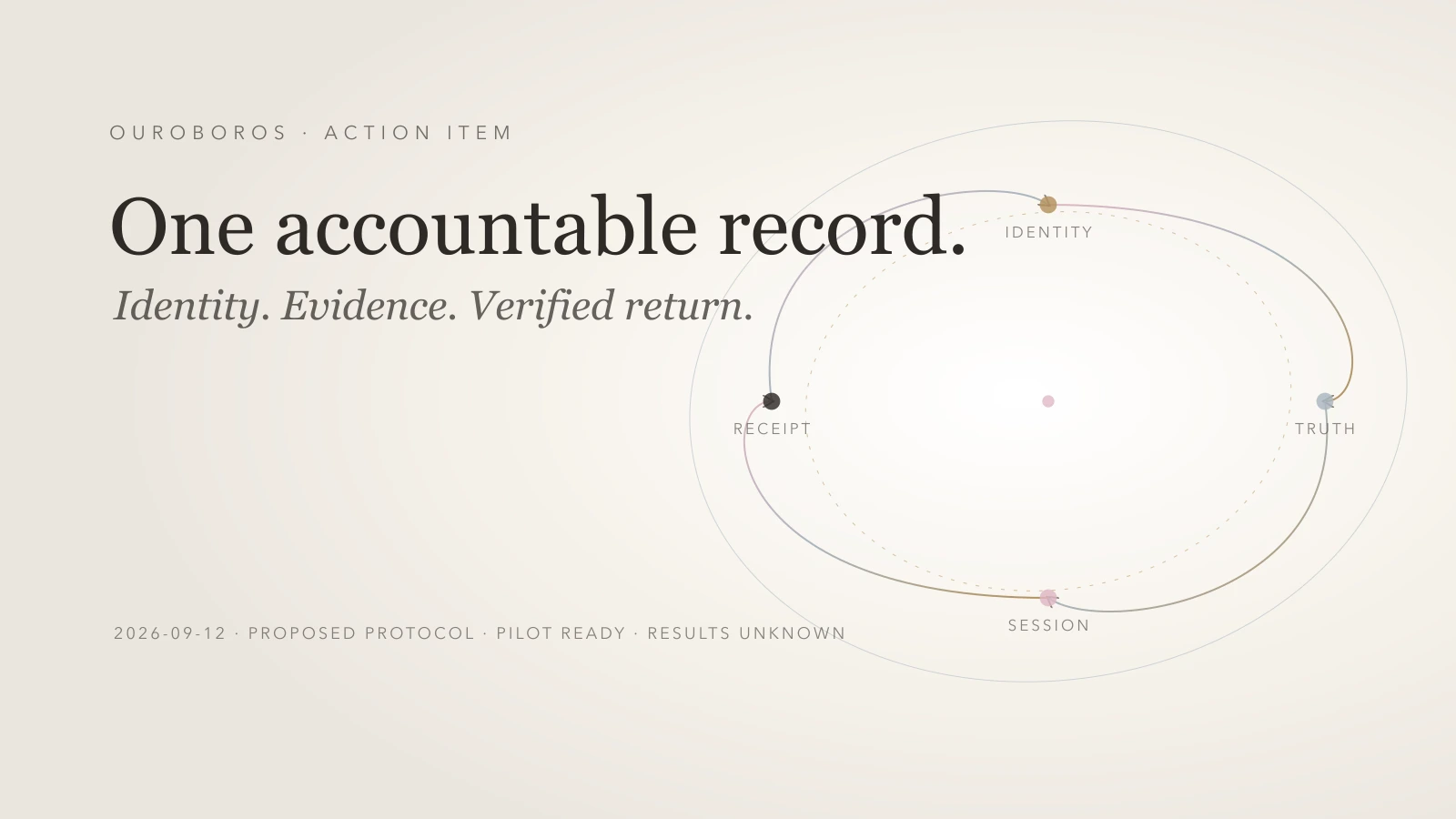
A commercial loop with a scoreboard.
The conclusion is straightforward: an AI-native company needs one accountable record of its work, even when its agents remember different conversations. Identity establishes who owns the decision. Versioned project records establish what currently governs the work. A verified return receipt establishes what actually happened. Connect those three, and memory becomes useful organizational infrastructure.
The distinction becomes visible in a small publishing operation. A founder discusses an idea in ChatGPT, develops it with Codex on a laptop, and publishes it from a workstation. Each conversation can sound perfectly informed. Yet one may remember an abandoned title, another may recall an earlier permission boundary, and a third may know that the article built successfully without knowing whether readers can reach it. The founder becomes the integration layer, carrying corrections between machines.
That is an illustrative failure pattern, rather than a measured account of every host in RobinOS. It explains the operating problem behind today’s assignment: how can a one-person company accumulate reliable knowledge without making its owner repeat the same identity, decisions and completion checks in every conversation?
Identity comes before memory
Robin’s public identity already offers a concrete starting point. The identity page connects Bin Xie with the professional and publishing name Robin Xie and the corresponding Chinese forms. An organization should preserve the evidence supporting that connection. A model recognizing similar names is insufficient grounds to merge two people, profiles or operating histories.
The source brief places iamrobin.ai, iSunTV, TideiSun and LinkedIn in the same identity discussion. They are distinct surfaces with different purposes. A personal publication, a corporate record and a professional profile may refer to the same person while describing different periods or responsibilities. An organizational record needs dated relationships, rather than a single paragraph that flattens every affiliation into the present tense.
My proposed identity registry would give the person a stable identifier, attach approved names and public links, and record who verified each relationship and when. It would distinguish an owned domain from an employer, a historical role from a current one, and a public author name from a credential used to operate a service. Changes would retain their predecessor and the reason for revision.
This is a proposal for record design, not a new identity verification or a change to Robin’s public accounts. A useful registry can begin with a handful of already approved entries. Uncertain matches stay unresolved. The same discipline that prevents duplicate customer records also prevents an agent from confidently combining two lives because their search results look convenient.
Three records with different jobs
OpenAI’s Memories documentation distinguishes ChatGPT memory from local Codex memory and says local updates happen in the background. Required guidance belongs in repository instructions or checked-in documentation. The practical inference is that recall should help locate governing evidence; it should never be the sole place a company records a binding decision.
I would separate three layers. The identity registry answers who the principal is and which relationships are confirmed. Versioned organizational memory contains current project decisions, ownership, evidence references and superseded records. Session or cognitive memory carries working context, tentative interpretations and useful reminders. Those layers can point to one another without sharing the same authority.
Consider a publishing destination. A session may remember that a draft was intended for a particular page. The project record should identify the approved canonical destination and revision. The release receipt should identify the bytes that reached that destination and the checks performed there. The three records answer intention, governing decision and observed outcome respectively.
This separation also makes correction affordable. A wrong recollection can be discarded without rewriting the accepted project record. A changed project decision can supersede an older revision without pretending the older decision never existed. An invalid receipt can be challenged with the evidence it cited. Each layer has an owner and a way to become stale.
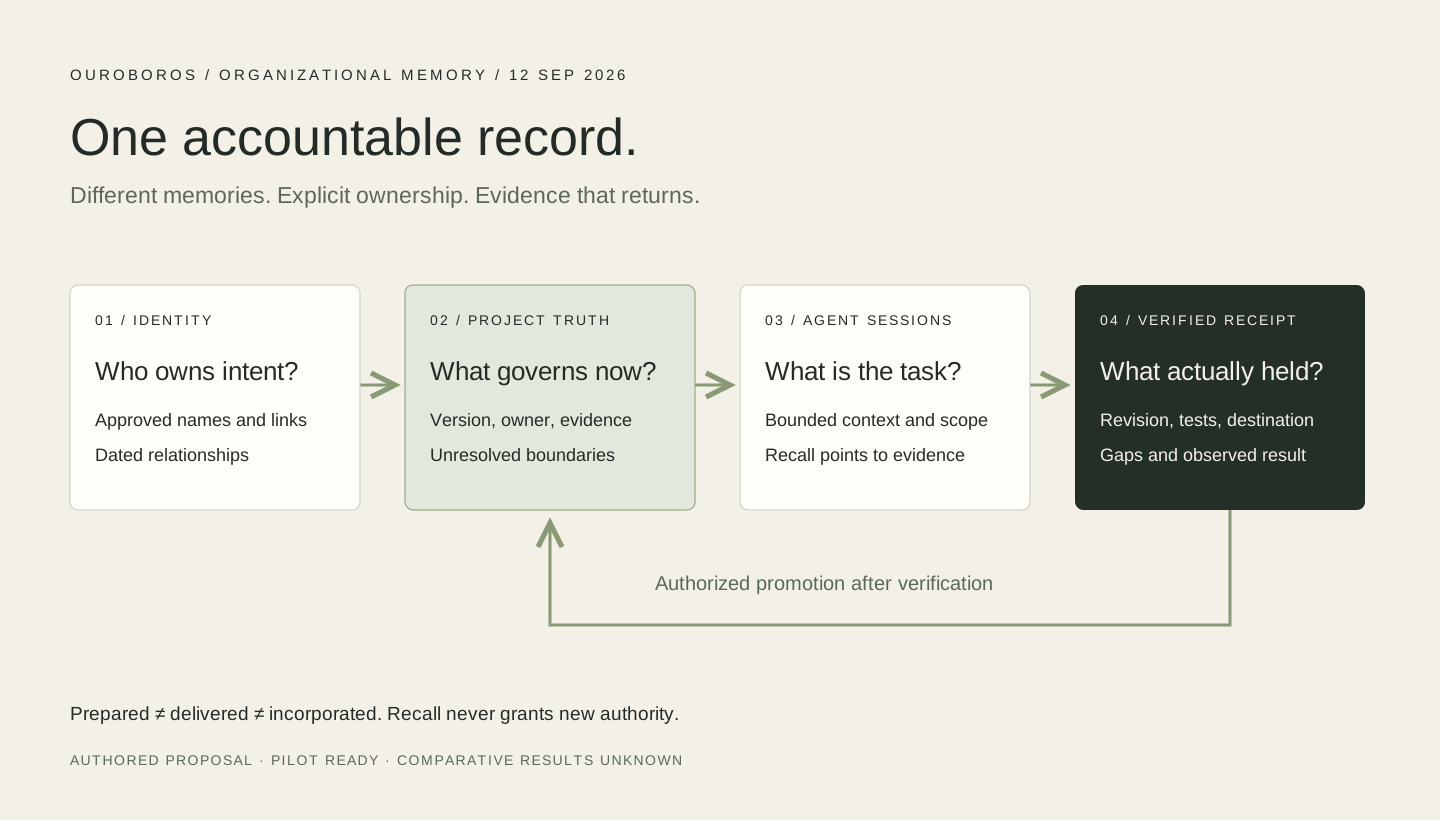
The diagram is an authored operating proposal. Its arrows describe permitted information flow and verification boundaries; they are not evidence that cross-host synchronization has been implemented or that every agent currently reads the same state.
Keep the governing record small
A larger instruction library can create a smaller attention span. OpenAI’s Astra guidance warns that excessive or conflicting skill descriptions can undermine selection and that detailed recipes may overconstrain capable models. The organizational response is to clarify ownership and retrieval, rather than copy every historical lesson into the root prompt.
The proposed project record has a compact front page: intended outcome, current decision, owner, evidence date, unresolved questions and next authorized action. Supporting artifacts hold the detail. A new session should be able to discover why a decision exists without loading an entire archive before correcting a sentence.
OpenAI documents scoped instruction discovery in its AGENTS.md guide. That gives teams a concrete place to express project expectations. It does not make every line in a repository equally authoritative, nor does it turn an external article into permission. The organization still needs to distinguish governing instructions, task evidence and untrusted content.
For a one-person company, simplicity has an economic purpose. Every duplicated rule creates another location that can lag behind a decision. Every mandatory reading ritual consumes time that should produce useful work. Keep the invariant rules few, place operating detail with its project, and retain old evidence as history rather than repeatedly promoting it into the present.
Give each host a bounded view
Sharing organizational truth does not require copying every local memory folder between computers. That approach would also copy private context, stale preferences and host-specific assumptions. A safer design distributes a bounded project snapshot with an explicit version, source owner and sensitivity label. The receiving agent knows what it received and what it has not verified.
RobinOS’s current local governance design names a canonical archive and explicit handoff routes. This article does not alter those routes or claim a fresh connectivity test. Its broader lesson is portable: choose where a record becomes authoritative, then make distribution follow the permitted direction. Connectivity, a friendly agent name and a successful file transfer do not themselves create publication authority.
Before a host performs consequential work, it should compare its project revision with the authorized source. If that comparison is unavailable, it should state the freshness limit and continue independent preparation where possible. An old snapshot may support understanding a design. It is weaker evidence for today’s destination, permission or live operating status.
Concurrent changes need a visible owner. If two agents revise the same record, preserve both proposals and reconcile them against the governing intent. Quietly accepting the latest timestamp can erase a valid decision made elsewhere. For a small operation, a single owner of each change is often easier to inspect than an elaborate automatic merge policy.
Make the return trip mandatory
The publishing loop provides a practical test. A Daily Brief or Daily Special supplies an assignment. Codex turns it into an article package. Content, language, build and public-route checks establish successive facts. A GPT Handoff receipt then returns a distilled result to the next conversation. Each transition should carry enough evidence to prevent the receiving agent from upgrading a claim by repetition.
The previous Action Item developed the related question of recovery after failure. Today’s extension is organizational: the result of a recovered task should enter the company record with its evidence and limits intact. A success-shaped message cannot replace a destination check simply because another agent wrote it.
A useful return receipt contains the task identifier, approved scope, source revision, artifact revision, checks actually run, external destination and observed result. It also states unresolved gaps, any remaining operation, and what would invalidate the result. Private operational references stay in the private archive; the shareable handoff includes only the evidence appropriate to its audience.
Receipt preparation, delivery and incorporation are separate events. A file ready for ChatGPT is not proof that ChatGPT received it. A delivered handoff is not proof that a future memory update incorporated it correctly. The record should preserve those distinctions and never mark a general memory change complete merely because an article describes one.
Separate completion from learning
Publication is a concrete outcome. Learning from publication is another outcome. Combining them into a single status makes either too easy to misreport. The article may be live while a downstream research ledger remains pending. A proposed operating lesson may be valuable while its benefit remains untested. Both can be recorded honestly without undoing the verified release.
OpenAI’s subagent documentation describes bounded delegation and warns that parallel writing can increase conflict and coordination costs. A useful organizational memory system therefore needs a responsible integrator. Individual agents return findings and evidence; the task owner reconciles them before updating the accepted project state.
My proposed learning record separates observation, hypothesis, decision and experiment. An observation might be that a publisher resumed from an accepted immutable source. A hypothesis might be that explicit receipts reduce repeated founder explanation. A decision might authorize a bounded trial. Only the trial’s result can support a claim about the time saved.
This prevents a common form of organizational mythology: one task succeeds, a summary declares the architecture proven, and later agents cite that summary as a benchmark. Store the actual task and the limits of inference. An organization compounds judgment by remembering why a conclusion was justified and when it needs another look.
Test what Murphy would break
Start with stale memory. Give a test session an older destination and a newer approved project revision. The expected behavior is to identify the conflict, select the governing revision within its authority and retain the obsolete reference as history. A smooth explanation followed by publication to the old destination is a failed test.
Next test a false identity merge. Supply two synthetic profiles with a similar name and one conflicting ownership fact. The system should leave the relationship unresolved, keep the evidence separate and request identity judgment only when the task actually depends on that relationship. Search similarity should never become an authorization shortcut.
Then test host divergence. Give two isolated test workers different revisions of a harmless project record. The integrating process must detect the difference and reconcile it before promoting either result. Measure whether it discovers the mismatch, which evidence controls resolution and how much owner intervention is required. The test must follow existing machine boundaries rather than create a new synchronization route.
Test secret leakage with an unmistakably fake marker in a private fixture. The public-copy and handoff gates should reject that marker. Use synthetic data so the test itself cannot expose a real credential. OpenAI’s Computer History documentation notes that generated local history may contain sensitive information. Richer recall makes audience controls more consequential.
Finally, test false completion. Let the build succeed while the simulated public destination returns a missing page. The receipt should distinguish build success from deployment verification and keep publication incomplete. Add a second case where the page is live but notification delivery remains unconfirmed. Neither a green build nor a prepared message should silently satisfy the remaining gate.
Measure the founder’s integration burden
The proposed pilot is one reversible publication exercise with synthetic failures, an agreed task and a fixed acceptance contract. Record the baseline workflow first. Then introduce the identity reference, versioned project snapshot and return receipt without changing the task difficulty. A result from two different assignments would be difficult to interpret.
Track incorrect identity merges, stale-state use, unresolved host conflicts, unsupported completion claims, time to recover the correct record and founder-intervention minutes. Include the cost of maintaining the records and reviewing rejected handoffs. A protocol that saves explanation while creating more clerical work elsewhere has not yet earned expansion.
No measured reduction in those costs is claimed here. The pilot remains READY, and comparative performance remains UNKNOWN. A useful first success would be modest: another authorized session can locate the accepted revision, explain the unresolved boundary and resume the intended work without asking the founder to reconstruct the history.
Expand only after that bounded result survives a fresh task. Keep the failed cases, revise the smallest rule that explains a recurring failure and test again. Organizational memory deserves the same discipline as an operating system: inspect the state, preserve the evidence and make recovery observable.
One owner and one definition of done
The immediate deliverable is this proposed protocol, its evidence diagram and an inspectable publication return record. The implementation question remains distinct: which records should be promoted, who may change them, and which handoff destinations are authorized? Answer those within the existing project and identity boundaries before modifying any shared memory system.
For the next authorized pilot, require five outcomes: the principal is correctly identified; the current project revision is found; host differences are surfaced; completion is supported by destination evidence; and the return receipt reaches its intended authorized record without private leakage. A single unresolved condition should remain visible rather than disappear into a confident summary.
An organizational brain becomes credible when its agents can disagree with their own recollection and return to evidence. The company then retains more than a conversation. It retains an accountable chain from intent to decision to verified work, with a clear place for the next correction.
Categories and keywords
Keywords: organizational memory, identity registry, Codex, ChatGPT, verified receipts, project truth.
Categories: Artificial Intelligence; Operating Systems; Organizational Design.
Hashtags: #AgenticAI #OrganizationalMemory #RobinOS #Ouroboros