01 · AI Circularity Ledger
Equity Before Orders
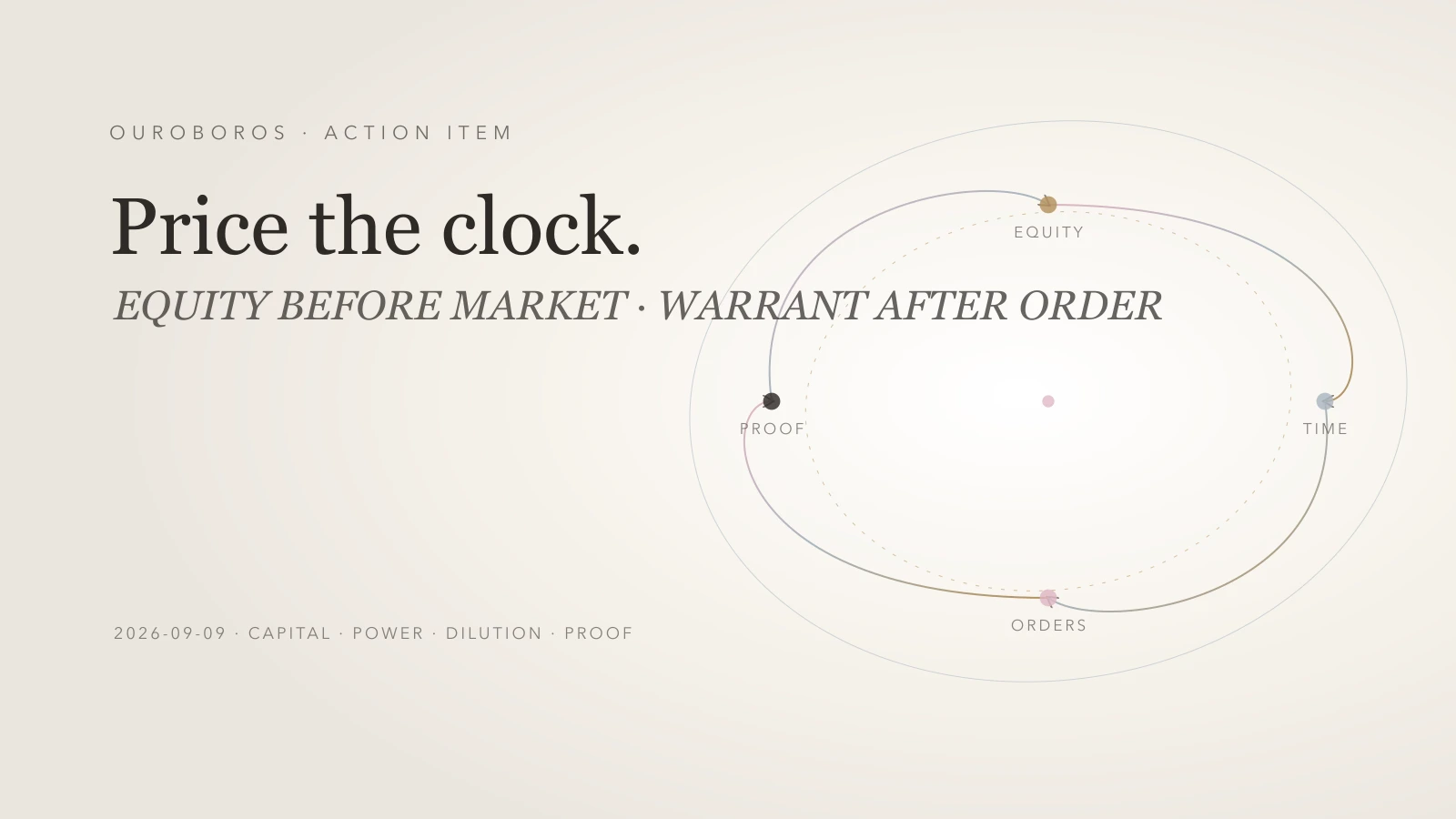
A commercial loop with a scoreboard.
Two strategic bets with different clocks
The conclusion is direct: early platform equity and procurement warrants belong in separate underwriting lanes. Both can align a technology supplier with a powerful customer. Both can create extraordinary upside. Their clocks, bargaining positions, cash commitments and failure modes differ enough that a single label such as “strategic investment” hides the decision.
Alphabet’s 2015 SpaceX investment bought equity before the full market was legible. Google disclosed a $900 million investment made to support innovation in space transport, reusability and satellite manufacturing. More than a decade later, Reuters reported that Alphabet’s 551.2 million shares were worth about $94.2 billion on June 30, 2026. That value was a market mark rather than fully realized cash. The original check still acquired exposure before Starlink, cloud integration and orbital AI research had become visible parts of the strategic map. Google 2014 annual report. Alphabet stake analysis.
The Amazon–Qualcomm and Google–Marvell arrangements begin later. Amazon and Google already control enormous procurement budgets. Their suppliers already need customer commitments, product qualification and purchase volume. Equity upside is released as commerce advances. Qualcomm’s filing grants Amazon warrants for up to 25 million shares at $161.26 per share. Marvell’s filing grants Google warrants for up to 58,970,907 shares at $206.58 per share. Each contract uses vesting to connect customer economics with supplier revenue. Qualcomm 8-K. Marvell 8-K.
The investor’s first task is therefore classification. Equity before market formation purchases uncertainty and duration. A warrant after procurement converts existing customer power into contingent ownership. Mixing the two leads to bad comparisons and weak governance.
Equity before the market buys possibility
The SpaceX investment shows how strategic equity can compound across applications. In 2015, reusable launch was the primitive. Lower launch cost and higher cadence could support satellite manufacturing, a communications constellation and other orbital services. Google did not need to specify every future product to understand that cheaper, more reliable access to orbit could open several valuable systems.
That possibility later became more concrete. Google Cloud and SpaceX announced in 2021 that Starlink ground stations would be located at Google data-center properties, connecting satellite edge infrastructure with Google’s private network and cloud services. The public announcement confirms a technical and commercial bridge. Revenue sharing, utilization and margin remain undisclosed. Google Cloud and SpaceX announcement.
Google’s Project Suncatcher later added a research path for solar-powered satellites carrying TPUs. It does not establish a SpaceX launch contract or commercial orbital-compute business. It does show how a launch primitive, a satellite network, cloud infrastructure and AI demand can occupy adjacent coordinates over time. Project Suncatcher.
This lane requires tolerance for long periods without clean valuation or liquidity. The owner pays cash early, accepts dilution and governance constraints, and depends on the company surviving technical and financing cycles. The reward can be exposure to markets that did not exist in the original model. The risk is equally large: possibility can remain a story while capital stays trapped.
An early-equity scorecard should ask five questions. Which foundational constraint falls if the technology works? Does cumulative engineering improve the primitive? Which adjacent markets become feasible? Can the owner finance the duration? Which operating bridges have moved from narrative to paid activity? The first three establish strategic option value. The last two determine whether the owner can remain present long enough to receive it.
Warrants after procurement price customer power
A procurement warrant begins from a different bargaining position. The customer may already have scarce demand, design influence and the ability to validate a new supplier. The supplier wants a long purchasing relationship and may use equity to make the customer care about enterprise value as well as unit price.
Qualcomm disclosed that 3.75 million Amazon warrant shares vested from initial purchase commitments. The remaining shares vest through commercial arrangements, orders and actual payments, with the final ceiling linked to as much as $60 billion of payments. That ceiling is a vesting condition. It is not contracted backlog, recognized revenue or free cash flow. The distinction matters because headlines can convert a conditional maximum into an imagined order book.
Marvell’s structure makes the clock even more visible. Its filing says 1,360,867 shares vest in equal quarterly installments during the first year, while the remaining shares vest through 240 tranches of $500 million in qualifying Custom Products revenue from the third quarter of fiscal 2027 through fiscal 2033. Fully vesting those performance shares would therefore correspond to $120 billion of qualifying revenue. The warrant expires in August 2033. Marvell warrant agreement.
The supplier gains potential volume, reference-customer validation and deeper technical coordination. It also grants a transfer of value. Existing shareholders bear dilution if shares vest and are exercised. Commercial accounting may reduce reported revenue or margins through warrant-related charges. Engineering capacity can become concentrated around one buyer. A large customer may receive both procurement leverage and equity upside while the supplier still carries execution risk.
This lane should therefore be underwritten from the purchase order outward. Track committed orders, actual purchases, qualifying revenue, vested shares, exercise economics, accounting treatment, gross margin, customer concentration, working capital and cash conversion. The warrant earns strategic credit only when commercial activity clears those gates.
Cash and control move in opposite directions
The cleanest contrast concerns who contributes cash and who already controls the relationship.
In early equity, the strategic investor transfers cash into a company whose market may still be forming. The investor receives ownership and accepts that the technology, customer base and financing path can fail. Its leverage comes from capital, strategic access and patience. The founder and company retain substantial control over operating direction.
In procurement warrants, the customer often contributes purchasing intent before it contributes the full amount of cash represented by the vesting ceiling. Its leverage comes from future orders, qualification and market validation. The supplier grants contingent ownership to secure or deepen the relationship. The customer can gain equity while paying for products it wanted to buy. That creates an economically powerful double position.
The customer still faces risks. It may tie an important architecture to a supplier that misses performance, yield or delivery targets. Warrant value may fall even when the supplied product remains necessary. A diversified customer must also avoid distorting procurement decisions merely to protect an equity position. Governance should keep technical qualification and total-cost decisions independent from mark-to-market enthusiasm.
The supplier faces a sharper concentration problem. A large headline can improve market perception while the future economics remain conditional. If the product carries weak margin, high custom-engineering expense or expensive working capital, revenue can grow without attractive returns. If the customer earns warrants as purchases rise, the supplier must create enough incremental enterprise value to exceed dilution and execution costs.
A five-column underwriting bridge
Robin’s investment framework can compare these structures without pretending they are identical. Use five columns: time, power, cash, dilution and realized synergy.
Time records when exposure begins and what milestones unlock value. Early equity starts before the market and may wait a decade. Procurement warrants start after commercial negotiation and use a contract-defined vesting period.
Power records the parties’ bargaining position. A young platform may hold scarce technical capability while needing capital. A hyperscaler may hold scarce volume, product validation and design influence. The source of power predicts who can demand optionality.
Cash separates invested capital, committed purchases, actual payments, recognized revenue and free cash flow. Alphabet’s $900 million was an investment. Qualcomm’s $60 billion is a payment-linked ceiling across conditions. Marvell’s $120 billion is implied by 240 revenue tranches. These quantities occupy different rows in any responsible model.
Dilution records the fully diluted share effect, exercise price, vesting probability, accounting treatment and value transferred to the customer. It must be compared with incremental gross profit and cash generation. Revenue alone does not pay for dilution.
Realized synergy records operating bridges that moved into production. The Starlink–Google Cloud integration is a confirmed bridge with undisclosed financial materiality. Qualcomm inference chips and optical connectivity need actual shipment, revenue and margin evidence. Marvell’s TPU-related custom products need qualifying revenue and cash conversion. Research, prototypes and agreements stay lower on the evidence ladder.
Each column carries a status: CONFIRMED, COMPANY_DISCLOSURE, UNKNOWN or FALSIFIED. A total score without those states would manufacture precision.
The paper gain cannot carry the thesis alone
Alphabet’s roughly $94.2 billion mark creates a powerful anchor. It also tempts the analyst to read every later relationship through the success of one early bet. That would ignore base rates and structure.
The SpaceX outcome combines selection, ownership duration, technical progress, market creation and a public valuation event. It does not prove that every strategic minority investment compounds possibilities. Many primitives fail, dilute heavily or never create a second market. A complete dataset would include write-offs, forced sales and partnerships that never became material.
Procurement warrants have their own seductive headline. Multiplying maximum shares by an exercise or market price produces a large number. The customer receives that full upside only if vesting conditions are met and the share value exceeds the exercise price. The supplier receives the required commerce only if orders, payments or qualifying revenue occur. The maximum should be labeled ceiling rather than backlog.
For the Amazon–Qualcomm case, the first proof is the 3.75 million vested shares linked to initial commitments. The next proof is disclosed purchases entering Qualcomm data-center revenue and profit. For Google–Marvell, the first proof includes the time-based grant and contract. The next proof is qualifying Custom Products revenue, vesting and durable cash return after the engineering and concentration burden.
An honest comparison therefore resists a single return number. Early equity can be marked to market while remaining unsold. A warrant can be unvested, vested, exercisable, exercised or sold. A purchase can be announced, committed, paid, recognized as revenue or converted to cash. The ledger should preserve every transition.
Governance keeps alignment from becoming extraction
Strategic alignment is valuable when both parties create more total value than either could create alone. It becomes extraction when one party uses bargaining power to claim upside without covering the cost imposed on the other.
The customer’s governance controls should include independent product qualification, a prohibition on counting uncommitted ceilings as backlog, conflict review when procurement choices affect warrant value, and disclosure of exercise or sale decisions. The supplier’s controls should include board review of fully diluted value transfer, margin floors, concentration limits, milestone definitions, termination effects and accounting treatment.
Both parties need an evidence trail from contract to cash. A purchase milestone should link to the relevant order, payment, recognized revenue, vested shares and resulting dilution. A strategic-synergy claim should link to a deployed product, customer use, economics and renewal. General relationship language cannot substitute for those artifacts.
This framework also clarifies Robin’s authority. The Daily Briefing assigns research, publication and monitoring. It authorizes no trade, private-market purchase, warrant exercise or capital commitment. Qualcomm, Marvell, Alphabet and Amazon remain research subjects. Any investment decision requires a separate current thesis, valuation, portfolio fit and explicit capital authority.
Publish the comparison and watch the conversion
The immediate result is a reusable comparison rather than a one-day trade. The existing Google × SpaceX analysis should carry the broader title and a new section separating early equity from procurement warrants. The existing Google–Marvell analysis supplies the detailed contract anatomy. This Action Item connects them to Amazon–Qualcomm and defines the common ledger.
The quarterly monitor needs two lanes. The early-equity lane records cost, ownership, dilution, current mark, realized proceeds and operating bridges. The procurement-warrant lane records orders, payments, qualifying revenue, vested shares, exercise status, dilution, margin, concentration and cash conversion. Cross-links preserve the shared strategic thesis while the fields prevent category error.
Upgrade the possibility-compounding thesis when the underlying capability creates another paid operating surface and the owner retains meaningful exposure. Upgrade the warrant thesis when purchases convert into profitable revenue and the incremental enterprise value exceeds dilution and execution cost. Downgrade when option stories multiply faster than deployed products, or when customer power transfers more value than the supplier earns.
The most useful capital questions remain simple. Who paid first? Who already held bargaining power? Which milestone moves cash? Which milestone moves ownership? What has reached operation? Who carries the loss when the future arrives late?
Answer those questions and the two structures become legible. Early equity owns a possibility before its map is drawn. Procurement warrants price a commercial relationship after the buyer can already see the road. Both can compound. Their evidence should never share a clock.
Categories and keywords
Categories: Capital Allocation; Artificial Intelligence; Strategic Finance; Public Equities
Keywords: Alphabet; Google; SpaceX; Amazon; Qualcomm; Marvell; possibility compounding; procurement warrants; strategic equity; AI circular financing; customer concentration; dilution; qualifying revenue; cash conversion
Hashtags: #CapitalAllocation #AIInfrastructure #StrategicFinance #Alphabet #SpaceX #Qualcomm #Marvell #Investing