01 · AI Circularity Ledger
The Junk Asset With Grid Access
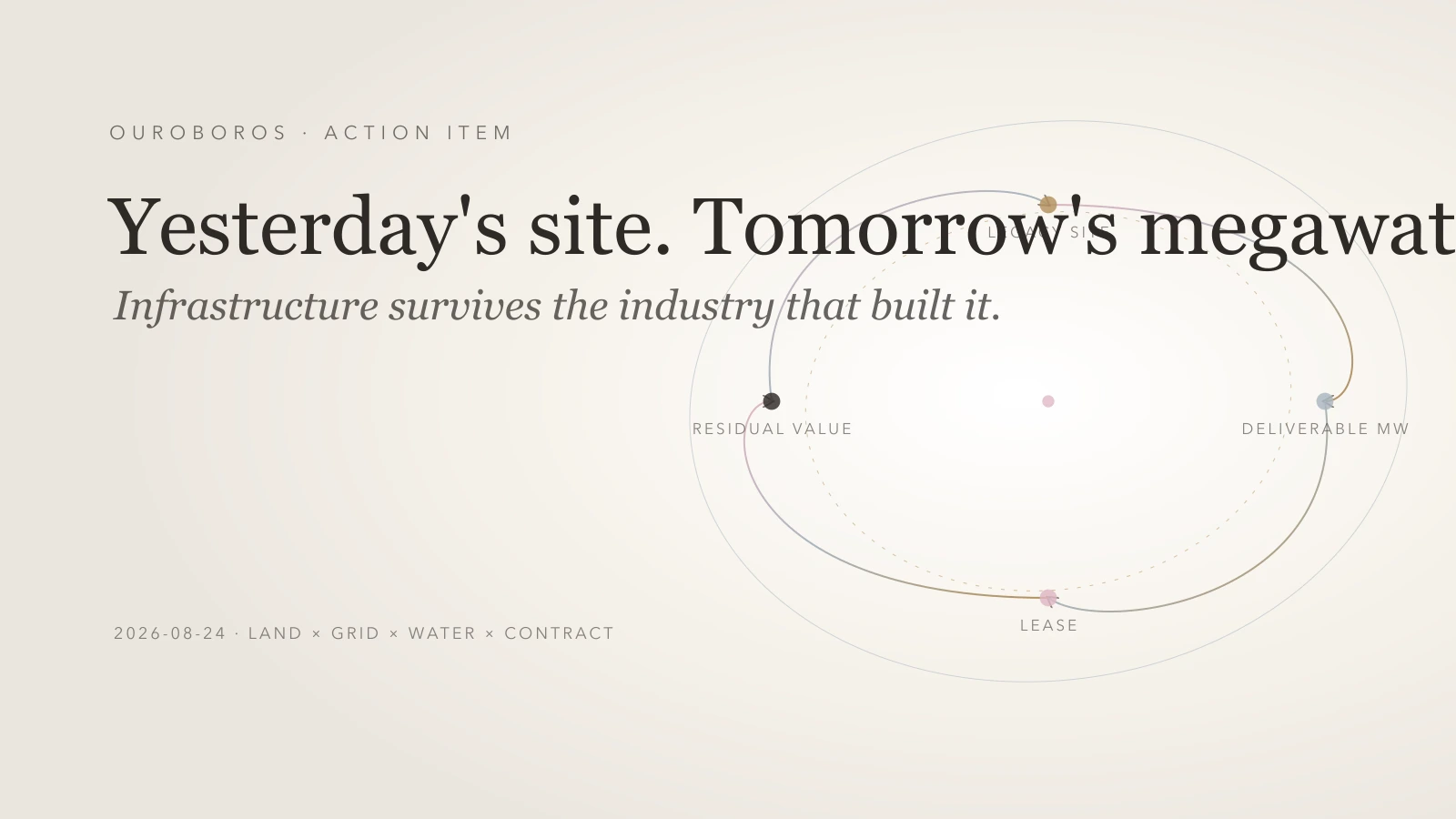
A commercial loop with a scoreboard.
The conclusion is hidden in the switchyard
The conclusion is direct: yesterday’s industrial waste can become tomorrow’s AI infrastructure advantage when the site already controls power, water, transport, permits, and a credible path to delivery.
PORTS-Pike turns that sentence into an 8-gigawatt investment case. A former uranium-enrichment complex in southern Ohio may host one of the largest AI campuses in the world. OpenAI says it has agreed to secure about 8 IT-GW under a 20-year lease. The first 800 MW is expected in 2028, largely through existing American Electric Power infrastructure. NVIDIA says it will invest $1.5 billion in SB Energy, supply the exclusive compute stack, and provide credit support for land, power, and shell construction tied to the first 4.25 IT-GW. Reuters reports that the guarantee ceiling could reach $105 billion.
The large numbers attract attention. The more durable insight sits beneath them. Portsmouth received its first industrial life because uranium enrichment demanded abundant water, reliable electricity, transport links, labor, and large secure acreage. AI requires a surprisingly similar physical envelope. The original process has disappeared. Much of the infrastructure logic survived.
That survival creates an investable form of optionality. A property labelled obsolete may hold assets whose replacement takes years: grid position, substation capacity, gas access, water rights, fiber routes, rail, roads, industrial zoning, environmental records, and a community accustomed to heavy industry. The land value can remain ordinary while the delivery value becomes extraordinary.
My decision is BUILD: INDUSTRIAL_RECLASSIFICATION_LEDGER.
A site remembers what it was built to do
Portsmouth was selected in 1952 for reasons that look contemporary. The Department of Energy’s site history highlights abundant water, reliable electric power, transportation routes, and labor. The federal site covers more than 3,700 acres and contains hundreds of structures and facilities. A separate DOE site appendix describes 2.2 GW of PJM design capacity, 40 million gallons per day of water, 54 miles of road, 12 miles of rail, and proximity to the Scioto and Ohio rivers.
These facts do more than describe an old plant. They explain why the asset can re-enter the economy.
Industrial infrastructure often outlives its founding product. The switchyard still connects to a network. A rail spur still reaches a freight corridor. A water system still reveals a permitted or engineered route. An industrial parcel still carries a history of intensive use. Even when each component needs expensive rehabilitation, its existence shortens the distance between a concept and a delivered megawatt.
That time difference has become valuable. AI developers can announce a campus in an afternoon. They earn revenue after land control, utility studies, generation, transmission, permits, financing, buildings, cooling, hardware, and commissioning line up. Years can separate the press release from the first useful token. Existing industrial sites compress selected links in that chain.
Investors should therefore distinguish raw acreage from inherited infrastructure. A cheap field with a hopeful power request is land speculation. A legacy site with documented grid assets, water, access, remediation boundaries, and credible counterparties is a different security. Both can fail. Their failure modes, timelines, and residual values differ materially.
Deliverable megawatts are the real unit
Nameplate power is easy to quote. Deliverable megawatts require evidence.
I would underwrite a legacy industrial site with one compact equation:
Reclassification value = deliverable MW × COD probability × contractability − remediation − upgrades − community risk
Deliverable MW means capacity that can reach the tenant at the agreed date, voltage, reliability, and cost. COD probability captures the chance that generation, transmission, permits, construction, and commissioning arrive together. Contractability asks whether a creditworthy customer will sign terms that lenders can finance. The deductions capture the industrial past and the political future.
PORTS-Pike provides unusually strong contractual signals. OpenAI describes a 20-year lease and says payments begin only as completed capacity becomes available. NVIDIA has attached capital, exclusive technology supply, and credit support to the first phase. SB Energy builds, owns, and operates the site. Those roles create a visible relationship map: federal land and legacy infrastructure flow into a developer; the developer delivers land, power, and shell; NVIDIA supplies the compute platform and credit support; OpenAI becomes the long-term user.
The map also reveals circularity. NVIDIA helps support the infrastructure through which OpenAI will buy NVIDIA systems. Revenue can remain real while the financing network helps create the demand. This mechanism belongs beside the Google–Marvell warrant case and the Broadcom credit loop in the AI Circularity Deal Ledger. Each structure requires its own cash-flow and loss-allocation analysis.
The crucial question is who absorbs delay. If an interconnection date slips, does rent wait? If additional generation costs rise, who funds them? If the tenant uses less capacity, does the lease still cover debt service? If the compute hardware ages faster than expected, does NVIDIA’s support reach the building, the equipment, the lease, or selected obligations? Public materials establish the direction of the structure. Final triggers, caps, remedies, and funded amounts remain UNKNOWN until contracts or filings disclose them.
The old liability still sends invoices
Industrial history carries costs with long memories.
The DOE cleanup strategy records hazardous, radioactive, mixed, and other wastes, plus soil and groundwater contamination. The agency describes regulatory agreements, extensive monitoring, demolition, waste disposal, and continuing remediation. Those obligations cannot be erased by changing the label from uranium enrichment to AI campus.
This is where a seductive real-estate story becomes an infrastructure underwriting exercise. Parcel boundaries matter. Responsibility for historical contamination matters. Construction interfaces with active cleanup matter. Water draw, thermal discharge, noise, transmission lines, gas generation, traffic, and local ratepayer exposure matter. A site can own rare infrastructure and still destroy capital through remediation, schedule, or community conflict.
The right posture is constructive diligence. Legacy conditions create the discount that makes reclassification possible. They also determine which parts of the discount are earned.
I would demand five maps before assigning value:
- Physical boundary: developable parcels, active cleanup zones, easements, flood exposure, and transport access.
- Power boundary: existing substations, firm capacity, upgrade queue, new generation, transmission responsibility, and phased COD.
- Environmental boundary: known contamination, responsible parties, monitoring, waste routes, indemnities, and regulatory milestones.
- Contract boundary: lease commencement, take-or-pay terms, delay allocation, guarantees, security, termination, and step-in rights.
- Community boundary: water, jobs, taxes, ratepayer protection, local procurement, noise, air emissions, and public reporting.
Every blank stays UNKNOWN. A glossy master plan cannot fill a missing interconnection study. A headline guarantee cannot fill undisclosed remedies. A federal partnership cannot fill an unresolved permit.
Paducah proves the pattern can repeat
Portsmouth has a sister case in western Kentucky. NextEra’s Paducah announcement describes a privately funded project of up to $100 billion. The plan targets 1.8 GW of utility capacity and more than 1.2 GW of compute capacity by 2032, backed by up to 4.6 GW of dedicated generation. Brookfield would develop and operate the data-center campus. NextEra would build and own the dedicated generation. Local utilities would provide wholesale and retail service.
The announcement explains why the old enrichment site matters: transmission capacity, water infrastructure, fiber, roads, industrial land, and a workforce history already exist. The new project proposes to add generation in stages and shield existing customers from project power costs. Definitive documents, utility approvals, and execution still lie ahead.
Two former gaseous-diffusion sites attracting giant compute plans form more than a coincidence. They create a screening template.
Search for industrial processes that historically consumed huge electricity, water, land, and logistics. Then ask which sites retain useful infrastructure after the original demand vanished. Aluminum smelters, chemical complexes, steel sites, pulp mills, refineries, coal plants, nuclear-support facilities, and cryptocurrency mines can enter the universe. Their economics will vary sharply. The shared feature is inherited physical capacity.
Texas mining sites deserve special attention. Bitcoin miners often secured land, interconnection positions, substations, power-market knowledge, and curtailment capability before AI load arrived. Some sites may convert. Others lack fiber, water, building design, creditworthy leases, or the reliability profile demanded by AI. The screen should reward deliverability and punish story-driven MW.
Residual value decides whether the loop survives
An AI campus is often described as infrastructure. Part of it behaves like specialized technology.
Land, substations, transmission, gas connections, water systems, roads, and industrial permits can serve multiple users over long periods. Buildings, cooling, electrical distribution, and network architecture have narrower reuse. GPU systems and proprietary clusters age fastest. Financing all layers with one confidence level creates a duration mismatch.
The residual-value test asks what remains useful after the preferred story breaks.
If OpenAI grows more slowly, can another investment-grade tenant absorb the capacity? If a new accelerator needs different cooling or power density, can the shell adapt? If gas or transmission schedules slip, can the first phase operate independently? If a lender takes control, does it receive a functioning campus, a half-built shell, or a contaminated parcel with unfinished interconnection work? If NVIDIA support expires or reaches a cap, which cash flows still cover debt?
The strongest legacy site has layered exit doors. The parcel can serve another compute tenant. The power assets can support another industrial load. Generation can sell into the grid under viable economics. Fiber and transport remain useful. Environmental responsibility stays allocated. The weakest site has a single tenant, a single technology generation, a single delayed power path, and no credible second use.
This residual-value discipline also guards against circular demand. Supplier support can accelerate construction and prove commitment. It can also hide how much independent customer demand exists. A site with robust alternative uses gives the financing loop a floor. A highly specialized campus asks the guarantor and tenant to carry more of the downside.
Build the reclassification ledger
RobinOS should track candidates as a portfolio of claims rather than a collection of exciting maps.
Each site receives one row with the following fields:
| Field | Decision evidence |
|---|---|
| Legacy use | original process, closure date, prior load, ownership |
| Surviving assets | land, grid, generation, gas, water, fiber, road, rail, permits |
| Deliverable MW | phased amount, voltage, reliability, cost, COD, source |
| Conversion scope | remediation, demolition, upgrades, buildings, cooling, transmission |
| Contractability | tenant, lease term, commencement, take-or-pay, guarantees, remedies |
| Community compact | ratepayer protection, jobs, water, emissions, taxes, reporting |
| Residual value | second tenant, alternate industrial use, asset portability, lender recovery |
| Evidence state | CONFIRMED, REPORTED, UNKNOWN, CONFLICTED, or STALE |
The ranking should avoid a single composite score at first. Topology matters more than a polished number. A site with 2 GW of nameplate capacity and a remote COD may rank below a 300 MW site with firm power, permits, a bankable lease, and a reusable shell.
The first comparison set should include PORTS-Pike, Paducah, selected Texas mining sites, and one chemical or metals complex. The purpose is to test the screen across different industrial histories. The output becomes useful to investors, developers, lenders, utilities, local governments, and executives hiring people who can connect all five languages: land, power, contracts, finance, and technology.
That last point is personal. The career opportunity sits inside the investment method. AI infrastructure needs operators who can translate between engineering evidence and capital decisions. A portfolio of reclassification cards shows that ability more clearly than another essay declaring that electricity is scarce.
The next proof
The smallest useful next step is a one-page PORTS-Pike underwriting card linked to this ledger entry. It should record the 8 IT-GW ambition, first 800 MW target, initial 4.25 IT-GW support structure, 20-year lease, parties, surviving infrastructure, cleanup interfaces, phase gates, community commitments, and every UNKNOWN contractual term.
Success has a measurable definition: another investor can read the card in five minutes and identify the asset, power path, customer, credit support, delay owner, environmental boundary, and residual-value exit.
The broader thesis is simple. The AI buildout will create new infrastructure. It will also reveal old infrastructure that the market stopped seeing. The best opportunity may already have a switchyard, a water line, a rail spur, a cleanup file, and an unfashionable address.
Yesterday’s industrial site remembers how to carry load. The investor’s job is to prove how much of that memory can become cash flow.
Categories and keywords
Categories: AI Infrastructure; Industrial Real Estate; Project Finance; Power; Asset Reclassification
Keywords: deliverable megawatts; grid access; PORTS-Pike; Paducah; industrial site reuse; residual value; AI circularity; data-center finance
Hashtags: #AIInfrastructure #ProjectFinance #Power #IndustrialRealEstate #DataCenters #ArtificialIntelligence #InfrastructureInvesting #RobinOS