INVEST · Research → story
Twenty years is not the protection
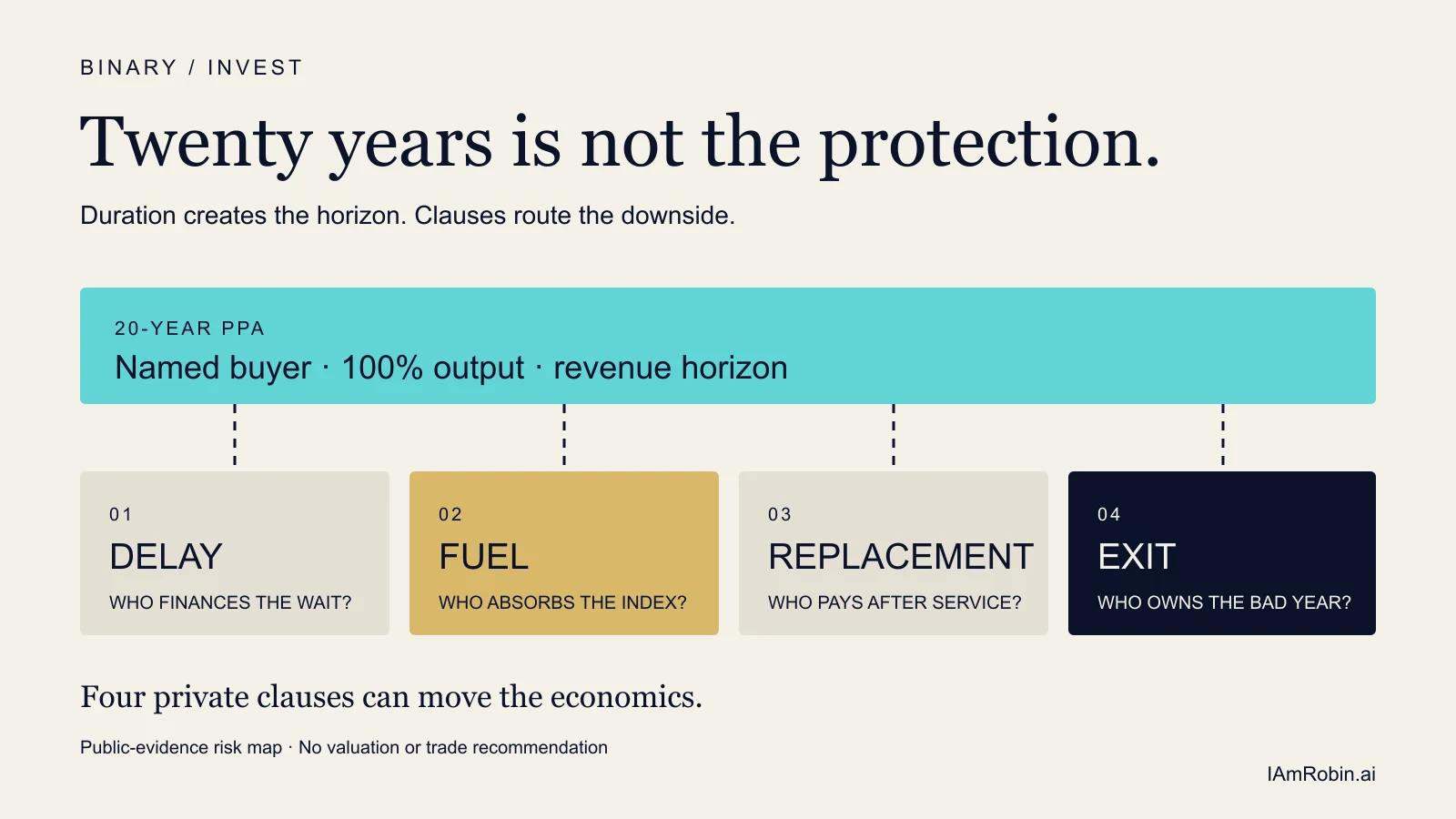
A 20-year PPA gives a $4 billion power project a buyer and a revenue horizon. Its economics still depend on four private clauses: delay, fuel, replacement and exit.
A 20-year contract can make a $4 billion power project look finished before the first shovel touches Wyoming soil.
The buyer is Google. The planned fuel-cell facility is 702 megawatts. AEP and funds advised by Basalt Infrastructure Partners own the project company. Construction is meant to start in 2026 and full operation is expected by the end of 2028. AEP announcement
That is serious commercial evidence. A named buyer and a long revenue horizon can turn an engineering plan into something lenders and equity partners can examine.
But the number 20 answers only one question: how long is the promised relationship?
It does not say who pays when reality disagrees with the model.
The buyer solves one large problem
A power plant without a buyer is a machine looking for a market. A power plant with a customer taking 100% of output for twenty years has a much stronger starting point.
AEP’s January filing makes that commitment unusually concrete. An unregulated subsidiary signed an unconditional agreement to buy about $2.65 billion of solid-oxide fuel cells. It also signed a 20-year offtake for all project output with what was then described as a high investment-grade customer. If the offtake’s pending conditions failed, AEP said it would be compensated for all capital and costs incurred. AEP Form 8-K
The October announcement names Google and confirms that the project has advanced. What it does not publish is the operating formula after those earlier conditions.
The buyer is visible. The risk-routing instructions are not.
Four clauses can move the economics
Imagine the project as four blank boxes attached to the headline PPA.
Delay. The public schedule says 2028. It does not show the commercial-operation deadline, delay damages, cure period or relief events. If equipment has been purchased but the plant is late, the decisive question is who finances the waiting.
Fuel. The technology does not combust natural gas, but it still needs a continuous qualifying fuel supply. Bloom says its Energy Server systems typically depend on local gas utilities. Bloom 2025 Form 10-K The private PPA would need to say who buys the gas, which index applies, who pays transport and what happens during curtailment.
Replacement. Bloom’s ordinary operations-and-maintenance model includes periodic fuel-cell replacement. Its standard warranty generally covers the first year after operations begin, while extended annual maintenance is optional and renewable. That company-wide description does not reveal the Cheyenne service term, performance guarantee, caps or responsibility after service expires.
Exit. A long term matters most when someone wants to leave early. The public record does not give the AEP PPA’s termination payment, collateral, residual-value rule or equipment-redeployment rights.
Each missing clause can change cash flow, financing need or residual value without changing the project’s announced megawatts by one watt.
Do not borrow protection from the next contract
Black Hills has published more detail about its separate agreements with Google. It says the wider data-center service arrangement includes cost pass-throughs, construction-period returns, full recovery of generation investment, early-termination protection and strong collateral. It also says Google bears the costs associated with serving the planned data center. Black Hills filing
Those protections are meaningful. They belong to the Black Hills agreements.
They cannot be copied into the AEP-Google PPA by proximity. The same campus can contain several contracts, several owners and several different answers to “who pays?”
This is where infrastructure stories often become too smooth. A press release describes one project. Finance sees a stack of agreements: ownership, equipment, service, fuel, power purchase and grid integration. Protection in one layer is evidence about that layer, not a universal umbrella.
Read the remedies before the megawatts
The smallest useful diligence request is not another demand forecast. It is four short extracts:
- the commercial-operation deadline and delay-damages schedule;
- the fuel index, transport duties and curtailment rule;
- the service, performance and replacement obligations; and
- the termination payment, collateral and asset-redeployment terms.
Those extracts would not make the project risk-free. They would make the downside legible.
That distinction matters for anyone comparing AI-infrastructure announcements. Capacity tells us the proposed physical scale. Contract duration tells us the intended commercial horizon. Neither tells us which balance sheet absorbs the bad year.
The public evidence supports a careful conclusion. The Cheyenne project has a credible buyer, named owners, a 20-year term and a large committed equipment purchase. Those are ingredients of financeability. The public documents do not yet let us price every delay, gas, replacement or exit risk.
Twenty years is valuable.
The protection is in the clauses.