INVEST · Research → story
The price of Friday
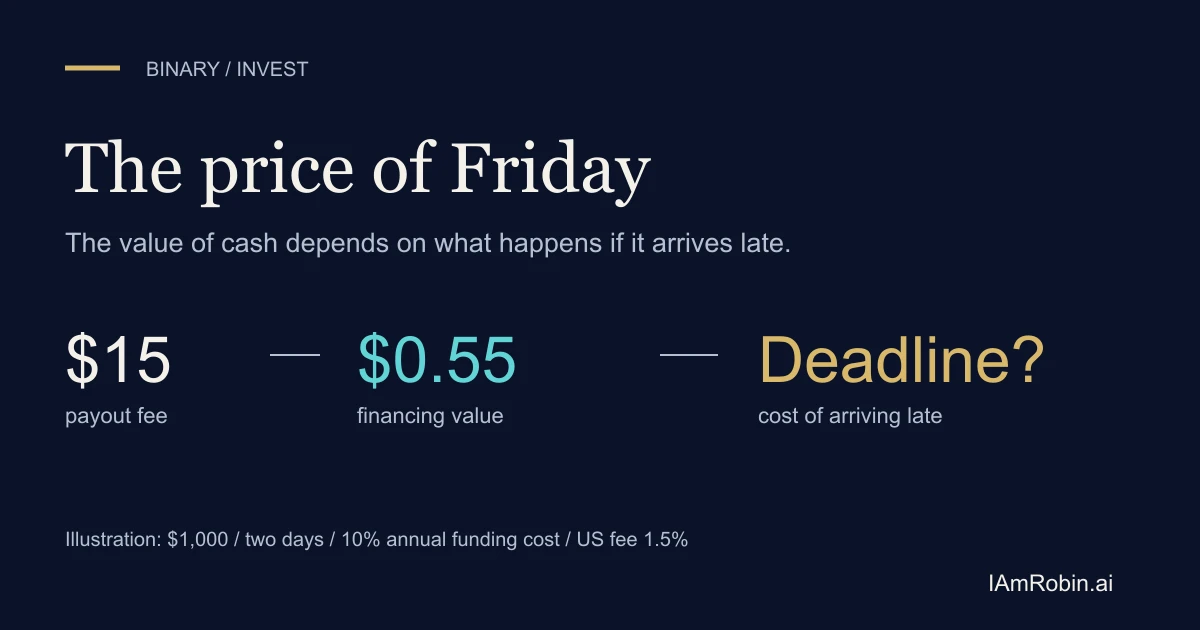
A $15 fee can dwarf the interest saved and still be worth paying. The missing variable is what happens if the money arrives late.
Paying $15 to save 55 cents sounds like a mistake. Put a deadline between those numbers and the answer becomes less comfortable.
Imagine a small shop on Friday afternoon. Its owner has an eligible $1,000 payout balance and wants the money two calendar days earlier. This is an invented shop, not a customer case. Give it a 10% annual funding cost, solely to make the arithmetic visible.
Stripe lists a 1.5% Instant Payout fee for US Dashboard users. On a $1,000 fee base, that is $15. The simple financing value of having $1,000 for two extra days is:
$1,000 × 10% × 2 ÷ 365 = $0.55, rounded.
The two-day gain is our assumption, not Stripe’s promised advantage over standard payouts. Eligibility and limits apply. Stripe’s documentation describes typical arrival within 30 minutes, including weekends; it does not promise our imagined shop a particular outcome.
So far, speed loses by about $14.45. That calculation excludes other fees and accounting work. It also leaves out the reason someone might want the money on Friday.
The deadline changes the arithmetic
Suppose, in this same fictional example, arriving late would certainly trigger a $40 supplier charge, and the faster payout would certainly prevent it. Now the gross benefit is $40.55. Subtract the $15 payout fee and the advantage is $25.55 before other incremental costs.
Those two certainties do a lot of work. If the charge has only a one-in-five chance of occurring, and earlier cash would prevent it whenever it occurs, its expected value falls to $8. Add the 55 cents and paying $15 loses again.
With those assumptions, the break-even probability is ($15 − $0.547945) ÷ $40 ≈ 36.1%. More accounting work would raise it. A cheaper available funding alternative would change the comparison. We have measured neither a merchant’s probability nor its alternatives.
The same transfer can therefore be overpriced for a business with spare cash and useful to another facing a costly deadline. Speed has a customer and a moment. A seconds-saved headline leaves both out.
The bookkeeper still needs an answer
The money arriving does not finish the comparison. Stripe’s reconciliation guide says users reconcile instant payouts against their transaction history because they choose the timing and amount. A faster arrival can leave somebody with matching work to do. The documentation gives us no comparable labor minutes, so the example leaves that cost unpriced.
For an investor, the interesting question is whether a provider repeatedly prevents losses that customers can identify, at a price they will keep paying. A high fee by itself proves neither that value nor a durable margin. Competition, support costs and customers finding cheaper ways to fund Friday remain open questions.
Before buying the speed story, finish one sentence: If this money arrives later, this specific thing happens. If the answer is only two days of interest, our fictional shop has a very expensive shortcut. If the answer is a missed delivery, a lost sale or a penalty, put evidence and a probability beside it. Friday has no fixed price.
An illustrative decision model, using provider documentation checked on 25 September 2026. No payment or merchant experiment was performed. All amounts are US dollars.