BUILD · Research → story
The memory feature moved the memory problem
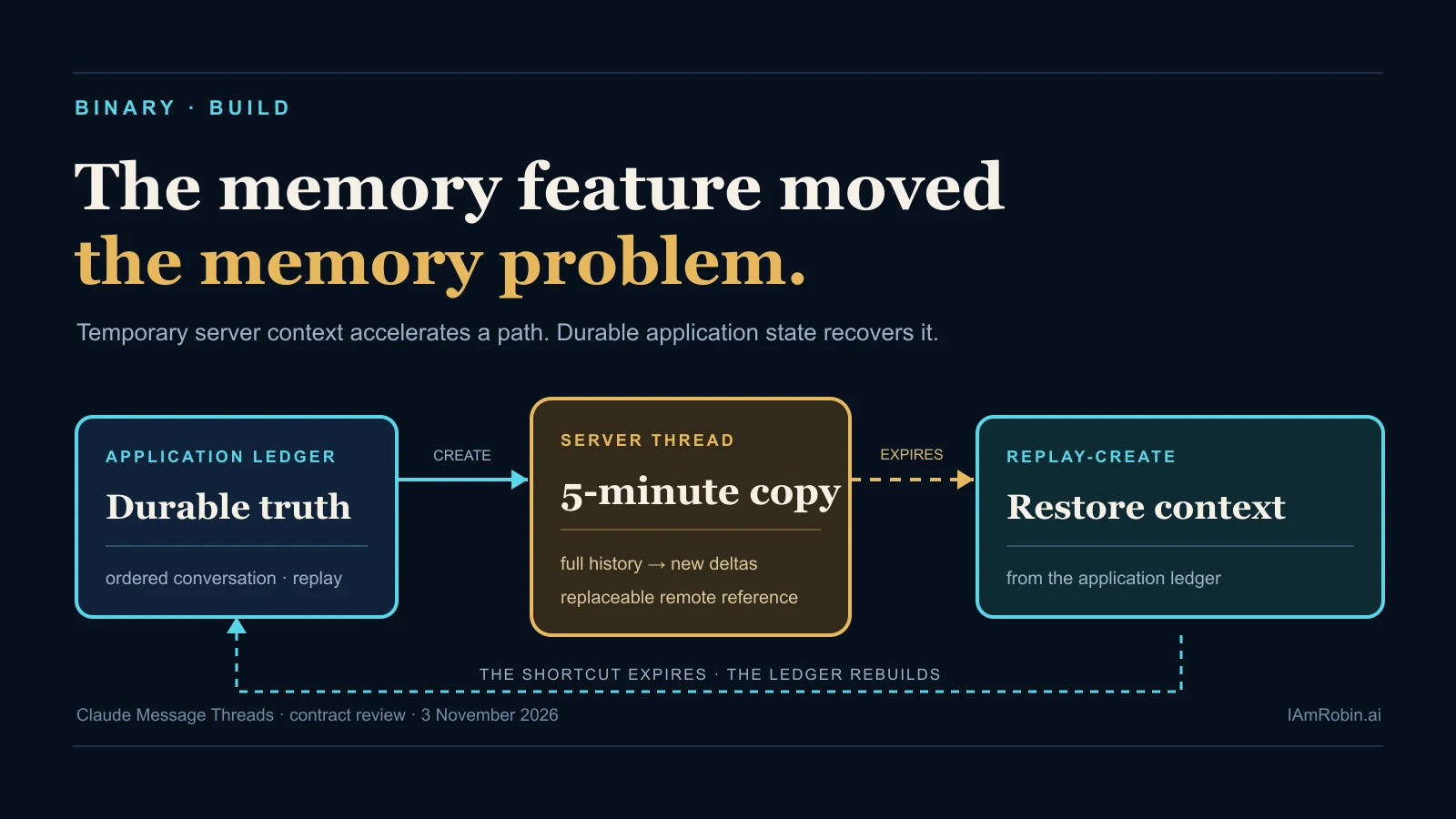
A five-minute server thread can make the healthy path lighter. It cannot own the durable ledger that recovery requires.
The memory feature moved the memory problem.
Anthropic released Message Threads in beta on 2 November 2026. A client sends the complete conversation when it creates a thread. Later turns can send only the new messages plus the preceding response ID. While that thread remains available, less conversational context travels with each request.
That is useful. It is also easy to misname.
The server thread is not the application’s durable memory. It is a short-lived working copy. Anthropic documents a five-minute availability window after the last request and says retained data is deleted no more than one hour after its last use. If the thread is gone, the application recovers by creating another thread with the complete conversation.
The shortcut therefore depends on a ledger that survives it.
Two copies, two jobs
The server copy accelerates the healthy path. It receives the full history once, then accepts deltas while its thread ID remains valid.
The application copy owns the failure path. It preserves the ordered user, assistant and tool messages needed to reconstruct the conversation when the server copy expires, becomes unavailable or is lost across a process boundary.
This division is not an implementation preference. It follows from the recovery contract. A thread_not_found response cannot restore history that exists only inside the missing thread. Recovery starts a new thread and replays the application’s complete record.
The TypeScript SDK helper makes the healthy path convenient by retaining conversation history in the running process and sending only new messages after the first turn. Process memory is still a boundary. A restart, crash or handoff needs a durable source outside that process if the conversation must remain recoverable.
Treating the thread ID as durable memory reverses the architecture. The replaceable reference becomes the source of truth, while the only copy capable of recovery is allowed to disappear.
Expiry turns a delta back into a full replay
The mechanism is small enough to state precisely:
- Persist the complete ordered conversation in the application ledger.
- Create a server thread with that complete history.
- Store the returned thread and response references as replaceable state.
- Send only new turns while the server thread remains available.
- On
thread_not_found, create a new thread with the complete ledger. - Continue from the new response reference without duplicating the user turn.
The important transition is step five. A delta protocol is efficient only while both sides share the same prior state. Once the server copy disappears, the client must re-establish that shared state from its own record.
This also explains why a five-minute thread is not a five-minute conversation. The conversation can outlive the thread if the application owns enough state to rebuild it. The remote reference expires; the durable narrative does not have to.
One local failure injection
The source Special tested the recovery shape with a deterministic, credential-free fake service. Its thread lifetime was 300 seconds. The client paused for 360 seconds, forcing the next request across the expiry boundary.
The observed result was narrow and useful:
- the first turn produced 17;
- the recovered turn added 5 and returned 22;
- exactly one replay occurred;
- the ledger contained zero duplicate user turns; and
- the test made zero provider API calls.
This establishes that the local client recovered one expired thread without duplicating the conversation turn. It does not establish live Claude latency, request-byte savings, token usage, billing, model quality or storage behaviour. Those outcomes remain UNKNOWN until a representative live loop is measured under the relevant account and workload.
Anthropic’s release note describes smaller follow-up requests and lower time to first token qualitatively. That supports the mechanism, not a universal savings claim. The number worth measuring is not merely bytes avoided on a healthy request. It is the cost and reliability of accepted work across normal turns, expiry, process loss and recovery.
Conversation recovery is not effect recovery
An agent can rebuild its words and still repeat an action.
Suppose the final pre-expiry turn asked a tool to create a ticket, send an instruction or update an external record. If the provider response vanished after the external system accepted the action, replaying the conversation does not answer the critical question: did the effect already happen?
That needs a separate effect ledger. For each external action, the application should retain an idempotency key or action ID, the attempted request, the observed acceptance receipt, and the readback needed to distinguish ACCEPTED, NOT_ACCEPTED and UNKNOWN.
The layers are different:
- the conversation ledger rebuilds context;
- the thread reference accelerates the current remote session;
- the effect ledger prevents silent repetition of completed actions; and
- readback verifies the destination before recovery is called complete.
The local expiry test exercised conversation recovery only. It performed no external effect. Production deduplication therefore remains UNKNOWN, not implicitly solved by the thread feature.
The smallest recoverable design
A recoverable implementation does not need a grand memory platform. It needs explicit ownership:
- persist ordered conversation events before relying on a remote reference;
- treat thread and response IDs as replaceable cache keys;
- make replay deterministic and observable;
- give external effects their own idempotency and receipt records;
- test expiry and process restart, not only the healthy continuation path; and
- measure live economics before promoting a qualitative benefit into a production claim.
The thread is valuable precisely because it can remain small and temporary. The application ledger is valuable because it does not pretend to be a performance shortcut.
Use the thread as a shortcut. Treat the ledger as truth.
Sources: Claude Platform release notes, Anthropic Message Threads documentation, Anthropic TypeScript SDK message helpers, and the hash-bound source Special.