03 · Daily Special · Signal 1
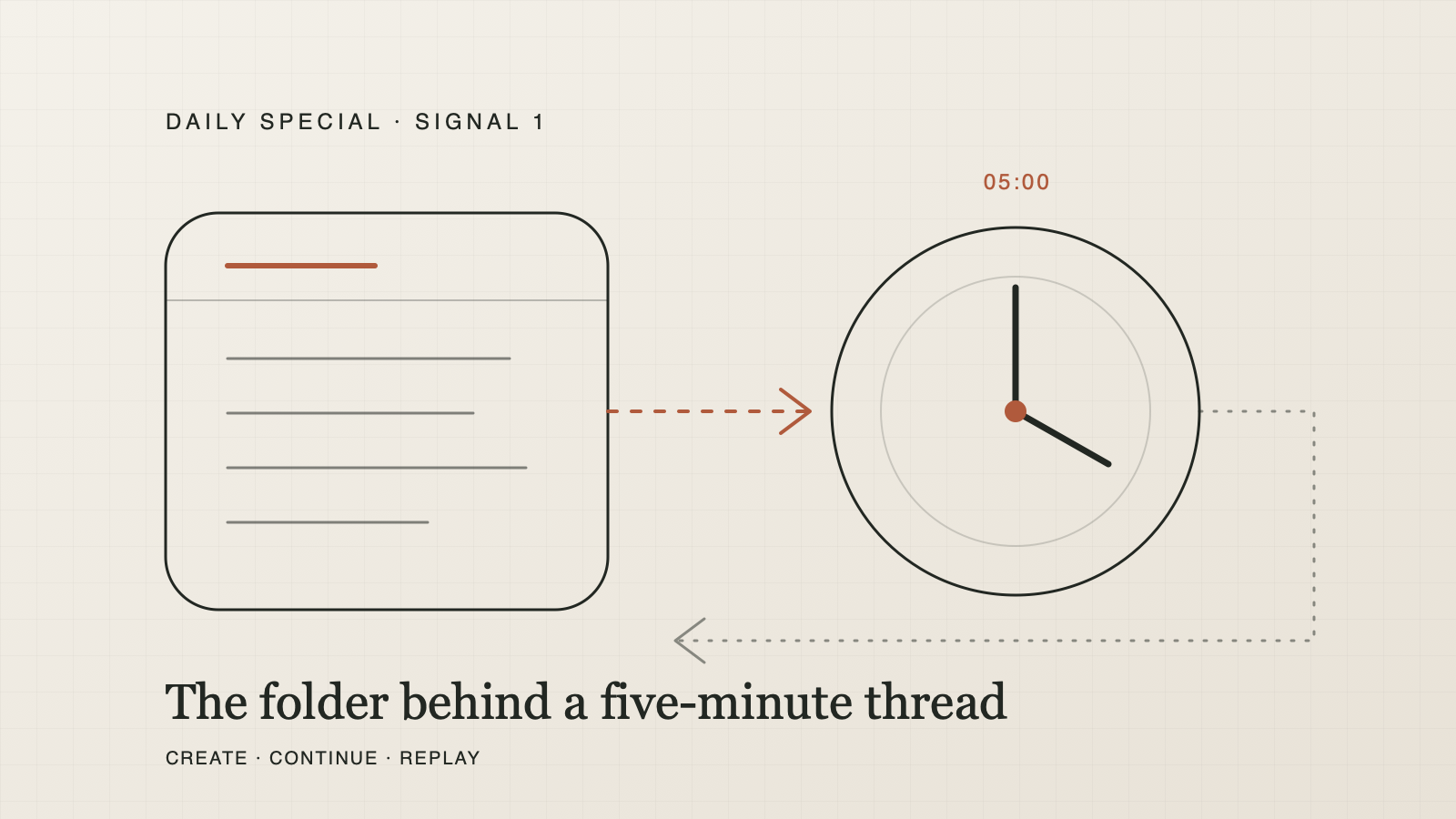
A bounded study of Anthropic Message Threads and one credential-free local expiry-recovery simulation; no live Claude request, provider credential, model inference, production action, external side effect, purchase, trade, capital allocation, company contact or underlying adoption decision.
What Happens When Claude’s Temporary Memory Expires
A conversation with an AI assistant feels continuous. You ask a question, read the answer, and add a detail. The software behind that exchange has to give the model enough of the earlier conversation to make sense of each new message. In an ordinary setup, that means sending earlier messages again as the conversation grows.
That repeated delivery is part of the work an agent application does. The application sits between the user and the model: it collects messages, keeps the conversation record, and prepares requests. In applications that use tools, it may also arrange actions such as looking up information or changing a record. Claude, Anthropic’s AI model, produces responses from the context supplied to it.
On 2 November 2026, Anthropic announced a beta feature called Message Threads that changes how applications deliver that context. Its service can temporarily keep the conversation, allowing the application to send just the newest messages on a follow-up request.
The attraction is easy to understand. As a conversation gets longer, carrying the whole exchange back and forth means repeating more material. Anthropic says Message Threads can make follow-up requests smaller and reduce time to first token—the wait before the response begins to appear. The release material reviewed for this story describes those benefits qualitatively; their size in everyday use remains an open measurement question.
The feature also introduces a short clock. According to Anthropic’s documentation, the stored conversation expires five minutes after the last request. A pause can therefore change what the application must do next.
What happens when the user returns after those five minutes?
Imagine leaving working papers on a library desk. While the papers remain there, you can return carrying only a new page and continue reading. After the desk is cleared, you need the complete folder again. In this analogy, Anthropic provides the desk, and the application remains responsible for the folder.
That division of responsibility is the heart of Message Threads—and the reason a small local experiment deliberately waited six minutes before continuing.
The feature begins with a request called create. The application sends the full conversation, and the service returns a response with an identifying reference. For the next turn, the application can use continue, sending the new messages together with the previous response ID. That reference tells the service which earlier conversation to use.
Anthropic documents the beta for its Claude API, the interface applications use to communicate with Claude, and for Amazon Bedrock, Google Cloud’s Vertex AI, and Microsoft Foundry. Those are additional cloud platforms through which developers can access models.
Across this setup, the retained conversation is described as best-effort temporary state. Five minutes after the last request, the thread expires. Anthropic separately says its data is deleted within one hour of its last use. These are two distinct boundaries: one concerns the thread’s availability for continued use; the other concerns deletion of the retained data.
A continuation can fail with HTTP 404, a response indicating that the requested resource is unavailable, and the error code thread_not_found. Expiration is one documented cause. Regional availability problems and a referenced thread that failed or was deleted can produce the same error.
Anthropic’s recovery method follows directly from the library analogy: bring the folder back. The application creates a fresh thread and sends the complete conversation again.
To check that recovery pattern, the supplied research used a deliberately simple local simulation. A fake thread service stood in for the remote service, and a client program handled the conversation. The exercise ran entirely locally, with zero Anthropic API calls and zero provider charges. Its purpose was to examine the client’s behavior when temporary state expired.
Before the run began, the test fixed its rules. The fake service would keep thread state for 300 seconds, or five minutes. The client would submit two numbered additions, 17 and 5, separated by a deliberate pause. Success required an accepted final value of 22, exactly one recovery, zero duplicate user-message IDs, and zero human interventions after the start.
The small arithmetic task made the recovery easy to inspect. The important work was keeping the conversation intact across the failure.
First, the client created a thread for the turn containing 17. Then it waited 360 seconds—six minutes of real elapsed time. That pause carried it beyond the fake service’s five-minute lifetime.
Next came the turn containing 5. The client attempted to continue the original thread and received the injected expiry error. It then took its own complete ledger, the ordered record of the conversation, and sent that history in a new create request.
The run finished with an accepted value of 22. It recorded one recovery and zero duplicate user-message IDs. There were three local request attempts: the successful creation, the failed continuation, and the successful creation using replayed history. The entire sequence took 360.104 seconds, with the deliberate six-minute wait accounting for almost all of that time.
For this particular client and this particular injected failure, the recovery worked.
The scope of that result matters. The experiment exercised a deterministic fake service, meaning its behavior followed fixed rules. It provides concrete evidence that the client could preserve its ledger, encounter the planned expiry, and replay the conversation successfully. Live Claude response speed, billing effects, model behavior, and service storage timing remain questions for measurements involving the actual platform.
The accepted answer also belonged to a tightly defined arithmetic exercise. Its success establishes that the local recovery met the test’s stated conditions. The quality of assistance across a real working day would require evidence from those tasks.
Anthropic supplies a TypeScript SDK helper—a ready-made programming component—that handles much of the conversation bookkeeping. According to its documentation, the helper retains the history and sends only new messages after the first turn. It also documents one automatic replay for three kinds of errors: an unavailable thread, a thread already continued, and a continuation already in progress.
That convenience has a clear boundary. The helper’s history lives in the running process’s memory. If that process ends, recovery depends on a durable conversation record maintained by the application, such as a record saved to storage that survives a restart.
Replaying a conversation also creates another model request. In an application connected to real-world actions, that opens a further question: how does the application distinguish an action already completed from one still waiting to happen?
For example, consider an application that can create a booking. A recovered conversation may contain the earlier booking request. The surrounding software needs its own way to recognize a completed booking and control any further attempt. This is an illustration of a separate responsibility: safeguards against repeated actions belong alongside conversation recovery. The local arithmetic experiment tested the conversation path; booking systems and other external tools require checks suited to their own effects.
Message Threads therefore changes the amount of history an application needs to transmit during a healthy exchange. The application continues to own the record from which that exchange can be rebuilt.
The six-minute pause makes that arrangement tangible. For a few minutes, the service can hold the working papers. When the temporary thread expires, the application’s own folder is what allows the conversation to continue.
Sources, reviewed through 3 November 2026, 9:05 a.m. Hong Kong time:
- Anthropic Claude Platform release notes, announcement dated 2 November 2026.
- Anthropic Message Threads documentation, observed 3 November 2026.
- Anthropic TypeScript SDK helpers documentation, observed 3 November 2026.
- Supplied local experiment record, reporting the simulated expiry and ledger replay described above.