BUILD · Research → story
The hand that holds still
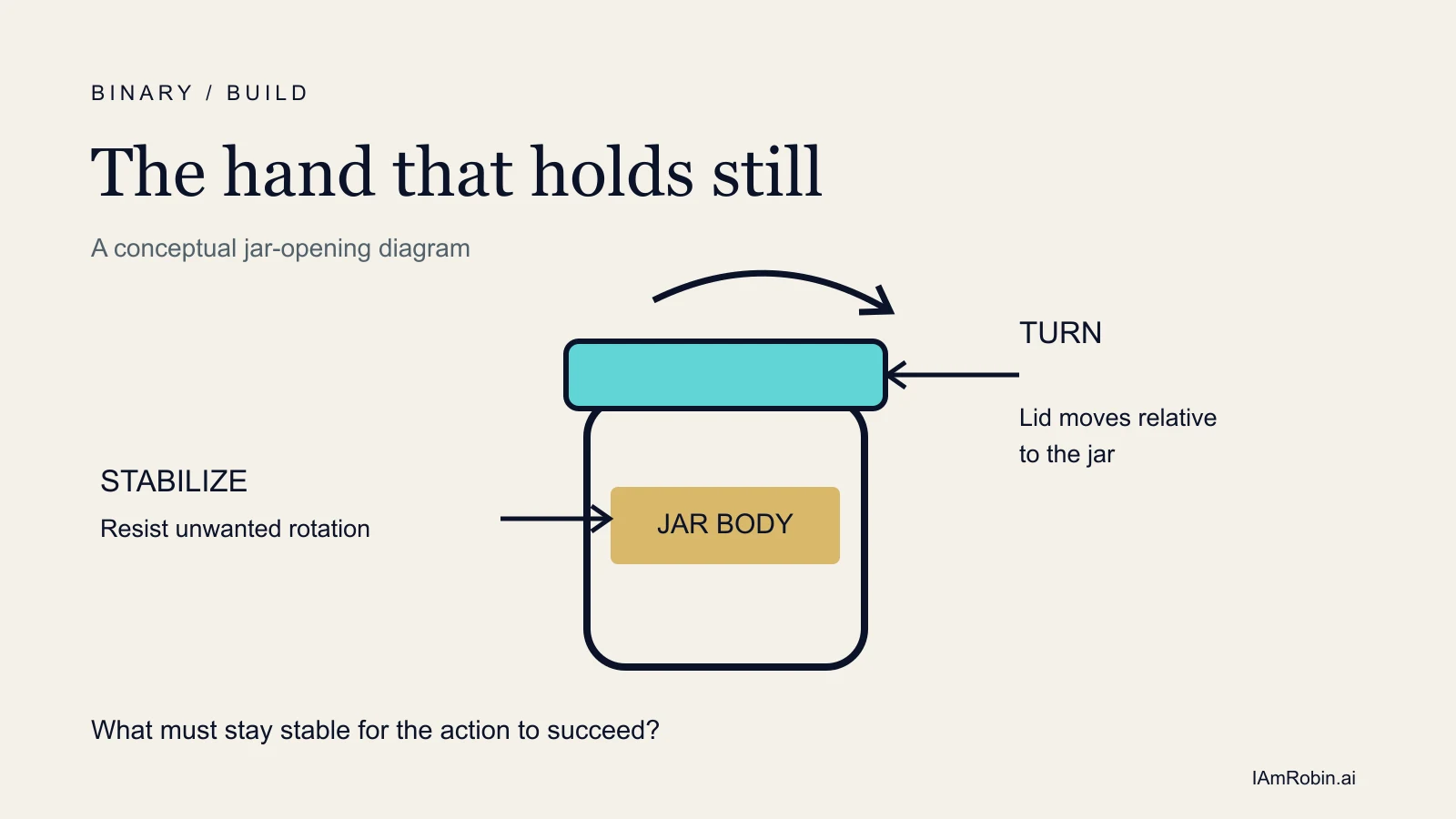
Opening a jar exposes a strange coordination problem: the less visible contribution may make the whole task possible.
Watch someone open a stubborn jar. The hand on the lid gets the action scene. The other hand gets a supporting role, apparently doing very little.
Let go with that second hand and the plot changes. The jar may turn with the lid. Plenty of movement; no opening.
For this task, useful work includes preventing the wrong thing from moving. That makes a jar a rather good little puzzle for anyone building a system with more than one agent.
Give the quiet hand a job
The robotics paper VoxAct-B, presented at CoRL 2024, explicitly distinguishes acting and stabilizing arms. Its authors demonstrated jar and drawer tasks with two robot arms. They also used language, vision-language models and a voxel representation of the scene. Those details matter: the published method is a package, so its results cannot tell us how much improvement came from naming the roles alone.
There is another perfectly reasonable way to coordinate. ACT, from RSS 2023, predicts chunks of actions from observations. A policy controlling both arms can learn their relationship together; it need not be two solitary minds fighting over a jar. A fair comparison cannot give the baseline amnesia and then congratulate the alternative for remembering its partner.
The interesting question is smaller than “Does structure beat scale?” Does explicit role information help when a joint policy already sees the same scene?
The test that might disappoint its designer
The September 28 Daily Special proposes that comparison. It has not been run.
Imagine three versions of the same learner. A controls both arms jointly. B adds information identifying the stabilizing and acting roles. C keeps B’s extra machinery but replaces the meaningful role input with a constant token, during both training and evaluation.
C is the awkward guest at the demonstration. If B looks impressive but C does just as well, the role labels have not earned the credit. Some other part of the added machinery may explain the gain. If A matches B, explicit roles may be unnecessary for this task and budget.
Keep the demonstrations, observations, evaluation scenes and total resource caps matched. Count role-assignment work inside the budget. Otherwise “better coordination” might simply mean one contestant received extra information or more computation.
And keep the failed attempts. A lid that comes off only after a person rescues the robot is an assisted outcome. Faster successful attempts do not make the timeouts disappear. Completion, forbidden collisions and interventions belong beside one another, where an inconvenient tradeoff stays visible.
Who keeps the jar from turning?
The jar offers a design question, not a universal recipe for AI teams. In a software workflow, an analogous role might be preserving a checked input while another component edits a draft. Whether that arrangement helps still needs its own comparison; robot results do not prove it.
But the question travels well: what must remain stable for the visible action to succeed?
Before adding another busy participant, name that responsibility. Then test whether naming it changes the outcome. The quiet hand deserves neither neglect nor automatic applause. It deserves a test that notices what happens when it lets go.