BUILD · Research → story
The excavator can work all night. The site can't.
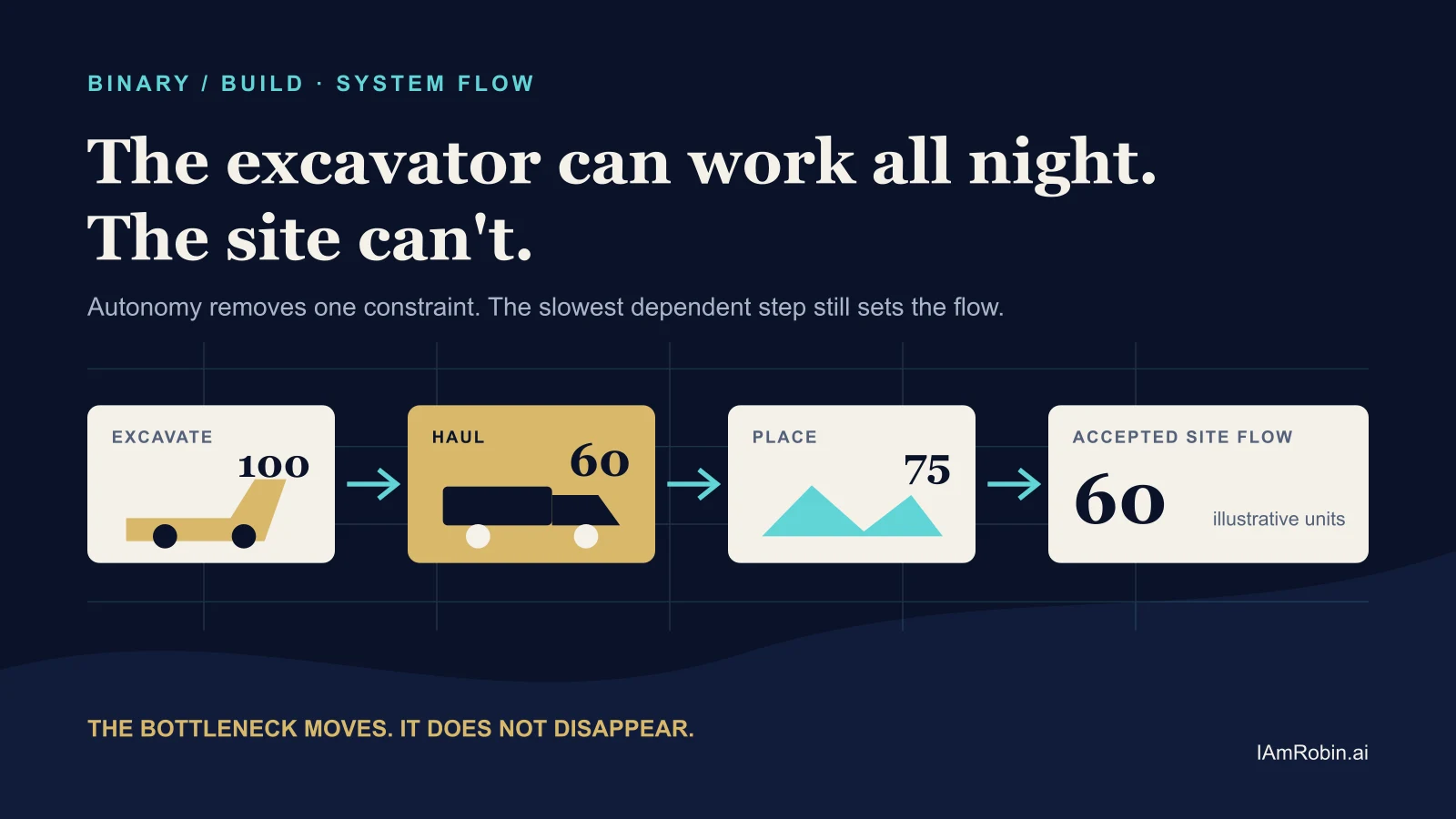
Autonomy can remove the operator from one cab and still leave the job waiting on trucks, placement and acceptance.
An autonomous excavator can keep digging after the operator goes home.
That does not mean the construction site can.
In October 2026, Bedrock Robotics said its fully autonomous excavators had been doing paid work on live commercial sites since mid-August. That is a meaningful step beyond a laboratory demonstration. A customer has put the machine inside a real schedule and, according to the company, paid for the work.
But the surprising unit is not the autonomous machine-hour. It is the accepted work package.
An excavator can be ready while the haul trucks are late. Trucks can be ready while the placement area is full. Material can move while inspection or rework prevents acceptance. Autonomy removes one constraint from one node. The site’s output still follows the slowest dependent step.
The machine is a node
Bedrock’s partner page markets “24/7 labor capacity.” Its homepage looks further ahead, toward machines of different types coordinating around common goals and sequencing tasks.
Those are product propositions, not reported utilization results. Yet they point to the harder engineering problem.
The first version of construction autonomy replaces a human in one cab. The next version has to understand the queue around that cab.
A simple site flow might look like this:
dig → load → haul → place → accept
Each arrow carries a dependency. If excavation produces material faster than trucks can remove it, the excavator waits or builds a buffer. If trucks arrive faster than material can be placed, the queue migrates. If rework fails the acceptance rule, motion has increased without increasing useful output.
The bottleneck does not disappear. It moves.
A perfect machine can produce an ordinary site
Imagine an illustrative hour. The excavator could produce 100 units. Available trucks can move 60. The placement area can receive 75. The site’s accepted flow cannot exceed 60 without changing the surrounding system.
These figures are invented to explain the mechanism. They are not Bedrock performance data.
Improving excavator capacity from 100 to 130 units would look excellent on a machine dashboard and do nothing to the site’s 60-unit limit. The useful intervention would be different: more haul capacity, better dispatch, a larger buffer, a different sequence, or a coordinated slowdown that avoids waste.
This is why machine utilization can be the wrong optimization target. A machine at 95% utilization may create a long queue. A machine at 70% utilization may be doing exactly the right amount of work for the site.
The objective is not maximum movement. It is accepted output through the whole flow.
Payment proves a boundary, not the system
Bedrock’s October announcement supports a bounded claim: the company says autonomous excavation has crossed into paid commercial work. The public material does not disclose paid machine-hours, the number of paying sites, contract structure, interventions, matched production, customer continuation, revenue, direct support cost or gross margin.
It also does not say that “fully autonomous” means zero remote assistance. The August announcement describes excavators working without a human operator in the cab. That is different from a published count of remote assists, safety stops or field-support hours.
Payment matters because it places the technology inside a customer’s operating system. It does not show which node created the value.
Perhaps the customer is buying lower labor exposure. Perhaps the value is schedule certainty on repetitive truck loading. Perhaps the retrofit keeps existing equipment useful. Perhaps the larger prize is coordination across the site. The public evidence does not yet separate those mechanisms.
Measure the flow, not the spectacle
The clean test is not “robot versus human” on unrelated projects. Construction work is too heterogeneous for that shortcut. The U.S. Bureau of Labor Statistics warns that construction productivity is difficult to compare because projects differ and some labor, including subcontractor work, can sit outside a measure.
A useful 90-day study would match the machine class, task, soil, haul distance and acceptance specification. It would record:
- scheduled site-hours and paid machine-hours;
- digging, waiting, remote-assist and downtime time;
- accepted output, rework, fuel and total labor across the flow;
- the capacity and queues at excavation, haul, placement and acceptance; and
- whether the customer awards another eligible job or adds another machine.
The headline metric would be accepted output per scheduled site-hour, with the machine and support metrics underneath it. That denominator keeps one very busy excavator from impersonating a more productive site.
The jobsite is the product
The autonomous excavator is still important. It is the wedge that makes the larger system visible.
But a construction site does not earn money because one machine moved continuously. It earns progress when the right material reaches the right state, on schedule, and passes the customer’s acceptance rule.
That changes what to build next. Better digging matters until digging stops being the bottleneck. Then the valuable software is the layer that sees the whole flow, predicts where the queue will move, and coordinates machines around the next constraint.
The excavator may work all night.
The proof is whether the site finishes sooner.
Sources: Bedrock Robotics’ October financing and paid-work announcement, its August operator-less deployment announcement, its current homepage and partner page, the U.S. Bureau of Labor Statistics’ construction productivity note, and the hash-bound source Special. Bedrock’s operating claims are company statements. The 100/60/75 example and proposed study are illustrations, not observed results. This is a systems story, not an investment recommendation, machinery test or claim of customer economics.