03 · Daily Special · Signal 7
The Excavator Got Paid: Why Bedrock Robotics' $4.1B Valuation Is Just the Beginning
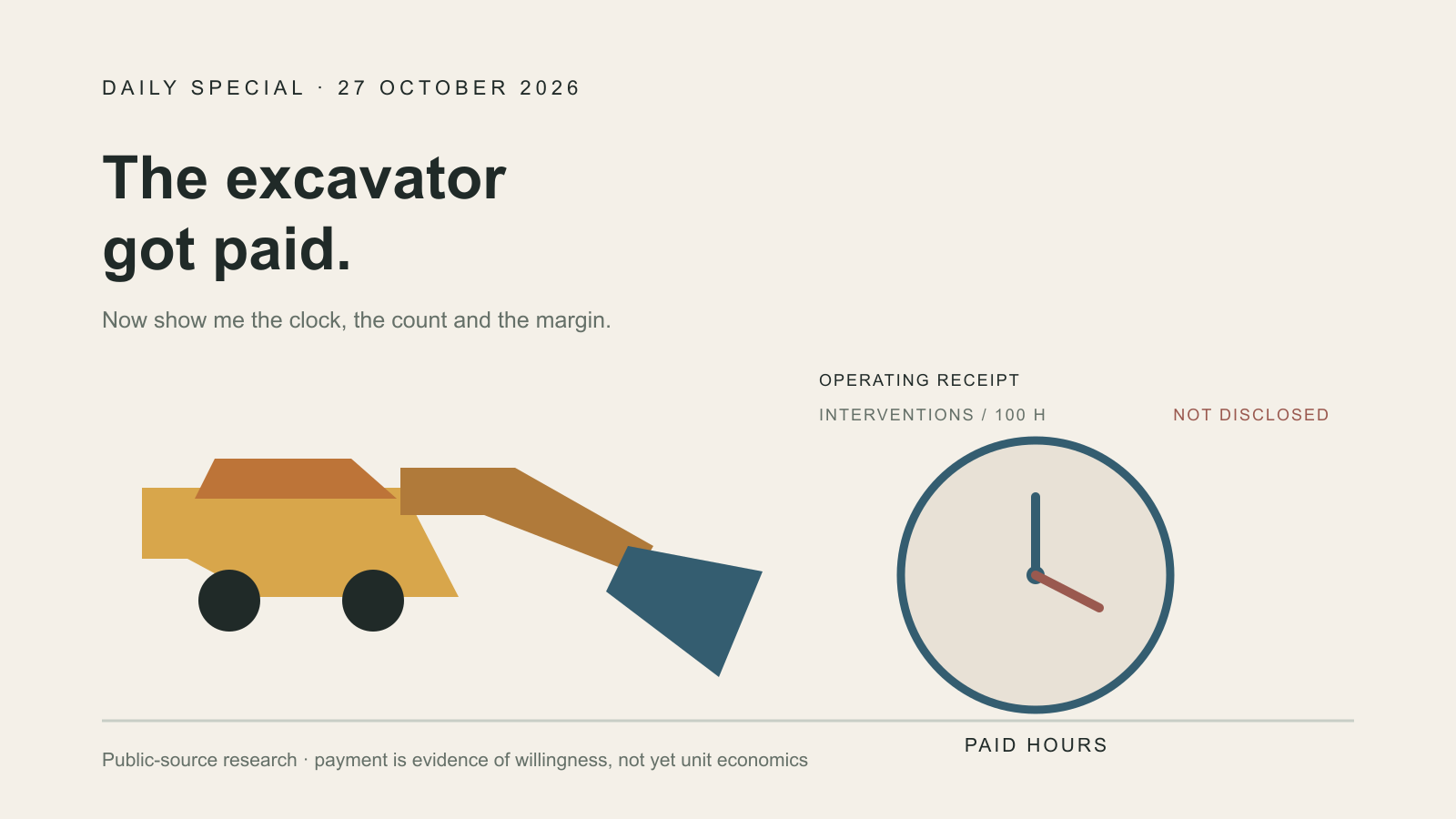
A bounded public-source study of what Bedrock Robotics' announced paid autonomous excavation establishes and what operating evidence would be needed to judge repeatable economics; no company or customer contact, machine trial, trade, capital allocation or underlying decision.
The tech world loves a massive funding headline. On October 26, 2026, Bedrock Robotics announced a staggering $600 million Series C funding round, catapulting its post-money valuation to $4.1 billion. The round was co-led by CapitalG and Emergence. But if you look closely at the announcement, the most groundbreaking detail isn’t the dollar amount. It is the company’s claim that since mid-August, its fully autonomous excavators have been performing paid work on live commercial job sites.
Bedrock Robotics, founded in 2024 by a team featuring former Waymo engineers, takes a unique approach: it retrofits existing heavy equipment—primarily excavators—with the sensors, compute power, and autonomous controls needed to operate without humans in the cab. Over the last 15 months, the company has climbed a proverbial ladder of evidence:
- In July 2025, the company launched publicly with four construction partners and $80 million raised, describing continuous work as an ambition.
- By February 2026, a Series B funding round brought total funding past $350 million, with a target for first fully operator-less deployments later that year.
- On August 17, 2026, Bedrock announced operator-less deployments on live, named sites, including projects with Sundt, Champion Site Prep, and Zachry.
- These deployments, however, were not explicitly labeled as paid work.
- The October 26, 2026 announcement says paid commercial work has begun.
Why “Paid” is a Milestone (But Not the Finish Line)
Getting a contractor to hand over cash suggests the arrangement is useful enough to put on a real schedule, alongside real crews, with real liability. This transition from asking “can the machine dig?” to “will someone pay for the digging?” is a more demanding commercial hurdle than an operator-less deployment alone.
However, a willingness to pay doesn’t automatically translate to strong unit economics. A “paid” job could mean many different things:
- It could be a discounted pilot program priced to learn rather than profit.
- It might be a milestone payment based on the volume of cubic yards accepted.
- The contractor could be paying an hourly service rate for every machine-hour recorded on the clock.
- It could involve a subscription for software and retrofitting on the contractor’s own machine.
- It may be a multi-site production contract that includes volume commitments.
Bedrock says its “total customer volume” has more than doubled since 2025, but the starting baseline is undefined. It names Haydon as a new deployment partner and new contracts with Wagner Construction, Smith Trucking Company, B&S Site Development, Native Excavating, Clarkson Construction, C.W. Matthews, and select ArchKey Solutions projects. But the core question remains: does each paid hour actually generate a profit?
The Missing Denominators
To truly evaluate Bedrock’s business, we need to see the denominators that turn its marketing claims into verifiable rates. Currently, vital metrics are missing from the public eye:
- Paid autonomous machine-hours and the number of paying sites would reveal the actual scale of commercial operations.
- The number of unplanned takeovers, remote assists, safety stops, and downtime events per 100 paid hours would show how heavily the machines still rely on human oversight.
- Measuring accepted output per paid hour against a matched human-operated crew would compare useful production rather than autonomy alone.
- Factoring in field support, servicing, warranty, and insurance would help show whether Bedrock makes a gross margin on the hours it sells.
- Seeing if customers continue using the service after their first paid job would indicate whether demand persists.
Bedrock’s homepage says partners can draw on “tens of thousands of hours in the field,” but it’s unclear whether these hours were paid, autonomous, testing, or cumulative. Furthermore, its partner page promotes “24/7 labor capacity” and same-day retrofits, but this describes the system’s proposition rather than proven, round-the-clock utilization.
The Clock Problem and the Toy Model
Defining an “hour” is trickier than it sounds. Does the clock keep ticking while the excavator waits for haul trucks? If a remote operator steps in for three minutes, is that hour still classified as “autonomous”? Are standby hours billable, and how is rework counted?
Utilization is the revenue lever, but support costs are the brakes. Imagine a simple, illustrative scenario where a provider charges $180 per paid autonomous hour, with $60 in variable costs and $40 in allocated retrofit expense:
- Running one shift for 160 hours a month yields a gross margin of 66.7 percent before the allocated retrofit expense.
- If two shifts scale at the same price and cost, monthly profit doubles in this model.
- However, if the added night shift requires significantly more remote supervision or site support, costing $90 an hour while the first shift remains at $60, the blended gross margin shrinks to 58.3 percent.
These numbers are invented to expose the mechanism, not to estimate Bedrock’s results. This is why understanding intervention rates and support-labor ratios is far more critical than a top-line valuation. Physical constraints also matter. An excavator that can dig 24 hours a day is only useful if the rest of the job site can feed and absorb 24 hours of digging.
Where Does Physical AI Find Its Value?
Compared with deploying another software inference, expanding physical AI brings heavy machinery, maintenance, liability, and site integration. Bedrock’s retrofit approach may reduce the need for full equipment purchases and lower switching friction.
But where does the actual value lie?
- The real game-changer might be a software layer that reorganizes the workflow and coordinates excavators, haul trucks, and graders.
- Autonomy could allow contractors to extend productive hours and spread the cost of machine ownership over far more output.
- Replacing the operator is the most obvious benefit, but it remains constrained by the need for remote supervision.
- For a contractor struggling to hire operators, having schedule certainty for critical tasks might be worth more than any hourly cost savings.
The Bottom Line
The $4.1 billion post-money valuation sets a price for the financing round under undisclosed terms, not necessarily what the entire company would sell for today. It reflects investor conviction—whether based on internal data showing exceptional operating leverage, a willingness to fund a capital-heavy commercialization phase, or simply a race to secure a position in a scarce market.
To truly benchmark this technology against human labor, you can’t just use industry averages. The Bureau of Labor Statistics noted in its September 2026 update that productivity trends diverge sharply across construction industries. The BLS also explains that output and hours are difficult to compare because projects differ and subcontractor labor can sit outside the measured hours. A real test requires a 90-day trial matching autonomous and conventional crews on comparable tasks. This trial would need to log scheduled time, actual digging time, rework, fuel, and labor, alongside a strict count of unplanned takeovers and safety stops.
Bedrock Robotics says it has achieved something meaningful: a customer paid for autonomous digging. Now, the industry is waiting for the next decisive rung on the ladder. We want to see the clock, the count, and the margin. Only then will that $4.1 billion valuation have a tangible operating result to be measured against.
Notes and sources
Bedrock’s October 26 release reports the financing, paid-work claim, customer-volume language and named deployment partner and contracts. Its August 17 release describes the earlier named operator-less deployments. Bedrock’s homepage and partner page supply the quoted field-hours and 24/7 propositions. The BLS construction labor productivity page supplies the sector comparison and its measurement limits.
The article’s pricing and cost figures are illustrative, not estimates of Bedrock. The public sources reviewed here do not disclose paid autonomous hours, the number of paying sites, contract structure, intervention rates, matched output, customer continuation, revenue, direct support cost or gross margin. A lack of public disclosure is not evidence that these figures are zero or poor.
- Bedrock Robotics Series C release, October 26, 2026
- Bedrock Robotics autonomous deployment release, August 17, 2026
- Bedrock Robotics homepage
- Bedrock Robotics partner page
- U.S. Bureau of Labor Statistics, Construction Labor Productivity
The full research artifact preserves the evidence boundary, illustrative model and proposed operating test.