INVEST · Research → story
The empty cab still has a payroll
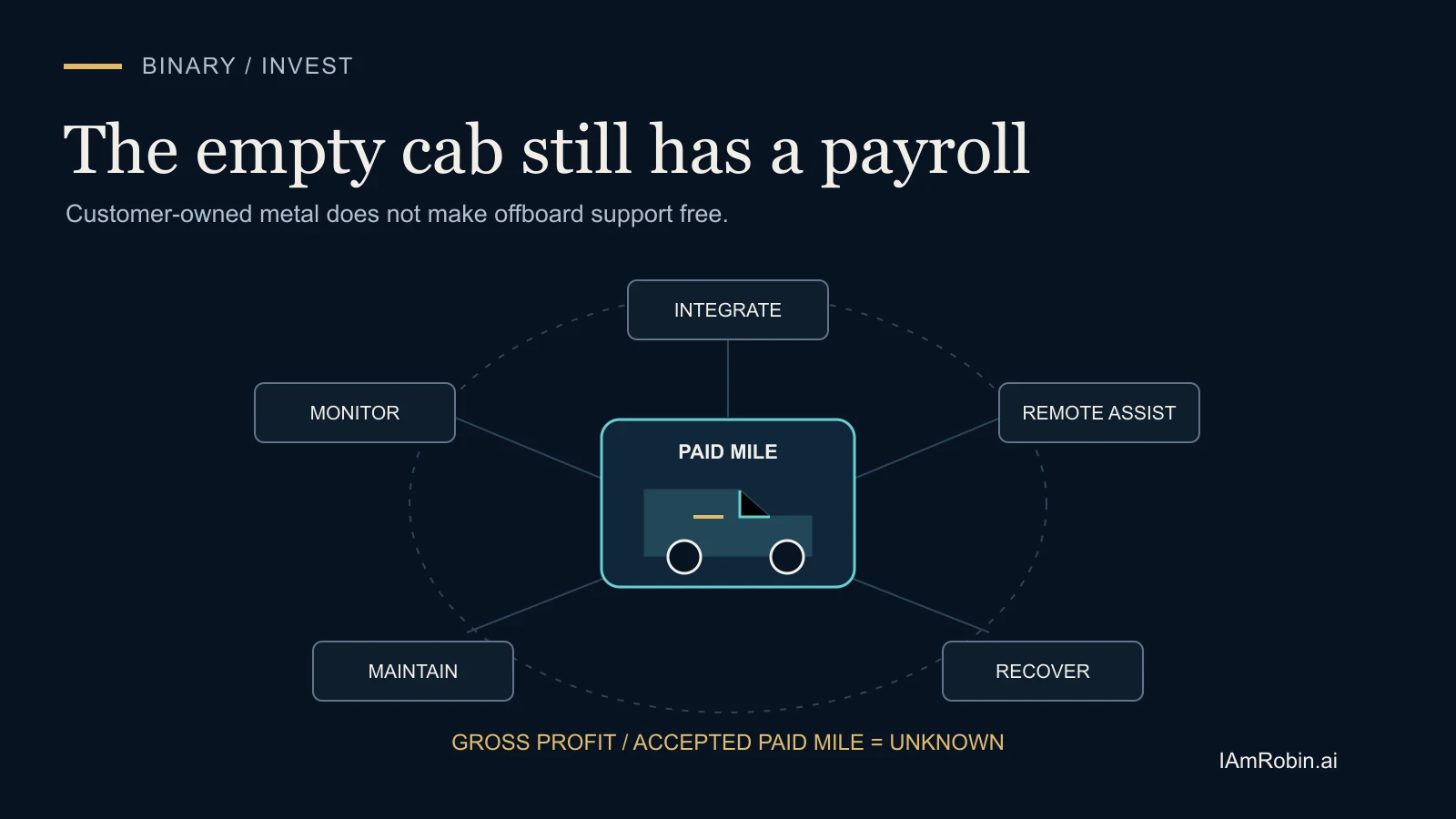
Carrier-owned trucks can make autonomy asset-light. Remote support, integration and recovery still decide gross profit per paid mile.
The driver can leave the cab without human labor leaving the mile.
That is the quieter question inside Kodiak AI’s agreement with DTL Transport. Kodiak announced that DTL would put the Kodiak Driver into 75 DTL-owned and DTL-operated trucks and pay a per-mile fee. The carrier owns the metal. Kodiak supplies the driver layer.
It sounds beautifully asset-light.
It may be. But an empty cab can still be surrounded by people: integration engineers, remote operators, maintenance partners, dispatchers, roadside recovery and the teams that decide what to do when the ordinary becomes strange.
The economic unit is not the truck. It is the accepted paid mile after the support around it has been counted.
The labor moved offboard
Kodiak’s June 2026 quarterly filing describes Driver-as-a-Service as more than software in a vehicle. The company provides the autonomy system, regular software updates, systems integration, remote monitoring, and operational and remote support. It also says it relies on partners for upfitting, remote monitoring and remote-assistance services, with greater reliance expected as operations scale.
This does not prove that the support burden is high. It proves that the support layer exists.
The distinction matters because a customer-owned truck changes who funds the vehicle, not whether the service around it is free. A carrier can own the tractor while the autonomy provider still carries hardware, integration, cloud, communications, monitoring, assistance and incident-response costs.
“Asset-light” and “labor-light” are different claims.
A per-mile fee creates a per-mile test
The clean equation is simple:
provider gross profit per accepted paid mile = revenue per accepted paid mile - full provider cost per accepted paid mile
The first term is not public for DTL. Neither is the second.
Kodiak’s filing says its DaaS pricing can use per-vehicle or per-mile fees, with mileage minimums where applicable. The DTL announcement, as preserved in the source Special, says DTL would pay by the mile. The reviewed public evidence does not disclose the DTL price, minimum mileage, contract term, delivery schedule or allocation of support and recovery costs.
Unknown is not bad. Unknown is where the diligence starts.
If revenue follows miles while support cost follows exceptions, the distribution of those exceptions matters more than the average truck count. One difficult route, weather pattern or recurring edge case can consume support capacity far out of proportion to its miles.
Count support minutes, not just assists
An intervention count alone can hide the workload.
Consider two purely illustrative systems:
- System A needs one remote assist per 1,000 paid miles, lasting five minutes.
- System B needs ten assists per 1,000 paid miles, lasting twenty minutes each.
System A consumes 0.005 assist-minutes per paid mile. System B consumes 0.2. The second support burden is forty times larger before adding standby coverage, handoffs, training or field recovery.
These figures are not Kodiak or DTL data. They show why a stable definition matters. A five-second confirmation and a forty-minute recovery should not become identical dots on a dashboard. Nor should an “available” truck be treated as a truck moving a paid load.
A useful operating receipt would separate:
- paid driverless miles and accepted loads;
- remote-assist events and minutes per 1,000 paid miles;
- safety stops, field recoveries and unavailable hours;
- integration, monitoring, maintenance and support labor; and
- who pays each cost when a truck is waiting rather than earning.
Thirty-five trucks prove one boundary
Kodiak is not beginning with an empty spreadsheet. As of June 30, 2026, the company reported more than 40,000 cumulative paid driverless hours, more than 20,000 loads across its operations, and 35 customer-owned driverless vehicles. Its filing also said DaaS represented 65% of revenue in the first six months of 2026.
That is real evidence that the model operates somewhere. It is not a DTL margin series.
The existing customer-owned fleet works in an industrial environment. The proposed DTL service moves into long interstate freight. Route length, weather, loading windows, maintenance, receiver schedules and recovery options change the operating envelope. Proof cannot be borrowed from one environment and spent twice.
The 75-truck contract is evidence of commercial intent. The first accepted paid mile would be evidence of operation. A repeated series of support-adjusted profitable miles would be evidence of economics.
Those are three different milestones.
The best automation may look staffed
There is a temptation to treat every person around an autonomous system as evidence that autonomy failed. That is too crude.
A small, skilled support team can be part of a strong product. Airlines, data centers and payment networks do not become less technological because humans watch exceptional states. The question is whether support grows more slowly than accepted output.
If ten times as many paid miles require only twice the support capacity, the model is learning to scale. If support hours rise one-for-one with miles, the software may have moved labor rather than removed the constraint. If rare incidents require expensive field recovery, the tail can dominate the average.
The right graph has two lines: accepted paid miles and full support cost. The business gets better when the first line outruns the second without weakening safety or service quality.
The payroll moved
The photograph will show the empty driver’s seat. Investors and operators need the offboard ledger.
For each paid mile, who integrated the system, watched the route, answered the exception, repaired the hardware, recovered the vehicle and absorbed the idle time? How often did that work occur? Did its cost fall as the fleet grew?
Kodiak’s architecture could be genuinely asset-light. The public evidence is not yet sufficient to calculate DTL’s full-cost economics, and it should not be forced into a number.
The empty cab is the visible breakthrough.
The payroll around it will decide whether the breakthrough compounds.
Sources: Kodiak’s DTL agreement announcement, its quarterly report for the quarter ended June 30, 2026, and the hash-bound source Special. The investor-relations page returned HTTP 403 to both direct and isolated-browser retrieval in this run, so agreement details are limited to the already verified source artifact. The 1/5 and 10/20 assist examples are illustrations, not observed operating data. DTL price, support burden, full cost per mile and gross margin remain UNKNOWN. This is a unit-economics framework, not an investment recommendation.