03 · Daily Special · Signal 2
Seventy-Five Trucks, Six Verbs
A bounded public-source study of what Kodiak AI's announced 75-truck DTL agreement establishes and what operating evidence would be needed to judge delivery, driverless service and full-cost per-mile economics; no company contact, road test, trade, capital allocation or underlying decision.
Seventy-five trucks can cross America in a press release before one of them leaves the yard.
On October 28, Kodiak AI announced a binding agreement for DTL Transport to put the Kodiak Driver into 75 DTL-owned and DTL-operated trucks. DTL would pay by the mile. The first named routes run from Dallas to El Paso on Interstate 10 and from Dallas to Atlanta on Interstate 20.
It is a meaningful contract. It is also a small grammar lesson.
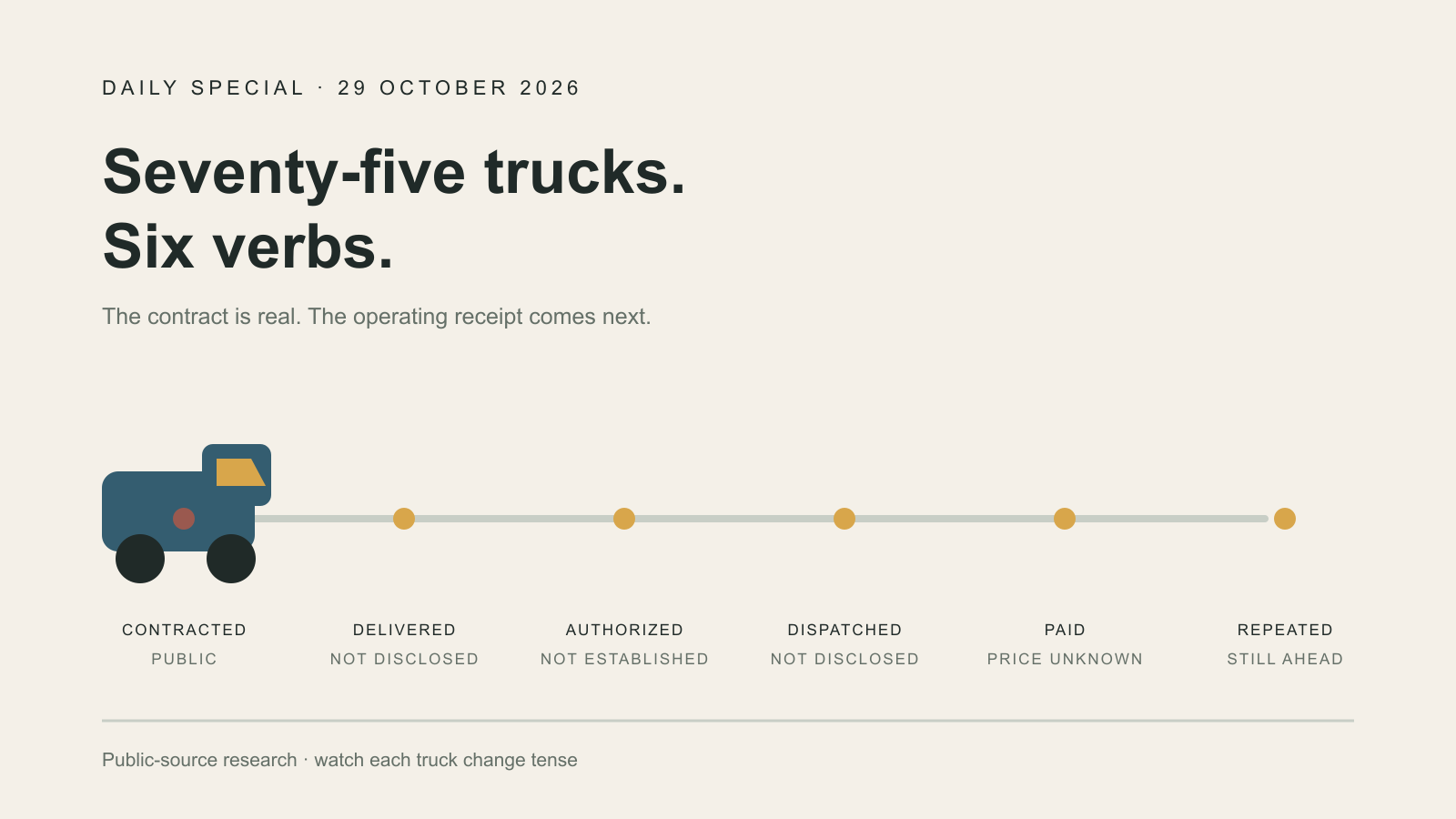
A truck can be contracted, delivered, authorized, dispatched, paid, and repeated. Corporate announcements often compress those six verbs into one handsome noun: fleet. Operations are less poetic. They happen one verb at a time.
The empty cab is not the whole product
The obvious image is a long-haul truck rolling through the Sun Belt with nobody in the driver’s seat. The less cinematic detail may matter more: DTL, a conventional freight carrier, is supposed to own and operate the trucks while paying Kodiak a per-mile fee for the autonomous driving system.
That is different from Kodiak buying every vehicle, finding every load, and becoming a trucking company with unusually clever equipment. In the Driver-as-a-Service model, the carrier keeps its fleet, dispatch operation, and customer relationships. Kodiak supplies the driver layer, software updates, integration, monitoring, and support.
If that architecture works, the autonomous company can scale through other people’s fleets. If it does not, the hidden support around each mile can turn an asset-light story into a surprisingly human business.
This is why the agreement is more interesting than a demonstration. Kodiak describes it as the first publicly announced definitive commitment by an interstate trucking company to operate driverless trucks in its own fleet under this model. DTL says it has more than 100 trucks, so a 75-truck commitment would be material to the company even though the exact fleet denominator is not public.
But the public evidence currently fills only the first column: contracted.
The pilot had a person in the cab
Kodiak and DTL did not meet yesterday. In September, they ran a 225-mile pilot carrying perishable freight between Fresno and Los Angeles. The route matters. Produce has a clock, and a delayed load can become a biology experiment nobody ordered.
The pilot also has an important qualifier: Kodiak’s own announcement said a human safety driver remained behind the wheel. It showed that the companies could put the system, the carrier, and a real load on the same road. It did not show driverless DTL service.
California’s permit record makes the distinction visible. As of October 21, the state DMV listed Kodiak among companies permitted to test with a driver. Its October 22 lists for driverless testing and deployment did not include Kodiak. That tells us about the California pilot, not the planned routes through Texas and toward Atlanta. The reviewed sources do not establish the route-by-route permissions for the future DTL operation.
“Tested route” and “authorized commercial service” are neighboring phrases, not synonyms.
Kodiak is not starting from zero
There is real operating evidence elsewhere. Kodiak launched its customer-owned Driver-as-a-Service model with Atlas Energy Solutions in the Permian Basin in December 2024. By June 30, 2026, Kodiak reported 35 Atlas-owned driverless trucks and more than 40,000 cumulative paid driverless hours. Across its Atlas and over-the-road operations, Kodiak Driver-powered vehicles had delivered more than 20,000 loads.
In October, Kodiak said one Atlas truck’s autonomy stack and vehicle stayed powered on and available for service for 64 consecutive days. Five other trucks had passed 45 days.
That is useful evidence of a system living outside a laboratory. It is not DTL evidence. The Atlas trucks work in an industrial environment; DTL’s proposed trucks would carry freight on long interstate routes. “Available for service” also does not mean driving continuously for 64 days. Availability, utilization, miles, loads, and successful customer delivery are different clocks.
The fair reading sits between hype and reflexive dismissal: Kodiak has a commercial driverless base, and the DTL contract asks whether that base can travel into a different operating world.
Two clocks, not one
The commercial attraction is easy to see. Federal hours-of-service rules generally allow a property-carrying driver to drive for 11 hours inside a 14-hour window after 10 hours off duty. Team drivers can keep a truck moving longer, but they add cost and complexity. A driverless system promises to loosen the relationship between vehicle utilization and a person’s need to sleep.
Unfortunately, the truck is not the entire freight system.
Loading docks have schedules. Tires wear. Sensors get dirty. Weather closes roads. Remote support teams need staffing. Maintenance still takes time. Receivers may not want a trailer arriving at 03:17, however tireless the tractor feels about it. The empty cab removes one constraint; it does not delete the rest of the supply chain.
This is where the per-mile fee becomes interesting. Revenue may scale with paid miles, but so can support, maintenance, insurance, connectivity, upfit, and incident-response costs. A mile that requires one remote-assistance event every few thousand miles is a different product from a mile that repeatedly needs a human to rescue the edge case. A route that produces more vehicle hours but also more downtime may look busy without becoming more valuable.
The public announcement does not disclose DTL’s fee, minimum miles, contract term, delivery schedule, intervention rate, or full cost per mile. That absence is not evidence that the figures are poor. It means the contract has not yet become an operating account in public.
A receipt for a moving fleet
Imagine a simple monthly card with six lines:
- trucks contracted;
- trucks delivered and fitted;
- trucks authorized for driverless service on the named routes;
- trucks actually dispatched on paid loads;
- paid driverless miles, accepted loads, interventions, and service availability under fixed definitions;
- full provider cost per paid mile, including the support nobody sees in the hero photograph.
The card would not need to reveal every trade secret. It would need stable definitions. Does a mile remain driverless if remote assistance occurs? Does “uptime” mean powered on, available, dispatched, or moving? Does a paid mile include repositioning? Who absorbs the cost of weather delays, maintenance, and a truck waiting at a closed dock?
Those questions are not bureaucratic decorations. They are the business model.
The sequence also protects us from a familiar mistake: borrowing proof from one stage to certify another. A signed contract is evidence of commitment, not delivery. A safety-driver pilot is evidence of integration, not driverless service. Forty thousand paid driverless hours in the Permian Basin are evidence of industrial operations, not interstate DTL economics. A 64-day availability streak is evidence of availability under its stated definition, not 64 days of continuous motion.
Each fact remains useful when it stays in its own lane.
The product around the product
The most defensible part of an autonomous trucking company may eventually be larger than the driving model. It may be the chain that fits hardware to a truck, maps a route, proves a safety case, handles a disabled vehicle, trains maintenance teams, prices insurance, supports dispatchers, and assigns responsibility when the ordinary becomes strange.
That chain is difficult to photograph, but it is what lets a carrier treat autonomy as an operating tool rather than a science project.
Kodiak and DTL have placed a serious first marker: 75 trucks, owned by the carrier, paid by the mile, aimed at real long-haul routes. Now the verbs have to change tense.
The empty cab will get the photograph. The operating receipt will tell us when the fleet arrived.
Notes and sources
Kodiak’s October 28 release supplies the 75-truck commitment, customer-ownership model, per-mile fee, first named routes, DTL fleet description, and Kodiak’s characterization of the agreement. The agreement itself was not available in the reviewed public sources, so the article does not infer undisclosed pricing, delivery, termination, or performance terms.
Kodiak’s September 24 release says the 225-mile California pilot carried perishable goods with a human safety driver. The California DMV permit page distinguishes testing with a driver from driverless testing and deployment; its public lists establish California status only, not permissions on the planned interstate routes.
Kodiak’s June 2026 quarterly filing supplies the Atlas fleet, paid driverless hours, loads, and DaaS description. Kodiak’s October 20 release supplies the 64-day and 45-day powered-on availability claims. These figures describe Kodiak’s industrial deployment and must not be read as DTL results. The FMCSA source supplies the general hours-of-service limits used to explain the utilization mechanism.
- Kodiak–DTL agreement announcement, October 28, 2026
- Kodiak–DTL California pilot announcement, September 24, 2026
- Kodiak quarterly report for the quarter ended June 30, 2026
- Kodiak Atlas uptime announcement, October 20, 2026
- California DMV autonomous vehicle permit holders
- FMCSA property-carrying hours-of-service rules
The full research artifact preserves the evidence ladder, operating definitions, and material limits.