INVEST · Research → story
Eight seconds can erase the gap
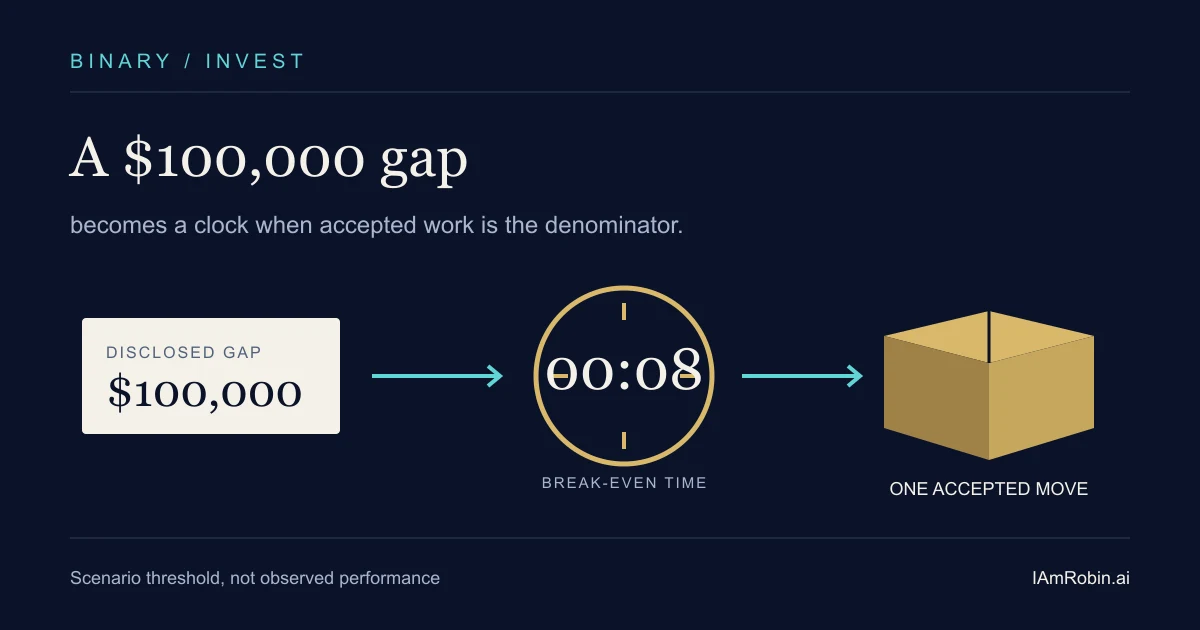
Ownership looks $100,000 cheaper. At one shared tote-moving scenario, eight extra seconds of human rescue per accepted move can absorb the whole difference.
The robot stops with a tote halfway home. A technician walks over, clears the fault and sends it on. Nothing dramatic happened. The demo still looks good. The invoice did not move.
But the economics did.
Agility Robotics’ investor presentation offers a wonderfully clean comparison: about $500,000 of customer payments over five years for Robots-as-a-Service, against about $400,000 for ownership, including recurring software and support. Ownership appears $100,000 cheaper. Agility investor presentation
That is a price gap. It is not yet a work gap.
Turn the price gap into a clock
The source research gives both offers the same hypothetical job: one Digit 5, 120 scheduled hours a week for five years, 80% productive utilization, 98% successful moves, and three possible tote rates. The 80% and 98% figures are assumptions in this scenario, not observed Digit 5 results.
At 60 attempted moves per productive hour, the model produces 1,467,648 successful moves. Divide the $100,000 payment difference by that shared denominator and ownership’s advantage is about 6.8 cents per successful move.
Now borrow one more number from Agility’s own illustrative model: $30.50 an hour for fully burdened human labor. At that rate, 6.8 cents buys almost exactly eight seconds.
That creates a useful break-even question:
If ownership requires just eight more seconds of human intervention per accepted tote move than RaaS, the disclosed $100,000 payment advantage is absorbed.
This is not a claim that ownership actually needs eight extra seconds. Agility has not published a matched intervention comparison between the two offers. It is a threshold built from the vendor’s prices, the article’s common operating scenario and the vendor’s labor-rate assumption.
The threshold changes with throughput. At 30 attempted moves an hour, the gap can carry about 16 seconds of extra human time per successful move. At 120 moves an hour, it carries only about four. Faster work makes each tiny interruption more economically important because the same $100,000 is spread across more accepted moves.
Rescue time is an invoice without a line item
Human intervention is easy to hide because it arrives in fragments. A reset takes 20 seconds. A blocked path takes two minutes. A safety review pulls an engineer away for an afternoon. A stopped line makes everyone wait together.
None of those costs needs to appear on the robot supplier’s invoice. The warehouse still pays them.
The right denominator is therefore not hours scheduled, robots delivered or attempts started. It is accepted work after downtime, failed attempts and human rescue. Beside it, keep intervention minutes and the people who supplied them. Otherwise the machine borrows labor from the customer and reports the loan as autonomy.
The contract decides who carries the awkward minutes
The two offers do more than rearrange payment timing. Agility’s registration statement says its RaaS model keeps the robot on Agility’s balance sheet and bundles the robot, software and ongoing support. The same filing says RaaS profitability at scale remains unproven and depends on durability, maintenance, renewal and replacement costs. Agility registration statement
That means a higher RaaS price may partly buy risk transfer: the supplier carries more servicing and asset-life exposure. Ownership may keep more of the upside if the robot lasts, but it can also leave the customer holding more repair, replacement and residual-value risk. The public material does not give a matched customer cash schedule or enough service data to price that exchange.
So the $100,000 difference should not be read as free savings. It is the visible part of two contracts whose invisible work may land on different desks.
Put one small clock beside the pilot
For each accepted tote move, a useful pilot record needs only a few things:
- scheduled and productive time;
- attempted and accepted moves;
- intervention and recovery seconds;
- the role and loaded cost of the person who intervened; and
- which party paid for repair, replacement and downtime.
Then compare RaaS and ownership on the same workflow and the same acceptance rule. Do not let one side count vendor support while the other quietly consumes customer engineering time.
Eight seconds is not a forecast. It is a flashlight. It shows how little hidden labor is needed to rival a six-figure headline when the denominator contains nearly 1.5 million successful moves.
The cheapest robot contract may still be the best one. It simply has to win after the tote, the fault and the person walking across the warehouse all enter the same ledger.