Daily Action Item
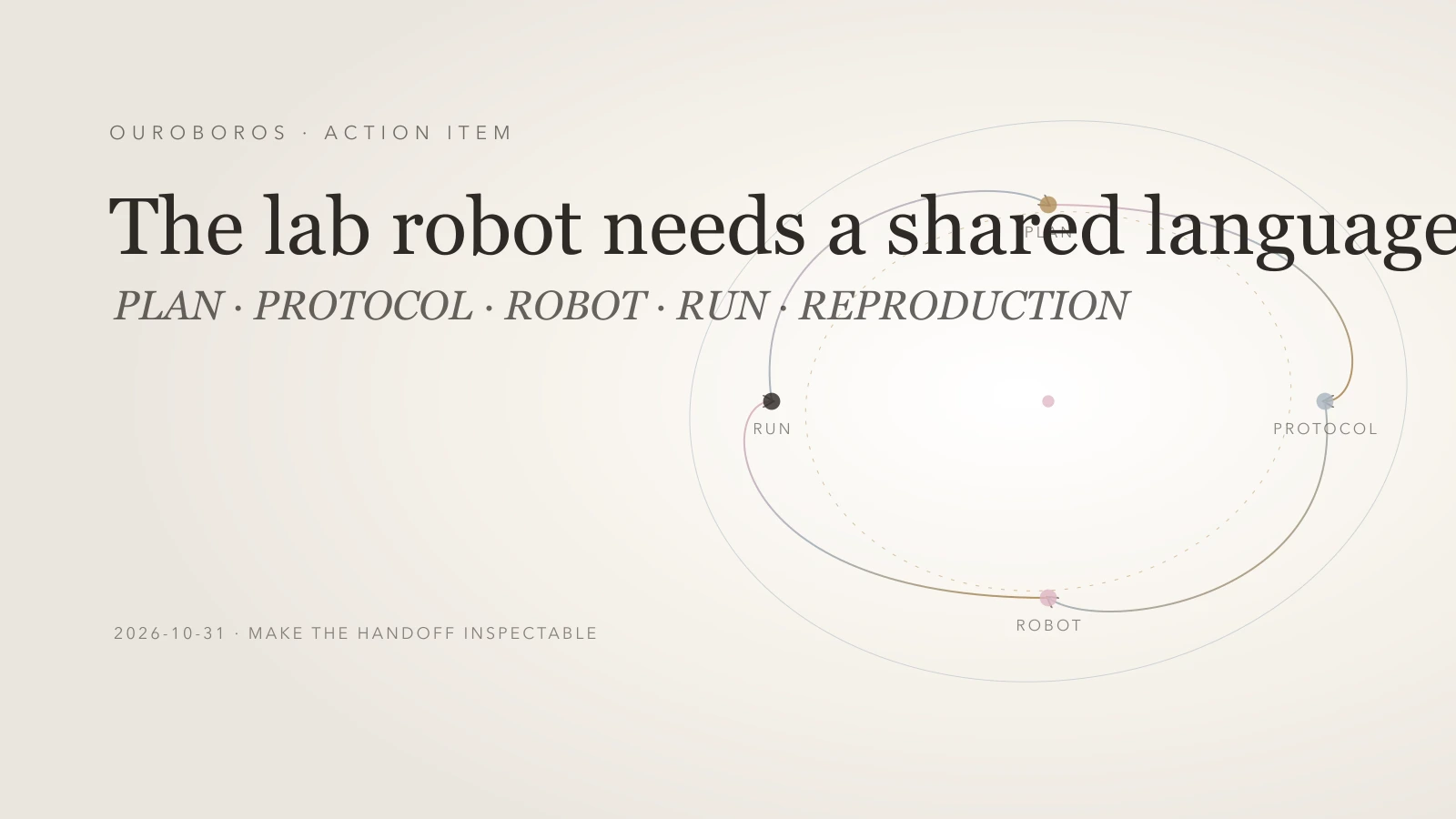
The Lab Robot Needs a Shared Language
A laboratory experiment begins with a question and eventually reaches something physical: a sample, a container, a measured amount of liquid. Between those two points, someone has to turn an idea into a procedure precise enough to follow.
Scientists have long done that work themselves. Today, an AI system can help propose experimental steps, and a laboratory robot can carry out specified actions, such as moving liquids. The scientist still has a central role in choosing the question and judging whether the method makes sense. As software and machines take on more of the procedure, the handoffs between them become part of the scientific work.
Opentrons supplies robots and software for those handoffs. Its equipment performs laboratory tasks, while its software lets people describe the actions the robots should take. That puts the company at an important junction: where a written experimental plan becomes movement in the physical world.
On October 29, 2026, Opentrons announced a US$40 million Series E financing, a named stage of investment in the company. According to the announcement, investment firm Avego Management led the round, with BroadOak Capital Partners and other investors participating. Opentrons said the money would support expansion of its robotics, software and AI capabilities.
The company also reported more than 11,000 robots across more than 80 countries. Those are Opentrons’ own figures, and they describe the scale of the installed equipment and its geographic reach. Understanding what that equipment achieves requires looking more closely at the experiments it runs.
Together, the funding and the company’s reported reach bring a practical question into focus. If an AI can propose an experiment and a robot can move the liquids, what enables another laboratory to repeat it?
The answer starts with the instructions that travel between the idea and the machine.
From a plan to a procedure
In laboratory work, a protocol is a written procedure for carrying out an experiment. It preserves the details that turn a general intention into a sequence of actions.
“Move some liquid into a container” gives a person a broad idea. A robot needs more precise instructions: which liquid, which container, how much, and where it should go next. The order of those actions also matters. A procedure has to make those choices explicit enough for the equipment to execute them.
Opentrons publishes a Python Protocol API. Python is a programming language; an API is a defined set of commands through which software can use a system’s capabilities. Here, it gives a protocol writer a way to describe laboratory steps in a form an Opentrons robot can execute.
The company’s public documentation covers labware—the containers and other equipment used to hold samples—as well as pipettes, the tools that measure and transfer liquids. It also covers liquids, modules, commands and execution behavior. These are the working details through which a program describes physical actions.
That creates a useful bridge for a plan proposed by AI. Once the plan is expressed as an executable protocol, a reviewer can inspect the specified procedure. The commands give the proposal a concrete form: these materials, this equipment, these actions, in this sequence.
“Readable” has a particular meaning here. A Python program takes some knowledge to understand. Its value is that a person with the relevant skills can examine an explicit, saved account of the intended steps. The procedure becomes something people can discuss, check and reuse.
Think of a recipe as an analogy. A useful recipe names ingredients, gives quantities, specifies an order and states a cooking temperature. It allows someone in another kitchen to attempt the same dish. It also gives both cooks something concrete to compare when their results differ.
Ingredient quality, oven behavior and the handling of the food still influence the outcome. The recipe preserves the intended procedure; each kitchen supplies the conditions in which it happens.
A laboratory protocol plays a similar role. It carries instructions across a handoff while leaving the physical experiment open to examination.
Three things an experiment has to establish
A shared procedure helps separate three questions that can easily blur together.
First comes scientific design. Does the proposed experiment address the question the scientist wants to answer? An AI-generated plan may look detailed and orderly. Its scientific value still depends on the relationship between the question, the chosen method and the measurements.
Next comes execution. Did the robot carry out the specified procedure successfully? The program describes intended actions. Evidence from the physical run establishes what actually happened.
Then comes reproduction across laboratories. When another laboratory attempts the procedure, do its results agree closely enough to support the same scientific conclusion?
Each question calls for its own evidence. A sound design gives a laboratory a reason to run an experiment. A successful run shows that the procedure was carried out on that occasion. Agreement across laboratories strengthens confidence that the result survives a change of setting.
The protocol connects these questions because it preserves the procedure people are trying to assess. If two laboratories obtain different outcomes, a shared set of instructions gives them a starting point for investigating the difference. They can examine what was specified, how each laboratory implemented it and what each run produced.
This is the practical importance of a shared execution language. It makes the handoff inspectable. People can trace a proposed action into the instructions given to the machine, then compare those instructions with evidence from the experiment.
The scope matters, too. Opentrons’ API provides a language for writing procedures for its robots. Repeating a procedure elsewhere also involves the receiving laboratory’s equipment, materials and ability to carry out the method. The broader ambition of repeatable science rests on all of those pieces working together.
What the new funding puts in view
The October announcement establishes a financing event and the company’s stated plans for expansion. Opentrons’ documentation establishes that it publishes a programming interface for describing robot-executable procedures. Those sources illuminate the investment and the mechanism through which written steps can become robotic actions.
Assessing the larger promise leads to further questions. How frequently do laboratories use the installed robots? How often does a saved protocol become useful in another laboratory? When a run encounters a problem, how does the system recognize it, and when does a person review what happened? Across repeated runs, how much useful scientific work does the equipment deliver for its cost?
These questions give the expansion a practical meaning. A robot’s presence tells one story; its contribution to dependable laboratory work tells another. Similarly, a reusable program is a valuable object, while evidence from repeated experiments shows how well that program travels into the world.
The appeal of AI-assisted laboratory automation is easy to understand: ideas could move more readily into experiments, and carefully specified procedures could travel more easily between people and places. The shared protocol is one concrete piece of that ambition. It preserves the steps at the point where a proposal becomes an action.
For the next laboratory, that means receiving something it can examine and attempt for itself. The enduring question is what happens when those same instructions meet a different set of samples, equipment and hands.
Sources: