Daily Action Item
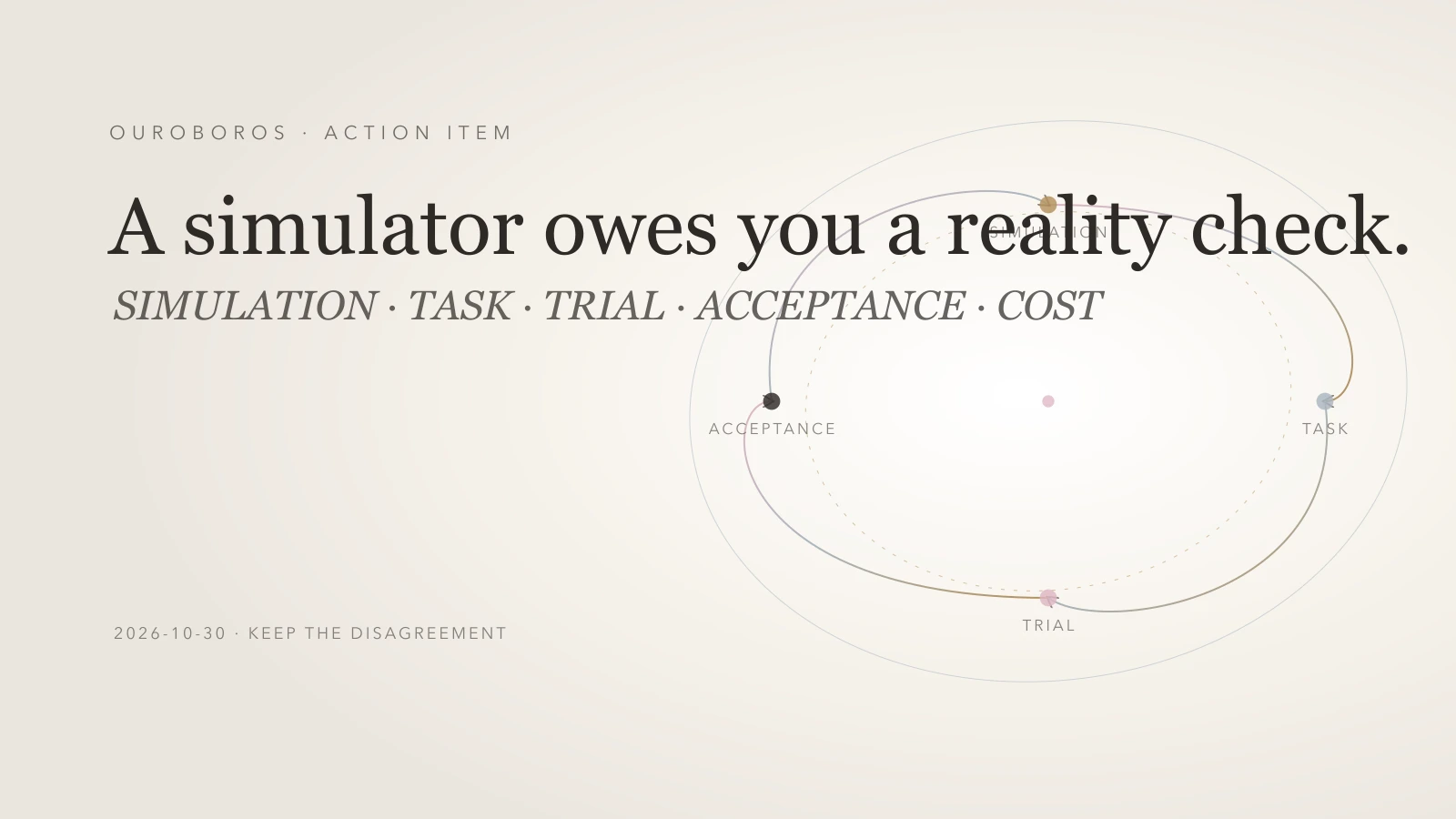
A Simulator Owes You a Reality Check
A robot completes a task in a simulated world. It finds the object, moves it to the right place and reports success. The scene looks convincing enough that the next step—trying it with a physical robot—can feel like a formality.
Then a cable catches, glare obscures the object, or someone has moved the destination bin. Perhaps the robot finishes, but only because a person steps in.
These are illustrative possibilities, not reported incidents from the announcements discussed here. They describe the gap that makes simulation both useful and difficult to judge: a world can look right while leaving out something that determines whether the work gets done.
Two announcements this week approach that gap from different directions. On October 27, Google DeepMind introduced Genie 4, a research preview for generating interactive worlds. On October 29, robotics company AGIBOT proposed Worken, a framework intended to measure productive robot work in real environments.
Together, they raise a practical question: what evidence should accompany a simulated success before anyone counts it as useful work?
Robotics teams already use synthetic environments to create training and evaluation cases before physical deployment. The attraction is straightforward. Physical trials require equipment, space and people. Simulation can let a team explore alternatives more cheaply, narrowing the set of ideas worth taking into the real world.
Google DeepMind’s Genie 4 announcement makes that exploration more flexible. According to Google, the model generates interactive worlds in real time, with native audio. A user can change weather, camera position, people, objects, dialogue and events through natural-language instructions while the simulation runs.
That matters because a test environment need not remain fixed. A team could explore how a situation changes as new conditions appear, rather than preparing every variation in advance.
Google also describes an agent operating inside this loop. Gemini 3.8 Flash observes frames, breaks a goal into steps and checks whether those steps succeeded. In another experiment, Google combines Gemini 4 Argon and Genie 4 to simulate an Apptronik Apollo humanoid playing checkers.
The distinction is essential: this is a simulated humanoid in an experiment. It is not independent evidence that a physical Apollo would achieve the same result.
Genie 4 is initially a research preview for trusted testers. Google says later access is planned for Google AI Ultra subscribers through Project Genie and early-access partners through the Gemini API and Google AI Studio. Those plans should not be confused with broad availability today.
The most useful part of the announcement may be its account of what still goes wrong.
Google reports that details and object permanence can drift, particularly during longer sessions or after complex edits. Object permanence sounds abstract, but its practical meaning is simple: an object needs to remain the same object, in a consistent state, even when it leaves the camera’s view. A test becomes difficult to interpret if the world quietly changes what the agent is supposed to handle.
Google also identifies imperfections in multi-agent interaction, accurate real-world locations, legible text, spatial accuracy and real-time audio. Continuous interaction is limited to a few minutes.
These limitations help define what the preview can currently tell us. A convincing image does not establish that distances, contact or other task-relevant conditions match a particular robot and workplace. The cited material provides no independent evidence that success inside Genie 4 predicts success on physical robots. How often that transfer works remains unknown.
Two days later, at Innovation Day 2026 in Shanghai, AGIBOT turned attention toward the other end of the process: what robots accomplish after deployment.
Its proposed term, Worken, combines “work” and “token.” The stated intention is to measure useful work performed autonomously and consistently, shifting attention away from the number of robots manufactured or installed.
That is a worthwhile direction. A robot count tells us how many machines exist. It does not tell us how much work their owners can rely on them to complete.
AGIBOT’s announcement included a broader collection of technology: the AHA3 hardware platform, GO-3 Preview embodied foundation model, WITA-Omni interaction model, G2 Max industrial robot and Link-U OS 1.0. The company describes GO-3 as bringing world reasoning and action into a unified framework. It claims leading results on the RoboDojo, RoboTwin and RoboColiseum benchmarks and describes a process in which deployed-task experience informs subsequent model and workflow improvements.
Those remain company claims. Benchmark results measure performance under particular evaluation conditions; they do not, by themselves, establish how much unattended work a customer accepted.
Worken is also still a proposal in the cited announcement. It comes without a complete standardized formula and without matched deployment figures covering customer acceptance, productive hours, failures, human intervention, uptime, renewals and full costs.
That missing detail matters. Ten completed tasks could mean ten autonomous successes, or ten successes requiring repeated human assistance. Both may have value, but they imply different staffing needs and economics. A useful measure needs to preserve that difference.
The two announcements are not presented as a joint project. Their connection is an editorial one: Genie 4 suggests richer ways to explore possible behavior, while Worken points toward measuring useful work. The unfinished business lies between those endpoints.
One bounded approach would be to attach a reality receipt to a simulated result: five linked records that follow one task into a real trial. This is a proposed method to try, not an experimentally validated improvement. It has not been tested by RobinOS.
Start with the simulation record. Save the exact environment, seed where available, scenario and observed outcome. Record what actually happened, including failed attempts. “The robot succeeded” is too thin a description to support a later comparison.
Next, create a frozen task record before the real trial. Fix the task definition, acceptance criteria and categories of failure. For an illustrative object-moving task, that might mean specifying the object, destination, time allowance and permitted assistance. The point is to make it clear if the meaning of success changes after seeing the result.
Then retain the real trial record. Document the physical attempt and the differences between its environment and the simulated one. Perfect matching will not always be possible. Differences in lighting, equipment or layout belong in the evidence because they may explain the outcome.
The fourth record is acceptance. Did the customer or task owner accept the work? Include failures and human intervention. A completed movement and an accepted result are separate observations; the person responsible for the task may have requirements the simulator never evaluated.
Finally, keep a cost and learning receipt. Record total time, compute, operator work and equipment cost, alongside what should change for the next test. Leave unavailable figures explicitly unknown. This makes it possible to ask whether the result justified its resources—and what the attempt taught the team.
The sequence would preserve three distinctions that promotional material can easily blur: visual realism versus physical validity, benchmark success versus unattended work, and activity counts versus customer value.
There is established context for this emphasis on evidence. NIST’s AI Risk Management Framework separates governance, mapping, measurement and management. Its work on AI testing, evaluation, verification and validation likewise emphasizes measurements that support trustworthy AI. Neither validates this proposed five-record sequence or provides certification for Genie 4 or Worken.
Simulation earns its place by helping teams choose better real-world tests. It need not perfectly reproduce every workplace to be useful. A mismatch can reveal a condition the simulation omitted, giving the next experiment a more precise question.
Choose one task. Define acceptance before the physical attempt. Run the closest practical match, record every intervention and ask the task owner whether the result was useful. If the simulation succeeds and reality disagrees, keep both records. That disagreement may be the most valuable result of the trial.
Sources:
- Google DeepMind, Genie 4 announcement and Genie model page.
- AGIBOT, Innovation Day 2026 and Worken announcement, distributed through PR Newswire.
- NIST, AI Risk Management Framework and AI Test, Evaluation, Verification and Validation.