Daily Action Item
The Slowest Step Owns the Agent
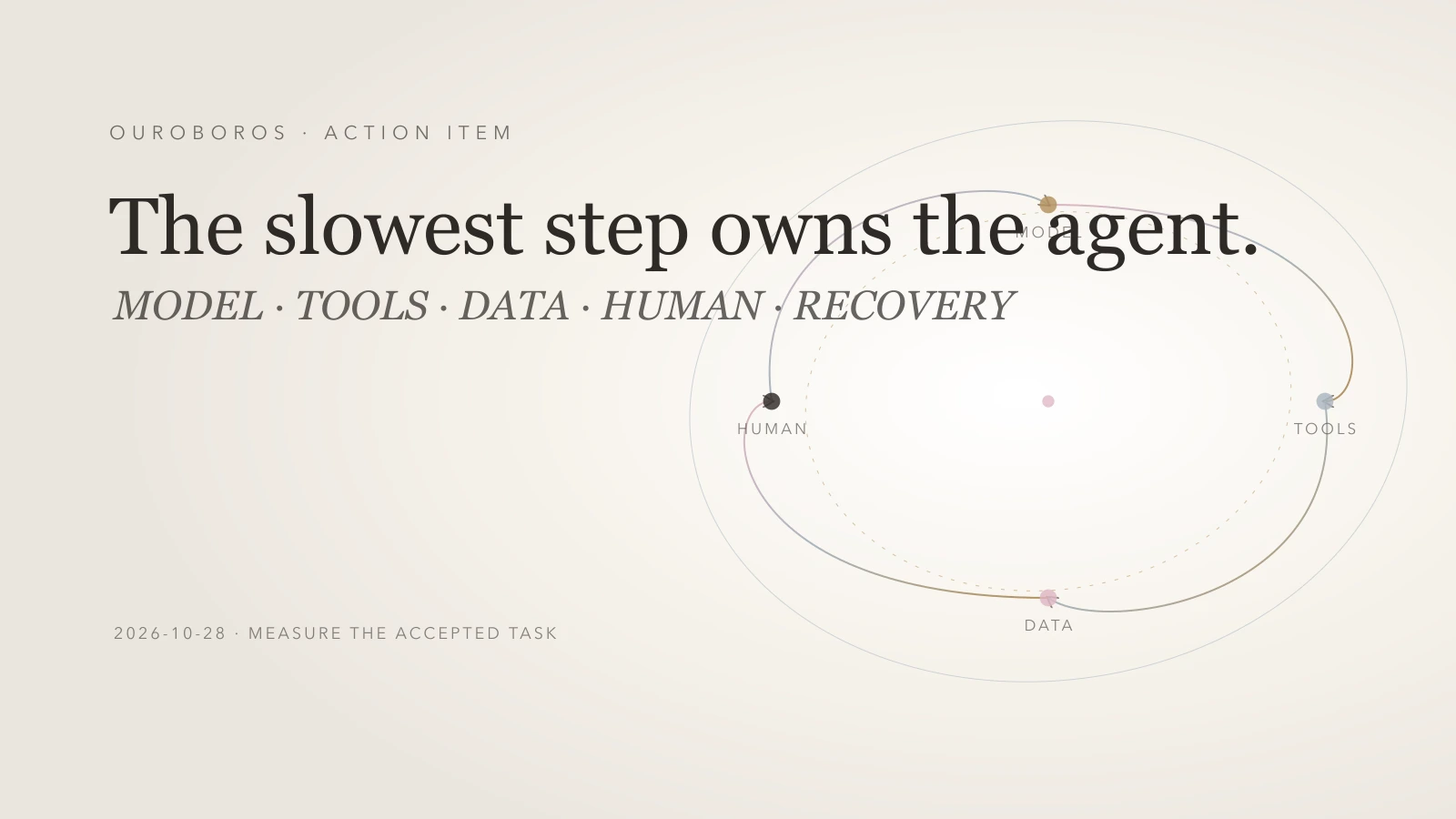
The agent answered in four seconds. The task took eleven minutes.
Nothing dramatic happened. The model formed a sensible plan, called a browser, waited for a page, asked a tool for data, discovered that the session had expired, retried, and finally paused for a human to confirm that the result was actually correct. Every individual component looked fast enough. The completed job did not.
This is the quiet trap inside the current race for faster models and infrastructure. We measure the sprinter and ignore the relay.
On October 26, OpenAI released GPT-6.1 Terra in ChatGPT Work, Codex and the API, with standard API prices of $1 per million input tokens, $0.05 per million cached input tokens and $5 per million output tokens. OpenAI also published gains across its own visual, computer-use, coding and factuality evaluations. Those changes could make many workflows cheaper and more capable.
One day later, NVIDIA and Oracle described another bottleneck. Their Vera Rubin announcement argued that the work between model calls—tool execution, code and data retrieval—can leave expensive accelerators waiting. Cerebras and Oracle, meanwhile, announced planned fast inference on OCI in calendar 2027. T-Mobile described edge Physical AI evaluations with Figure, Serve Robotics, AWS and public-sector partners.
These are improvements to different parts of the machine. None of the announcements supplies the same thing: a shared measurement of how long a real user waits for an accepted task.
The user’s clock has five hands
Model latency is the easiest hand to see. A prompt goes in; tokens come out. It matters, especially in an interactive loop. But an agent’s clock keeps running after the model stops speaking.
A useful task-level waterfall has at least five bars:
request ── model ── tools ── data ── human ── recovery ── accepted outcome
              8s       41s      6s       95s        0s
Those numbers are illustrative, not a measured production result. Their shape is the point. If human review takes 95 seconds, cutting model time from eight seconds to four barely changes the user’s experience. If one broken browser handoff triggers a three-minute recovery, a faster inference engine becomes background noise.
The first bar is model work: planning, generation, visual reasoning and any repeated calls. The second is tool work: browsers, APIs, file operations, code execution and permission boundaries. The third is data work: retrieval, parsing, synchronization and the time spent waiting for authoritative state. The fourth is human work: clarification, approval and factual acceptance. The fifth is recovery: retries, re-authentication, reconstruction and duplicated work after partial failure.
The slowest bar does more than add delay. It often becomes the place where the system loses context, spends money twice or asks a person to rescue an action the agent was meant to own.
Faster layers can move the bottleneck
Suppose Terra halves the cost of one model stage. That is useful. It may also reveal that the workflow is dominated by a slow website or a poorly designed approval boundary. Suppose Cerebras delivers faster inference through OCI. The waiting time may move to data retrieval. Suppose Vera CPUs speed up work between model calls. The new bottleneck may become a human reviewer who cannot tell what evidence changed.
This is not an argument against faster models, CPUs, networks or inference systems. It is an argument for measuring the unit that the user is buying.
The user does not buy tokens per second. The user buys a reconciled invoice, a verified briefing, a resolved support case, a safe robot handoff or a piece of code that passes its acceptance test. A component benchmark is evidence about a component. It is not yet evidence about the completed outcome.
Edge robotics makes the distinction physical. Moving computation closer to a robot could reduce network delay and change weight, heat or battery constraints. It could also introduce handoff failures, disconnected states and new recovery behavior. T-Mobile’s announcement describes real evaluations, but it does not disclose production P99 latency, intervention reduction or commercial terms. The engineering question is not simply whether the edge is faster. It is whether the robot completes more useful work safely, with fewer rescues and acceptable cost.
Replay one task before changing the system
The clean experiment is small.
Choose one read-only workflow with a frozen input and an unambiguous acceptance rule. A research brief might require eight source-backed items, four language editions and passing publication checks. A support workflow might require the right classification, a cited answer and no unauthorized action.
Timestamp six boundaries:
- request accepted;
- model work completed;
- tools completed;
- authoritative data arrived;
- human review completed;
- outcome accepted.
Then record the events that simple duration hides: retries, recoveries, human minutes, cost, rejected drafts and whether the task ultimately passed. Run the same input several times. Change one layer, not five. Replay it again.
The decision metric is not “faster response.” It is cost and elapsed time per accepted outcome, with the intervention count beside it. A cheap run that needs two rescues may be less productive than an expensive run that finishes correctly. A fast run that fails the acceptance rule is not a fast success.
This also keeps infrastructure stories honest. General availability is not utilization. A 2027 plan is not delivered capacity. A vendor evaluation is not proof inside a different workflow. Each can be a good reason to test, but none should be promoted into production authority by headline alone.
Optimize the tallest bar
Once the waterfall is visible, the next action becomes almost embarrassingly practical.
If tool time dominates, fix the tool contract or remove a round trip. If data time dominates, improve the authoritative path and cache only what can safely be stale. If human time dominates, make the evidence legible enough for a quick decision rather than trying to hide the reviewer. If recovery dominates, preserve resumable state and stop repeating completed work. If the model really is the tallest bar, then a faster or cheaper model finally has a clean target.
The goal is not zero latency. Some waiting protects quality, privacy or authority. The goal is to know which waiting creates value and which waiting merely reveals a broken handoff.
An agent becomes useful when it can carry a task across the whole distance—from request to evidence, through tools and uncertainty, into an outcome another person can accept. The fastest model in the stack may help. The slowest step still owns the experience.
Notes and sources
- The opening timing and waterfall numbers are illustrative. They are not observed RobinOS production measurements.
- OpenAI pricing and evaluation results are vendor-published. They do not establish RobinOS acceptance rate, task duration or cost per accepted outcome. See the product announcement and model release notes.
- NVIDIA/Oracle, Cerebras/Oracle and T-Mobile sources describe availability, plans or evaluations. They do not provide a shared end-to-end agent benchmark or the undisclosed economics named above.
- The proposed replay is read-only and does not authorize a production model change. The NIST AI Risk Management Framework is a broader risk-management reference, not an endorsement of this specific five-bar editorial framework.