01 · AI Circularity Ledger
One Inquiry Proves One Thing
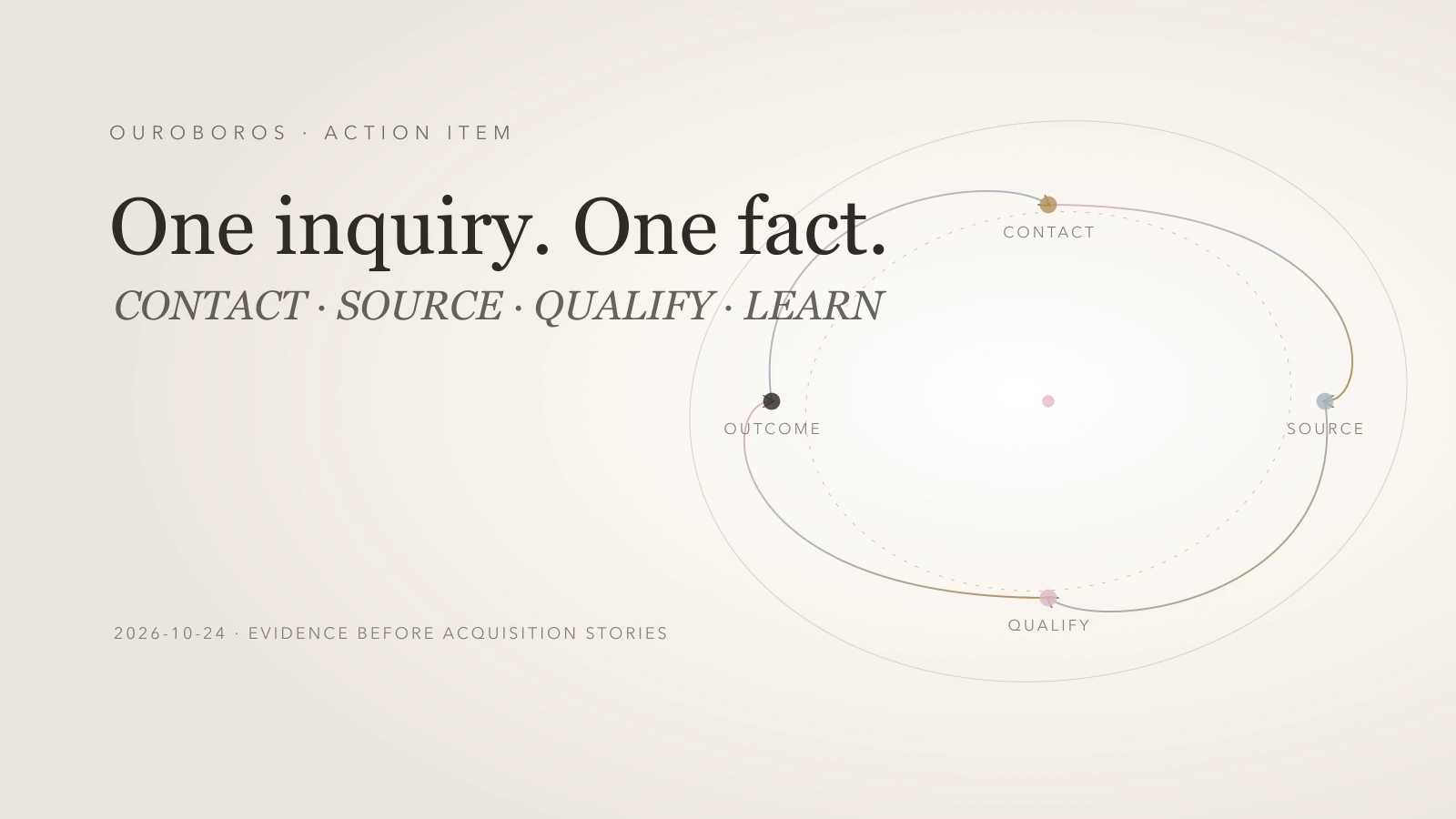
A commercial loop with a scoreboard.
One message arrived through the iSunTV website. It asked about cooperation. No Google Ads were running.
That is a small event with a surprisingly clean edge. One person saw enough of the business to make contact. The website helped turn an unknown visitor into a conversation.
It proves exactly that much.
The message does not reveal whether the visitor found iSunTV through Google Search, an AI answer, a referral, a shared link, direct navigation, or an older offline connection. It says nothing yet about budget, authority, timing, commercial fit, or a future transaction. There is one inquiry, one date, and one visible behavioral step.
This is where early-stage businesses often lose the plot. A weak signal gets dismissed as anecdote, or inflated into a growth story. Both reactions throw away information. The useful move is to preserve the signal at its true size, then design the next evidence gate.
The website made a promise legible
Before anyone asks where the visitor came from, ask what the visitor could understand after arriving.
The public iSunTV website presents a specific identity: Chinese entrepreneurs, global markets, interviews, licensing, authorization verification, and a route to make contact. It gives a stranger several ways to answer basic questions. What does this organization talk about? Who is it trying to connect? What might cooperation mean? Is there a visible path to a real person?
iamrobin.ai adds another layer. It describes Robin’s work on iSunTV as a shift toward an AI-native news lab, streaming commerce, and one-person-company experiments. A visitor moving between those sites can see both an institution and the builder trying to change it.
That public surface matters. A contact form alone rarely creates intent. The pages around it reduce uncertainty until a visitor decides that writing is worth the effort.
The inquiry therefore gives the site one meaningful credit: the offer was legible enough to prompt action. It cannot yet tell us which page, sentence, search result, conversation, or recommendation did the persuading.
Removing one cause does not identify the cause
“No Google Ads” is useful evidence. It removes a paid-search campaign as the direct explanation for this inquiry.
Many other paths remain open. Google Analytics describes source and medium as the dimensions used to understand where visitors came from. Source may be a search engine, another website, a campaign, or direct traffic. Medium separates categories such as organic search, referral, email, social, and paid search.
Even those labels have limits. Google explains that (direct) / (none) can mean a typed URL or bookmark, yet it can also appear when referral information is lost through untagged links, redirects, shorteners, offline documents, or privacy tools. A neat dashboard cell may contain several different stories.
Search Console’s performance report can add search queries, impressions, clicks, countries, devices, and landing pages. That would help test whether relevant search visibility existed around the inquiry date. It still would not prove that a particular person sent the message unless the evidence joined at an appropriate, privacy-respecting level.
Attribution is a chain of evidence, not a guess with a familiar logo attached.
The honest state for this inquiry is simple: paid Google Ads are excluded by the owner’s account; the actual acquisition source remains unknown.
An inquiry has to climb four steps
The first step is contact. A person or organization initiated a conversation. That happened.
The second is qualification. Does the request match something iSunTV can and wants to do? Is there a concrete need, a responsible decision-maker, a plausible time frame, and a next action both sides accept? Those questions can be answered without assigning a lead score or building a large CRM.
The third is progression. A qualified conversation should move to a visible next state: a meeting, a written brief, a proposal, a pilot, a licensing review, or a clear decision to stop. Silence is also an outcome when it is recorded honestly.
The fourth is repetition. A channel exists only after multiple relevant contacts arrive through a traceable path and create enough commercial value to justify the time and cost of maintaining that path.
These steps prevent language from outrunning evidence. “Inbound inquiry” is accurate today. “Qualified opportunity” needs a completed qualification record. “Customer acquisition” needs an economic outcome. “Repeatable channel” needs a series, a denominator, and costs.
One inquiry can move through all four steps. It cannot skip them.
Keep the record smaller than the person
The temptation after an unexpected lead is to collect everything: identity, company, message history, profile links, screenshots, analytics exports, and every theory about origin. That creates a large private record before the business knows what it needs.
The NIST Privacy Framework treats data processing as a risk-management decision and includes data minimization among its principles. The practical lesson here is modest. Keep the business evidence needed for the decision; avoid building a dossier around the sender.
A useful inquiry record can fit on one screen:
- received date and public entry point;
- acquisition source, or
UNKNOWNwith the reason; - stated need in a short, non-identifying summary;
- fit, authority, timing, and next step;
- current state: inquiry, qualified, progressing, stopped, or won;
- evidence for the state and the next review date.
Personal contact details can remain in the authorized communication system rather than being copied into an editorial or analytics ledger. The public article needs even less: the existence of the inquiry, its evidentiary limits, and later state changes that can be disclosed safely.
This keeps the record useful and reversible. It also makes correction easy. If analytics later shows a credible source, update the source field. If the conversation qualifies, update the state. If it ends, record why. None of those changes requires rewriting the original event.
The next update should earn a stronger noun
The same-day Daily Briefing assigns this article one job: document what the website actually proved.
The answer is narrower than a growth case and more useful than a shrug. A stranger found a public explanation of iSunTV, understood enough to see a possible relationship, and chose to begin a conversation.
The next evidence should earn the next noun.
If the need fits, call it qualified. If both sides accept a concrete next step, call it progressing. If value changes hands, record the commercial outcome. If similar opportunities arrive through an attributable path at an acceptable cost, then start discussing a channel.
Until then, one inquiry proves one thing: the website made a conversation possible.