01 · AI Circularity Ledger
Your Stock Has a Second Life
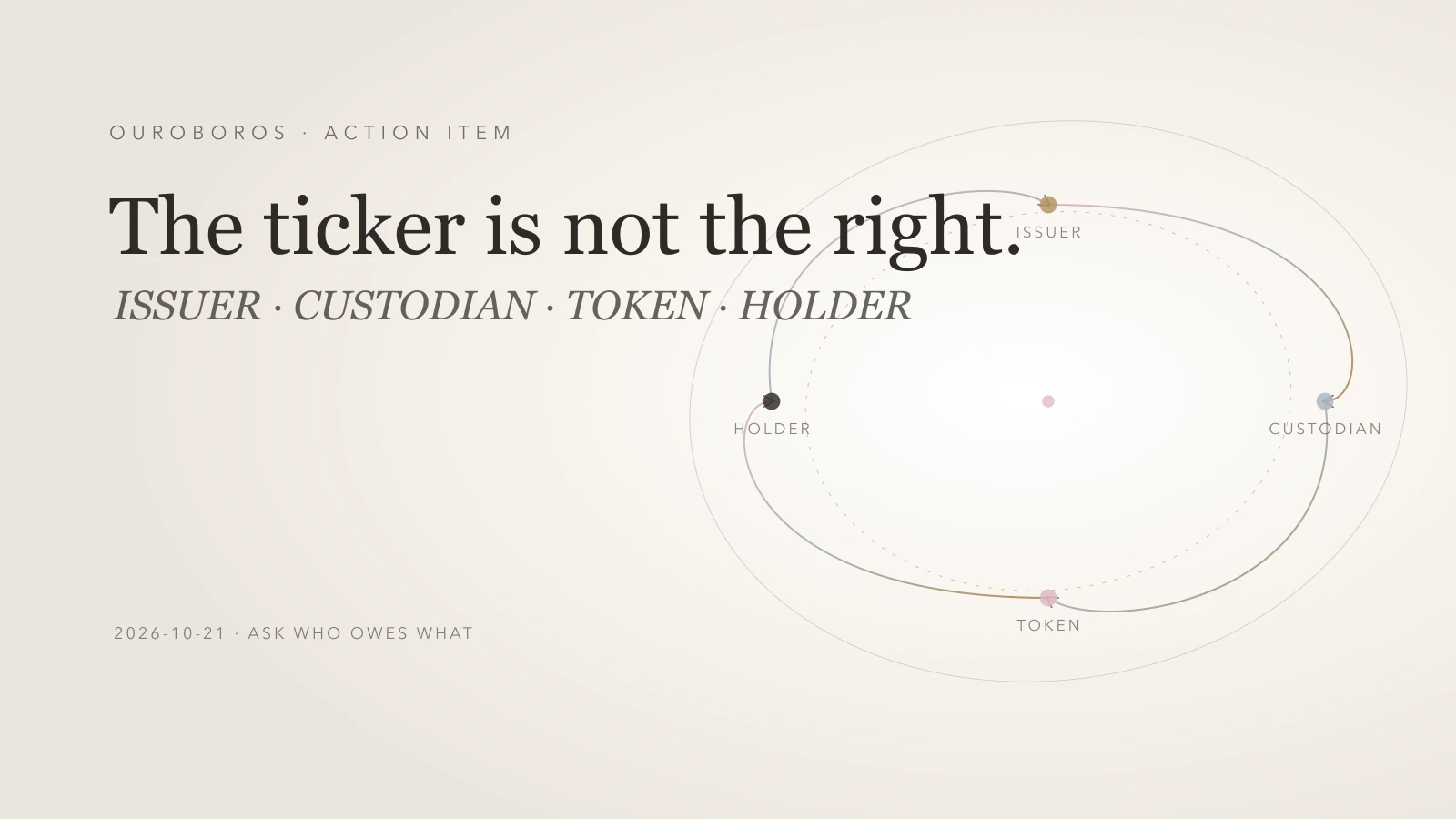
A commercial loop with a scoreboard.
The conclusion is simple: a stock token can share a ticker with a public company while giving its holder a very different legal and economic object.
The token may be the security itself, recorded by the issuer or its agent. It may be an entitlement to a share held by a custodian. It may be a note or derivative whose value follows a share while the holder receives no claim against the company. All three can produce a familiar price on a screen. Their voting, dividend, redemption, insolvency, transfer, and enforcement paths can diverge.
This is why issuer objections to tokenized-stock trading matter even when an issuer cannot stop every third party from creating an instrument that references its price. The objection is a signal about consent, trademark, market integrity, disclosure, or investor confusion. It is not, by itself, a complete description of the holder’s rights. The useful question begins one layer lower: after the token leaves the marketing page, who owes what to its holder?
The answer needs a rights map. Price exposure sits on one line. Ownership records, custody, contractual claims, shareholder services, trading venue rules, and recovery in failure sit on separate lines. Combining them into the word “stock” hides the structure that determines the outcome.
One label, three different claims
The SEC staff statement on tokenized securities supplies a useful taxonomy. It describes issuer-sponsored tokenization and third-party-sponsored models, while stressing that structures differ and the rights attached to a crypto asset may differ materially from the underlying security.
In an issuer-sponsored model, the issuer or its agent integrates a crypto network into the system used to record owners. A valid transfer of the token changes the official ownership record. The token is connected to the master securityholder file rather than merely pointing toward an asset elsewhere. Corporate actions, transfer restrictions, and identity controls still matter, though the ownership chain begins with the issuer’s own recordkeeping architecture.
In a custodial model, a third party holds the underlying shares and issues tokens representing interests in those assets. The token holder’s position depends on the custody chain, account structure, contractual terms, segregation, reconciliation, and the third party’s ability to deliver shareholder benefits. The company may continue to see the custodian or nominee in its records. The holder may receive an economic entitlement through the intermediary without appearing as the registered owner.
In a synthetic model, the token tracks price through a note, contract, security-based swap, or other obligation. The holder owns a claim against the product issuer or counterparty rather than a claim against the referenced company. Dividends may be simulated as cash adjustments. Voting may be absent. Redemption may depend on contractual formulas. Counterparty insolvency can matter more than the referenced company’s solvency.
These are different products even when each interface displays the same ticker. The ticker describes the reference. The contract describes the asset.
Registered, beneficial, and synthetic are separate
Ordinary securities already contain layers. Investor.gov’s explanation of registered and beneficial ownership distinguishes a registered owner recorded directly on company books from a beneficial owner whose shares are held through a bank or broker in street name. Tokenization adds possible ledgers and contractual wrappers to that established chain.
Registered ownership is the clearest link to the issuer’s record. The transfer agent or comparable recordkeeper maintains the official list and supports distributions and corporate actions. This does not remove every operational or legal risk. It establishes where the ownership record lives and which transfer changes it.
Beneficial ownership is familiar rather than defective. Most investors use intermediaries. The critical point is that the intermediary chain has defined duties, records, controls, and resolution processes. A tokenized custodial entitlement needs an equally legible chain. The holder should know the legal owner of the backing share, the custodian, the token issuer, the account in which shares sit, the reconciliation frequency, and the process for receiving dividends, voting instructions, splits, tender offers, or proceeds.
Synthetic exposure can be useful, too. It can extend trading hours, change denomination, reach new venues, or package risk. Its value proposition should be judged as a derivative or issuer obligation. Calling it a tokenized stock without the qualifier encourages the holder to import rights from the referenced share that the contract never grants.
The distinction becomes decisive in failure. If the token platform becomes insolvent, an issuer-recorded share, a segregated custodial entitlement, and an unsecured synthetic claim may enter three different recovery paths. A live price before failure offers almost no evidence about which path applies afterward.
Consent is a signal, not the whole verdict
OKXICE’s public-notice page publishes notices relating to issuer objections. The venue’s latest notice at the research cutoff was dated October 19, 2026. Public reporting counted objections from 16 companies. The venue had not announced a live launch date at the cutoff, so trading quality, redemption behavior, spreads, volume, and customer adoption remained unavailable.
An issuer objection can mean several things. The company may reject any implication that it sponsored or approved the token. It may seek to protect trademarks or reduce confusion. It may worry that off-hours pricing, fragmented liquidity, or incomplete corporate-action handling will be attributed to its ordinary shares. It may believe disclosures or investor protections are inadequate. The objection itself does not tell us which tokenization model applies or whether the instrument is lawful.
The inverse also holds. Silence from an issuer does not prove consent, endorsement, reserve quality, or equivalent shareholder rights. A platform can list an instrument under its own legal theory without obtaining a public statement from every referenced company. Investors still need the instrument’s documents and the applicable regulatory perimeter.
Consent should therefore occupy one field on the rights map. Record APPROVED, OBJECTED, NO PUBLIC POSITION, or UNKNOWN, with a dated source. Keep it separate from legal structure, backing, entitlement, and venue authorization. This prevents an objection from becoming an invented ban and prevents silence from becoming invented approval.
Venue permission does not rewrite the claim
The SEC statement on the Innovation Exemption describes conditional, time-limited relief for eligible trading activity. Exemptive relief can define who may operate, which assets or transactions qualify, which conditions apply, and how long the permission lasts. It can create a supervised path for experimentation.
That venue-level permission does not transform a synthetic instrument into issuer stock. It does not place a token holder onto the company’s register, create voting rights, or guarantee redemption at net asset value. It also does not establish that a product has launched, gathered liquidity, or survived a stressed market. Those claims require separate evidence.
This separation is useful beyond one venue. Regulation can answer “may this intermediary offer or trade this product under stated conditions?” Product documents answer “what is the product?” Custody and ledger evidence answer “is the backing present and reconciled?” Corporate records answer “does the issuer recognize this holder or transfer?” Market data answer “how did trading perform?” One favorable answer cannot fill every row.
The SEC staff taxonomy is also a staff statement rather than a rule with independent legal force. It clarifies categories and assumptions. A specific product still requires its own documents, facts, jurisdictions, and legal analysis. The framework is a reading tool, not a universal approval stamp.
A second clock changes price discovery
Tokenized instruments can trade while the primary equity market is closed. That creates a second clock. News can enter the token venue first. The token may show a price while the reference share has no contemporaneous quote. When the primary market reopens, the two prices can converge, overshoot, or remain separated by access, funding, inventory, and contractual limits.
This sounds like continuous price discovery, though the quality of that discovery depends on depth and arbitrage. A displayed price from thin trading can be informative, noisy, or easy to move. Arbitrage requires a route between token and share. A synthetic token with cash settlement has a different convergence mechanism from a redeemable custodial token. Transfer windows, identity checks, market holidays, borrow availability, funding costs, and venue outages can block the apparent trade.
The instrument can also influence perception. A sharp off-hours move may circulate under the company’s ticker even when the company neither issued nor approved the token. Journalists and investors may read the token price as a forecast for the ordinary share. That may be useful information, yet it remains a price generated in a different market with different participants and constraints.
Before calling this better price discovery, measure quoted depth, executed volume, spreads, price impact, arbitrage completion, divergence at the primary open, and failure rates. Separate trades from indicative marks. Record whether the holder can create or redeem against underlying shares. Without those fields, “24/7” describes hours rather than market quality.
The six-line rights card
A product can be screened with a compact card before anyone discusses yield or access.
Issuer line. Did the company or its authorized agent issue, approve, object to, or take no public position on the token? Which name and trademark permissions exist? Where is the dated evidence?
Ownership line. Does a token transfer update the issuer’s master securityholder file? If shares sit in street name, who is registered and who is beneficial? If the token is synthetic, name the legal obligor and avoid the word ownership.
Backing line. What asset, account, or contract supports each token? Who holds it? Is the backing segregated? How often are token supply and asset balances reconciled? Can a holder independently verify the relevant quantity without exposing private customer data?
Rights line. Who receives dividends, votes, split shares, tender materials, litigation proceeds, and other corporate actions? Which rights pass through automatically, by instruction, by discretionary policy, as cash equivalents, or never?
Exit line. Can the holder redeem for a share, cash, or only sell to another buyer? State fees, minimums, identity requirements, supported hours, settlement times, suspension powers, and the treatment of market closures.
Failure line. What happens if the token issuer, custodian, broker, venue, stablecoin, oracle, or smart contract fails? Identify governing law, priority, recovery assets, and the party responsible for correcting a ledger mismatch.
The card turns a marketing noun into a chain of enforceable verbs. It does not rank every structure the same way. It makes the trade visible. An issuer-recorded token can still have weak liquidity. A well-collateralized custodial token can still add intermediary risk. A synthetic product can be transparent and useful when its counterparty, settlement, and risk are clearly disclosed.
What the current evidence proves
Commissioner Peirce’s earlier statement, “Enchanting, but Not Magical”, captured the durable constraint: moving a security to a new technical form does not erase the underlying legal questions. It also noted that a token lacking legal and beneficial ownership of the referenced security may fall into a different regulatory category.
The current public evidence establishes that regulators now describe distinct tokenization models; a temporary venue exemption exists with conditions; OKXICE publishes an issuer-objection process; and several referenced issuers have objected publicly. It does not establish a live OKXICE market, complete reserves, reliable redemption, equivalent voting, institutional liquidity, tighter spreads, or investor benefit.
The state is therefore PRE-LAUNCH / WATCH. The mechanism and policy perimeter are concrete enough to map. Operating performance remains UNKNOWN. No investment or product-use conclusion follows from the announcements.
The next evidence gate is a complete lifecycle for each model. For an issuer-recorded token, show issuance, transfer, ownership-record change, corporate action, and withdrawal or cancellation. For a custodial token, reconcile backing, token supply, beneficiary records, dividend treatment, redemption, and insolvency segregation. For a synthetic token, disclose the obligor, collateral, payoff, fees, termination events, and a stressed settlement.
Then compare token and ordinary share through one material event: earnings, a dividend, a split, a tender, or a market halt. Measure price divergence, spread, depth, settlement, failed transfers, corporate-action accuracy, intervention, and total holder cost. That evidence would test whether the second life preserves the rights users think they bought.
Read the claim before the ticker
Investor.gov defines a beneficial owner as someone who holds stock indirectly through an intermediary. That compact definition is a useful anchor. Indirect ownership has an established meaning. A token must state whether it fits that meaning, establishes direct ownership, or provides another type of claim.
The vocabulary should follow the contract. Say issuer-recorded security when the issuer’s official record changes. Say custodial entitlement when the token represents an interest in shares held through an intermediary. Say synthetic exposure when value references a share without ownership rights. Reserve “tokenized stock” as a broad category, then immediately name the subtype.
This discipline helps issuers, venues, writers, and holders. Issuers can object without pretending every reference product is identical. Venues can describe innovation without borrowing rights their contracts do not supply. Writers can report price moves without implying corporate approval. Holders can choose exposure with a clear view of the party they must trust.
A stock can have a second life on another ledger, venue, or clock. The second life inherits no rights merely from the ticker. Those rights come from records, contracts, custody, and law. Read them before reading the chart.
Categories and keywords
Categories: Financial Systems, Tokenized Securities, Market Structure
Keywords: tokenized stocks, beneficial ownership, issuer consent, synthetic exposure, shareholder rights, custody, 24/7 markets
Hashtags: #TokenizedStocks #MarketStructure #ShareholderRights #DigitalAssets #Ouroboros