03 · Daily Special · Signal 2
Nine minutes cannot prove a shift
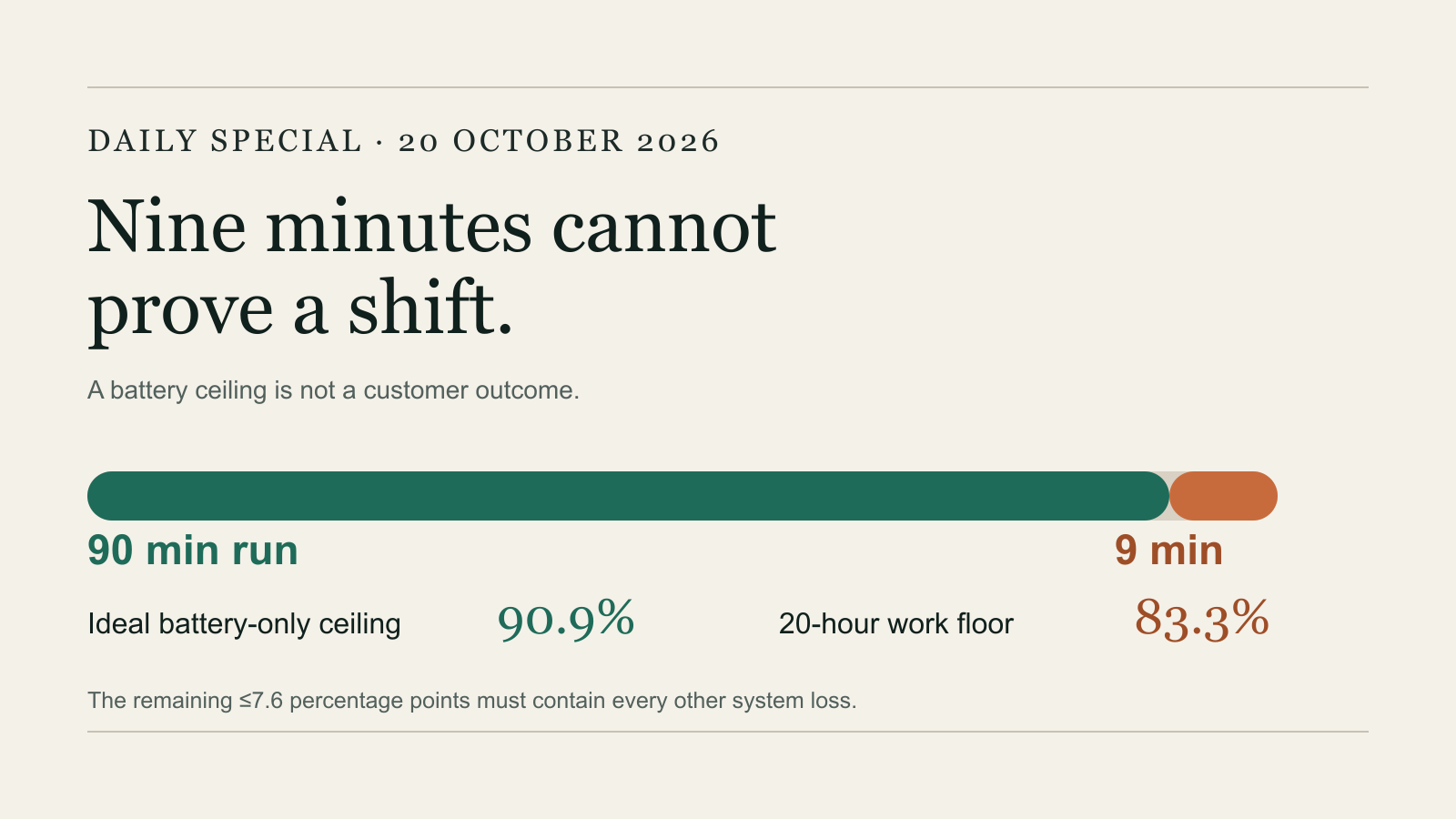
A public-source measurement map translating Digit 5's announced 90-minute runtime and nine-minute recharge into a battery-only ceiling, a fleet charger bound, and the customer-shift ledger still needed; no deployment, purchase, investment, contact, or trade.
A nine-minute charge is an excellent answer to a small question: how long is the robot attached to a charger?
A factory asks the larger one: how much accepted work arrives by the end of the shift?
Agility Robotics says Digit 5 will run for 90 minutes, recharge in nine and work for more than 20 hours in a 24-hour day. The battery announcement calls this a jump from Digit 4’s roughly 2:1 run-to-charge ratio to 10:1. It sounds like one decimal point has solved the shift.
The battery math does hold. It also reveals where the real test begins.
The ceiling is 21 hours 49 minutes
One ideal cycle contains 90 minutes of running and nine minutes of charging. So the robot can run during 90 divided by 99 minutes, or 90.9%, of the battery cycle.
Stretch that perfect rhythm across a day and the result is about 21 hours 49 minutes of runtime and 2 hours 11 minutes of charging. Digit 4’s disclosed 2:1 ratio would produce a 16-hour battery ceiling under the same fantasy of perfection. On paper, the new system recovers almost six hours.
That is a meaningful engineering move. It is also a ceiling, built from a world with instant docking, an empty charger, no cooling delay, no maintenance, no blocked path, no fault, no human intervention and a useful task waiting at every moment.
Agility’s claim of more than 20 hours represents more than 83.3% of the day. If we use exactly 20 hours as the floor, there are about 109 minutes between it and the ideal battery ceiling. Every non-charging loss must fit inside that interval: travel to the charger, alignment, queueing, cooling, service, recovery, task waiting and rejected work.
The nine-minute number shrinks one bottleneck. It does not make the others disappear. It makes them easier to see.
Ten robots turn a charger into a traffic problem
An individual robot arrives at the charger once every 99 ideal minutes and occupies it for nine. One robot therefore consumes 9.1% of a charger’s clock.
With perfect staggering, five robots consume 45.5%. Ten consume 90.9%. Eleven consume 100%, leaving no time for docking, a late arrival, a hot battery or a charger fault.
This is a capacity bound, not Agility’s deployment plan. The company has not published a customer robots-per-charger ratio or queue record for Digit 5. The little exercise matters because a fleet does not experience an average. It experiences Monday morning, when two robots arrive together and one of them waits.
Fast charging can lower the number of spare robots a facility needs. It can also move coordination risk into the charging lane. Without an arrival distribution and some slack, “nine minutes” can become nine minutes plus a queue.
Motion needs a customer acceptance stamp
Agility reports that an earlier Digit moved more than 100,000 totes at GXO. That is real cumulative volume. The published page does not tell us how many scheduled hours elapsed, how many interventions occurred, how much time charging consumed or how many moves needed a repeat.
Those missing denominators matter because power-on time, walking time and useful work are different things. A robot can be moving beautifully while the warehouse waits for an accepted tote.
Agility’s own deployment process points toward the right test. Its 90-day operational pilot measures uptime, throughput and reliability before a workflow scales. I would connect those three words with one shift ledger:
- scheduled minutes;
- productive autonomous minutes on eventually accepted work;
- charging, docking and charger-queue minutes;
- blocked, waiting, service, fault and recovery minutes;
- human interventions, with duration and reason;
- rejected or repeated tasks; and
- battery state of health under the same load and temperature profile.
Then the first useful denominator is wonderfully plain: accepted tasks per scheduled hour. Put productive autonomous minutes beside it. One shows what the customer received; the other shows how much of the shift the robot actually converted into that result.
The announcement is still a target
The SEC-filed investor-day transcript explains why Agility rejected swappable batteries: extra mechanical complexity, another human or machine in the loop, and spare packs to manage. That is a credible design argument. The same transcript describes the 90/9 battery as something Digit 5 will use.
Agility’s Digit 5 page says the machine remains in development and its specifications are preliminary estimates based on internal testing and pre-production configurations. Early customer access is expected in the first half of 2027. The battery announcement itself places runtime, recharge time, cycle life, uptime and fleet economics inside its forward-looking statements.
So the current evidence supports a useful, narrower conclusion. Nine-minute charging could remove a large part of the battery penalty that constrained Digit 4. The company has not yet published the customer-shift ledger that turns that design target into more than 20 productive hours, durable cycle life or cost per accepted task.
There is nothing disappointing about that boundary. Good engineering often looks like moving a bottleneck until the next one becomes measurable.
The next proof should therefore be boring in the best way: a named customer, complete shifts, normal loads, normal temperatures, every intervention, every rejected task and the full charging queue. If the 90/9 target survives that ledger, the small number will have earned the large claim.
The full research artifact contains the calculations, fleet charger bound, proposed shift ledger and source limits. This work completes a public-source measurement map. It did not deploy a robot, contact a customer, make a purchase or change an investment decision.