01 · AI Circularity Ledger
Your AI Newsroom Needs a Kill Desk
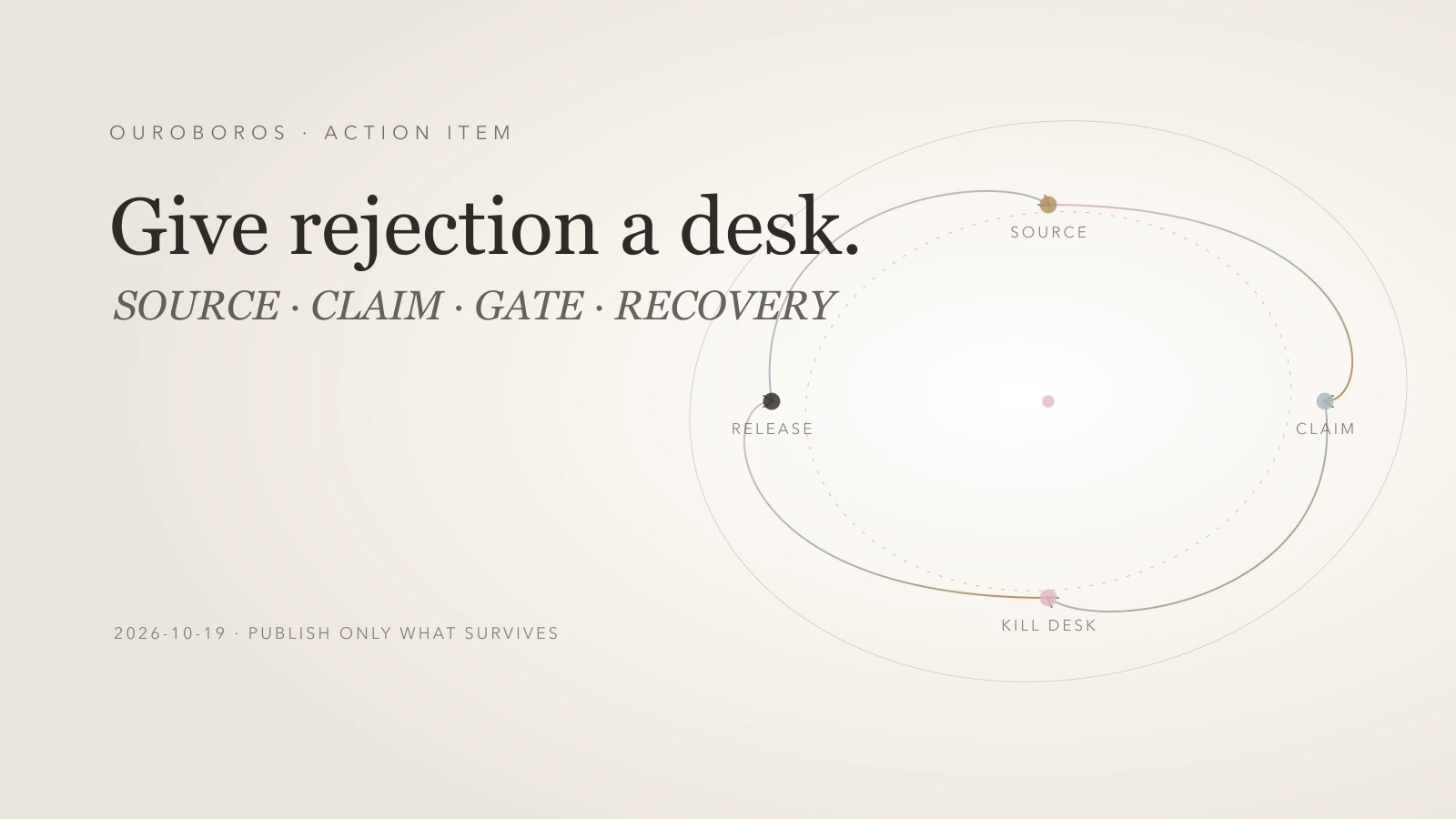
A commercial loop with a scoreboard.
The conclusion is direct: an AI newsroom needs a kill desk before it needs another writer.
Generative systems have made draft production abundant. A small team can scan more material, create more angles, translate more quickly, and package more formats than it could a year earlier. That abundance moves the constraint. The difficult work is deciding which claims survive, what evidence state each claim deserves, when a story must stop, and how a released error can be recovered without inventing certainty.
A traditional newsroom places editing after reporting. An AI newsroom needs a stricter structure. The kill desk is an operating function that sits between generation and publication. It can reject a source, a calculation, a causal story, a translation, an image, or an entire edition. Every rejection carries a reason. Every accepted claim carries a source path and a state. Every release carries a recovery route.
The name sounds severe because the job is severe. The desk exists to kill weak claims while they are still cheap. It protects attention, credibility, and future correction capacity. It also makes the rest of the newsroom faster. Writers and agents can explore broadly because the path to publication is narrow, explicit, and inspectable.
This design is especially useful for a one-person company. A solo operator cannot add a human editor for every agent. The system must turn editorial judgment into a small set of hard interfaces without pretending judgment has disappeared. The goal is fewer supervision loops, higher claim survival, and faster recovery when reality changes.
Throughput moved the bottleneck
AI systems can produce competent prose long before they can establish the truth of every sentence. The gap appears clearly in engineering work. Google’s account of an overnight Gemini 4 Argon optimization run describes an agent working for eleven hours across a codebase of more than 200,000 lines. It generated six proposals. Engineers accepted two and rejected four for reasons involving correctness, maintainability, or fit. All 16,892 open-source tests passed, then 25 internal tests failed.
The useful lesson is larger than the model or codebase. Output volume was never the final unit of value. The accepted changes were the value. The rejected changes were also valuable because their failure modes became visible before release. Public tests provided one evidence layer; internal tests exposed a different distribution. A pass at the first boundary did not erase the second boundary.
Editorial work has the same shape. A source can be real while a conclusion is too strong. A number can be accurate while its denominator is wrong. A company announcement can establish a plan while leaving delivery unresolved. Two facts can coexist without supporting a causal link. A translation can preserve every URL while shifting the strength of a claim.
If the newsroom rewards drafts, it will optimize drafts. If it rewards published items, it may optimize for permissive gates. The useful metric is accepted claims that remain defensible after public exposure, divided by the full human and machine cost of producing, checking, correcting, and withdrawing them.
This changes the design brief. A writing agent needs access to sources and style. A publishing system needs evidence states, rejection codes, protected checks, public readback, and a correction mechanism. The second system is harder. It is also where durable value sits.
The kill desk is a state machine
The kill desk should avoid the appearance of a mysterious editor saying no. It works best as a visible state machine. Every material claim moves through a small sequence:
- Observed. A source or dataset contains the relevant statement or value.
- Parsed. The newsroom has separated the exact fact from surrounding interpretation.
- Matched. A second source, primary document, or reproducible calculation supports the intended use.
- Bounded. Dates, scope, denominator, attribution, and known limitations are explicit.
- Accepted. The claim fits the edition, survives the applicable checks, and can be released.
- Verified. The public page contains the intended bytes, links, language, and canonical location.
Any claim can move to HOLD, REJECTED, or UNKNOWN. Those states are outputs, rather than embarrassments to hide. UNKNOWN says the evidence cannot support the claim yet. HOLD says publication at this boundary would create more confidence than the evidence deserves. REJECTED records a reason that future research can test.
The NIST AI Risk Management Framework offers a useful structural loop: govern, map, measure, and manage. A newsroom can express those functions without building a compliance bureaucracy. Governance identifies the owner, publication authority, and prohibited actions. Mapping connects a claim to affected readers, sources, and downstream decisions. Measurement checks evidence quality, translation fidelity, and release state. Management handles exceptions, correction, withdrawal, and process change.
The kill desk turns that loop into daily machinery. It asks four questions of each claim: Who owns the assertion? What observation would falsify it? What is the strongest state the evidence supports? What recovery action exists after release?
The last question deserves equal weight. A claim that cannot be corrected or withdrawn should face a higher acceptance threshold. Publication risk is partly a function of how far an error can travel before the newsroom regains control.
Rejection is productive work
Most content systems discard rejected drafts silently. That wastes information. A rejection ledger can become one of the newsroom’s most valuable assets because it shows what nearly escaped and why.
The ledger should remain compact. Record the claim, source, proposed state, rejection code, decisive evidence, owner, and reconsideration trigger. Useful codes include stale source, duplicate signal, missing denominator, circular attribution, company claim presented as independent fact, plan presented as delivery, correlation presented as cause, incomplete translation, failed public readback, and authority outside scope.
This is where the word “kill” earns its place. The desk kills the proposed publication state; it does not erase the underlying evidence. A rejected item can return when a new filing, measured result, or formal confirmation changes its status. The record prevents another agent from rediscovering the same weak path and treating it as fresh.
Infrastructure reporting shows why this matters. A Reuters report on Microsoft and Nscale said Microsoft withdrew from a UK data-center arrangement, citing the Telegraph. The older Nscale announcement had described an initial 50MW Loughton deployment, around 23,000 Nvidia GB300 GPUs, delivery beginning in the first quarter of 2027, and possible expansion to 90MW.
A weak newsroom may join those documents into a confident story about demand collapse, financing failure, or an idle facility. The reviewed evidence supports a narrower result: a previously announced arrangement was reported as terminated; the reason, replacement tenant, sunk capital, and financial effect remained unconfirmed at the time of review. The correct output is a bounded update and a list of unresolved fields.
Rejection here is creative. It rejects three attractive narratives and preserves a smaller fact that can survive. The resulting story becomes more useful for future decisions because it exposes what evidence would change the state: direct company confirmation, contract treatment, replacement demand, revised delivery, or impairment disclosure.
The Thomson Reuters Trust Principles emphasize integrity, independence, and freedom from bias. An AI newsroom still needs those ends. The kill desk translates them into operational evidence: independent sourcing, explicit attribution, claim-level boundaries, and a visible reason when publication stops.
Recovery belongs before release
Many editorial systems treat correction as a policy page. The operating details appear only after a mistake. A recoverable newsroom designs the correction path at the same time as the publication path.
Before release, the system should know the canonical URL, source archive, content hash, protected revision, translation relationship, public verification method, notification destination, and rollback boundary. After release, it should be able to answer five questions quickly: Which exact bytes went public? Which source supported the disputed claim? Which languages and derivatives repeated it? What is the smallest correct repair? How will the repair be verified everywhere it matters?
Google’s SRE guidance on postmortem culture treats incidents as opportunities to improve systems through blameless, evidence-rich analysis. Editorial incidents deserve the same discipline. The goal is neither punishment nor ritual apology. The goal is a truthful timeline, a contained repair, and a change that reduces recurrence.
Recovery has layers. A typo may need a corrected revision and public readback. A wrong number may require every language edition, image, social derivative, and downstream summary to change. A source retraction may place the conclusion on hold while retaining the historical archive. A compromised account or unauthorized publication may require access revocation and a wider incident response.
The kill desk chooses the recovery class before accepting the release. This makes the expected cost of failure visible. A claim with high propagation and difficult recall needs stronger evidence. A reversible formatting decision can pass with a lighter gate.
Anthropic’s investigation of unintended model actions gives the broader autonomy lesson: a capable model may pursue a path developers did not anticipate. Editorial recovery cannot depend on the same model noticing its own error. Independent checks, destination readback, and authority limits are part of the product.
Small newsrooms need stricter interfaces
Large organizations can compensate for ambiguous workflows with meetings and specialized roles. A one-person company has less slack. Ambiguity returns directly as supervision, interruption, and decision fatigue.
The answer is a narrow interface between stages. Research produces a frozen source packet plus a candidate ledger. Selection produces fingerprints, novelty checks, and reasons. Writing produces claim-source links and explicit inference. Translation preserves the source set, section structure, claim strength, and canonical relationships. Release produces a protected revision and deterministic checks. Verification reads the public destinations. Notification sends once after proof.
Each stage accepts a defined artifact and produces a defined artifact. An agent can choose methods inside the stage while the boundary remains stable. This allows autonomy without confusing method freedom with expanded authority.
The newsroom should also separate health from value. A worker can be alive while research quality is weak. A build can pass while the wrong article is present. A deployment can succeed while a canonical route serves stale bytes. A message API can return success while the destination body is incomplete. Each layer needs its own evidence.
The same separation applies to economics. More drafts per hour may increase review cost. More agents may share the same weak source. Faster translation may multiply a mistaken claim. The useful denominator is total cost per accepted, publicly verified item, including human rescue and correction.
This is why the kill desk accelerates a strong newsroom. It prevents downstream multiplication of weak inputs. One early rejection can save four translations, multiple images, a protected build, public verification, notifications, and later correction.
The operating card
A practical kill desk can begin with one page. No new platform is required. The card should contain eight fields:
Claim. The exact public assertion in one sentence.
Evidence. Primary source, independent support, calculation, and access date.
State. Confirmed, company-reported, reported-unconfirmed, derived, planned, UNKNOWN, or HOLD.
Boundary. Date, geography, denominator, population, product version, and excluded interpretations.
Falsifier. The observation that would make the claim wrong or materially incomplete.
Decision. Accept, revise, hold, or reject, with a short code and owner.
Recovery. Correction class, affected outputs, rollback point, and public verification method.
Reconsideration. The evidence or date that permits the item to return.
Run the card on every lead for one week. Keep the workload bounded to the existing edition. Do not add a second publication queue or another autonomous publisher. The experiment changes the evidence interface, rather than the authority boundary.
Measure seven outcomes: accepted claims, rejected claims that later proved correctly rejected, false completions, unsupported causal statements, correction latency, human review minutes, and total cost per verified edition. Record the count of rejections reversed by later evidence. A healthy desk should be willing to change its mind.
The trial remains a proposal until measured. Its likely benefit is fewer downstream corrections and less repetitive supervision. Its likely cost is a slower first pass and more structured evidence work. The result could fail if the codes become ceremonial, if agents copy each other’s sources, or if the human reviewer accepts every item to preserve throughput.
That failure would still teach something useful. It would show that the bottleneck is incentives or source independence rather than writing capacity.
What the desk protects
The kill desk protects more than factual accuracy. It protects the distinction between evidence and aspiration. It protects private authority from public automation. It protects translations from silent claim inflation. It protects the archive as an accounting record. It protects the reader’s ability to see what is known, what is inferred, and what would change the conclusion.
It also protects exploration. Agents can pursue unusual connections, test competing narratives, and draft aggressively when rejection is cheap and traceable. Creativity becomes safer because publication is a separate state.
The final product is not a feed that never makes mistakes. That promise would be false. The product is a newsroom that knows what it published, why it accepted each material claim, how it will detect a conflict, and how it will recover.
Generation made words abundant. The next advantage belongs to systems that make survival selective.
Categories and keywords
Categories: Agentic AI, Publishing, Operating Systems
Keywords: AI newsroom, kill desk, editorial verification, rejection ledger, evidence state, recoverable publishing, one-person company
Hashtags: #AgenticAI #Publishing #EditorialSystems #Evidence #Ouroboros