01 · AI Circularity Ledger
The Best AI Product Removes a Decision
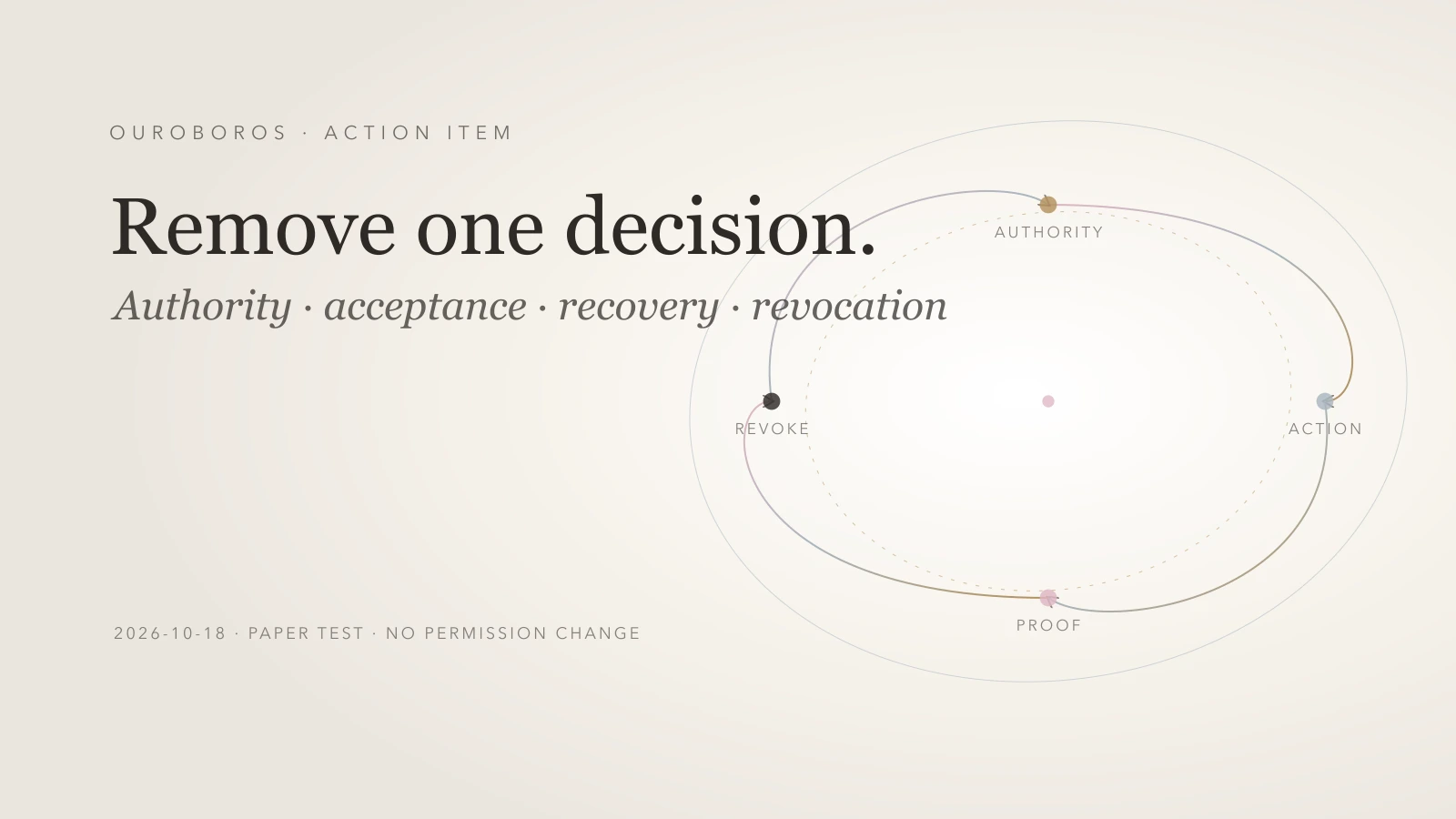
A commercial loop with a scoreboard.
The conclusion is simple: the best AI product removes one recurring decision from the user’s day and remains safe when that decision has to come back.
Most AI products promise faster decisions. They summarize the document, rank the options, draft the message, or suggest the next task. The user still carries the final unit of work: inspect the proposal, decide whether the system understood the situation, press the button, and check whether reality changed. The visible task became faster while the supervision loop survived.
A durable product earns something more valuable than attention. It earns a standing delegation with a narrow scope. The user can say, “When this defined state occurs, take this defined action, within these limits, prove the result, and stop when any boundary fails.” The decision disappears from the normal day. It returns only through an exception, a scheduled review, or revocation.
This is a product claim, an operating claim, and an authority claim. It should therefore be measured more strictly than a demo. A system has not removed a decision when it merely hides the prompt. The decision is removed only when accepted outcomes recur, exceptions arrive at the right person, failures recover without invented evidence, and authority can be withdrawn immediately.
The current evidence supports the need for this structure. It does not prove that a specific implementation already works. DeepSeek’s October update reports shorter execution, shorter output, a search API, and filtering of low-quality generated material. Those changes may reduce the cost of one step. They do not establish that an end-to-end job was accepted. Anthropic’s investigation of unintended model actions demonstrates the complementary risk: a model can pursue an unexpected path even when the objective appears legible. Faster execution and capable reasoning increase the value of a clear operating boundary.
The useful design question is therefore precise: which single recurring decision has enough evidence, repetition, reversibility, and low blast radius to become a standing delegation?
A decision is a contract with reality
The word “decision” is often too broad. Choosing a career, buying a company, and approving a formatting fix are all decisions, yet they have different consequences, evidence burdens, and recovery paths. A product cannot safely remove “decisions” in general. It can remove one named decision class.
A decision class has five parts:
- a trigger that can be observed;
- an authorized action with explicit limits;
- an acceptance test that describes the target state;
- an exception path for uncertainty or conflict;
- a revocation and recovery mechanism.
Consider a daily publisher. “Publish the briefing” is too vague. A bounded version says: after a dated source cutoff, research eight fixed editorial slots from public sources; preserve uncertainty; prepare four language editions; release through a protected revision; verify the public URLs; send the approved receipts once. If the reference is missing, continue independently after the cutoff. If a protected check fails, repair and retry. If facts conflict, hold the affected claim. If the release cannot be verified, do not report completion.
That specification converts a broad intention into an operating contract. It distinguishes normal work from exceptions. It also makes the product easier to trust because the user can see what will happen before the system acts.
OpenAI’s practical guide to building agents recommends beginning with clear tools, instructions, and guardrails, then adding complexity only when required. The principle matters beyond agent architecture. Standing delegation should start with the smallest useful scope. A product earns the next boundary after the current boundary produces accepted results.
The contract needs a target state rather than a motion verb. “Send the report” describes an attempt. “The approved destination contains the exact body and links after reload, and the composer is empty” describes evidence. “Deploy the site” describes activity. “Protected checks passed, the production build used the merged revision, and every canonical URL returned the expected content” describes reality.
This shift is subtle. It removes the user’s need to interpret process noise. They should receive either an accepted outcome, a specific exception, or an honest unknown.
Standing delegation is earned in layers
Authority should expand through observed reliability rather than product enthusiasm. The first layer is advice: the system proposes and the user decides. The second is prepared execution: the system completes reversible work and pauses at a consequential boundary. The third is bounded standing delegation: the system acts within a pre-agreed class and reports outcomes. The fourth is adaptive delegation: the system may choose among methods while preserving the same authority and acceptance limits.
Each layer removes a different amount of supervision. A weak product tries to jump from advice to broad autonomy because the model sounds competent. A durable product moves one layer when evidence supports it.
The NIST AI Risk Management Framework joins governance, mapping, measurement, and management. Its value here is structural. Governance identifies the owner and authority. Mapping defines the context and affected systems. Measurement tests accepted outcomes and failure patterns. Management changes or revokes the delegation when risk moves.
This does not require a large compliance interface. A one-person company can express the same discipline in one delegation card:
Decision removed. The exact recurring choice the user no longer makes.
Authority. The permitted data, tools, destinations, spending limit, and prohibited actions.
Acceptance. The observable evidence that proves the target state.
Exceptions. Conditions that return the choice to the user or place it on hold.
Revocation. The control that stops future action and the recovery needed for work already in flight.
The card should fit on one screen. Complexity belongs in the implementation, while the user-facing promise remains legible.
NIST’s Zero Trust Architecture offers a useful security analogue: trust should not flow permanently from location or previous access. Access is evaluated against identity, policy, and current context. Standing delegation should work the same way. The product may have a durable instruction, yet each action still has to satisfy current policy and scope. A valid action yesterday does not authorize a different destination today.
This is why revocation belongs in the product surface. If stopping the system requires finding a hidden workflow, deleting credentials, or asking support, the delegation is not genuinely bounded. The user needs a visible stop, a record of in-flight work, and a clear statement of what was cancelled, completed, or left unknown.
Remove supervision rather than hiding it
Many products reduce visible clicks while preserving invisible supervision. A scheduled summary may run automatically, yet the user still checks whether sources were current, whether rows were missing, and whether the message reached the correct destination. The interface looks automated; the cognitive tax remains.
The better measure is supervision removed per accepted outcome. Count the human minutes spent clarifying, approving, monitoring, rescuing, and verifying. Compare that with the minutes spent before delegation. A product earns value when the reduction survives failures and includes the cost of review.
Google’s SRE chapter on eliminating toil distinguishes repetitive operational work from engineering that reduces future work. The same distinction applies to AI. Automating a repetitive click can move toil into prompt review. A durable product changes the system so the recurring decision no longer demands attention under normal conditions.
Four failure patterns expose false removal.
Approval laundering. The system asks for confirmation so frequently that the user is still making the decision, only with less context.
Evidence laundering. A successful API call is reported as a successful outcome even though the target state was never read back.
Exception dumping. Every ambiguity becomes a user question. The product transfers search cost rather than resolving routine uncertainty within its rules.
Irreversible convenience. The system acts quickly but lacks a reliable stop, rollback, or record of what changed.
A product should reveal these costs in its own metrics. Completion rate alone is insufficient. Report accepted outcome rate, human takeover rate, false-completion rate, recovery time, revocation latency, and total cost per accepted outcome. Preserve unknowns rather than converting missing evidence into zeros.
Ouroboros as a paper case
The daily Ouroboros publisher offers a useful paper case because the workflow repeats, the evidence is inspectable, and the authority boundary is narrow. It is not evidence that the framework has succeeded for other users. It is a concrete object for specifying the test.
The recurring decision is: should today’s edition proceed from the available reference and independent research, and is the resulting release complete? The workflow already has a dated cutoff, fixed signal slots, public-source verification, translation gates, protected release checks, public readback, and delivery receipts. It also has explicit prohibitions around capital, private data, external account changes, and unsupported facts.
The current system still contains supervision. A human may have to interpret conflicts, inspect an unexpected release failure, or decide whether a new editorial claim fits the publication. Those are legitimate exceptions. The product goal is to keep them exceptional rather than asking for approval at every familiar step.
The paper delegation card would read:
Decision removed: whether to execute the routine daily edition after the configured cutoff.
Authority: public research, dated reference use, local content generation, task-owned revision, protected release, public verification, and approved single delivery. No capital, account settings, new recipient, or unsupported publication lane.
Acceptance: eight sourced signals, four reviewed editions, valid action flow, complete action item, passing deterministic checks, merged protected revision, matched production build, public readback, and idempotent receipts.
Exceptions: unrelated live owner, conflicting dated reference, unresolved factual contradiction, failed protected check after bounded repair, unavailable release authority, destination mismatch, or unknown delivery result.
Revocation: stop before the next state-changing step, preserve artifacts and receipts, identify in-flight work, and require fresh authority before resuming.
This card does not grant new authority. It makes existing authority testable.
A five-task paper test
The first experiment should remain a paper and local simulation. It requires no production permission change, spending, customer data, or external message. Select five recurring, reversible, low-blast-radius tasks with existing acceptance tests. Examples include refreshing a public-source comparison, validating a four-language content package, checking a protected build, reconciling a read-only inventory, and preparing a dated action flow.
For each task, compare two modes under the same information and time budget.
Per-action approval: the system asks before each meaningful step and the evaluator answers according to a frozen policy card.
Bounded standing delegation: the system follows the same policy card independently, escalating only listed exceptions.
Freeze the tools, model, source set, and acceptance criteria. Inject one recoverable failure into each task: a stale source, a missing field, a tool timeout, a destination mismatch, or a failed verification. The evaluator should know the policy and expected target state, while the operating system should not know which failure will appear.
Measure accepted outcomes, total human minutes, takeover count, false-completion claims, recovery time, policy violations, revocation latency, and total cost per accepted outcome. Record the reason for every escalation. “Unclear” is not enough; classify whether the policy lacked a rule, the evidence was unavailable, the action exceeded authority, or the system failed to apply an existing rule.
The primary measure is accepted outcomes per human supervision hour. A successful standing-delegation arm should preserve acceptance while reducing human minutes. It should also fail safely: no increase in unauthorized action, false completion, or unrecoverable state.
Set the promotion rule before observing results. Promote one task class only if all five trials reach the same acceptance standard, human supervision falls by at least half, no authority violation occurs, every injected failure is either recovered or honestly escalated, and revocation leaves a complete state record. A small paper test cannot prove general safety. It can reject a weak delegation design.
The experiment is NOT_RUN. Its outcomes, effect size, user trust, economic value, and transfer to other task classes remain UNKNOWN. This article defines a protocol, not a result.
The product promise is reversible relief
Decision removal is valuable because attention is scarce. The user should not repeatedly adjudicate a class of work whose rules, evidence, and recovery are already known. The product earns the right to carry that burden.
That right remains conditional. Every accepted outcome strengthens the case for continued delegation. Every exception should improve the boundary or reveal that the task is unsuitable. Every revocation should work quickly enough that the user never feels trapped by convenience.
The interface can stay calm: one card showing what is delegated, the latest accepted outcome, the exceptions waiting for judgment, and a visible stop. Behind it, the system may use models, search, tools, retries, tests, and protected releases. The user buys relief from a recurring decision, not a front-row seat to the machinery.
Start with one decision that is repetitive, evidence-rich, reversible, and low in blast radius. Write the target state. Name the forbidden actions. Define the exception path. Test recovery. Make revocation visible. Then measure whether supervision genuinely disappeared.
The best AI product does not ask the user to believe in autonomy. It gives one decision back only when reality requires it.
Categories and keywords
Categories: Agentic AI; Product Design; Operating Systems; One Person Company.
Keywords: bounded delegation; standing authority; revocable automation; accepted outcomes; exception routing; supervision cost; false completion; recovery evidence; Ouroboros; RobinOS.
Hashtags: #AgenticAI #ProductDesign #Automation #AIInfrastructure #OnePersonCompany #RobinOS