01 · AI Circularity Ledger
Underwriting the AI Power Fund
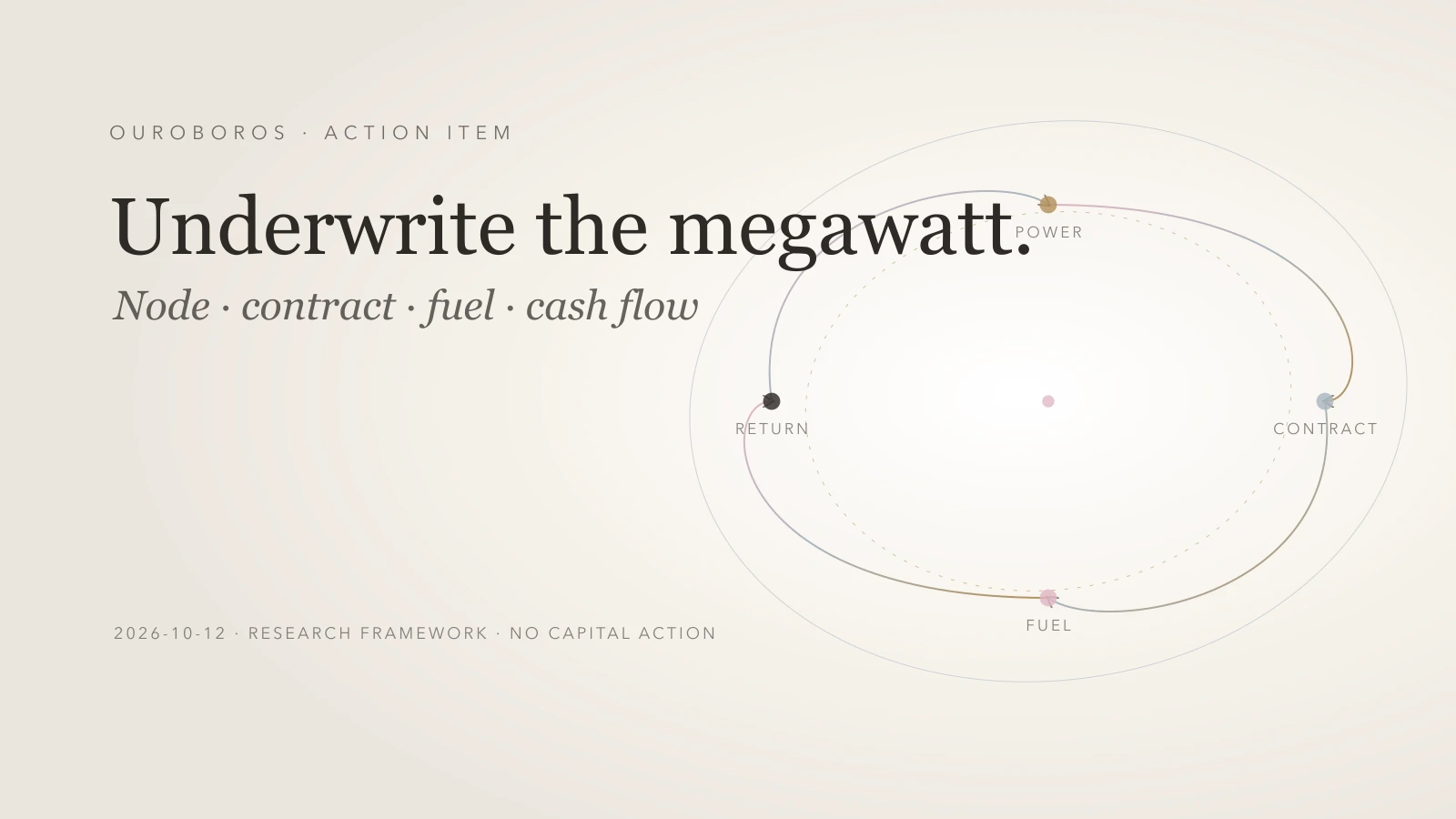
A commercial loop with a scoreboard.
The conclusion is straightforward: 5 GW is a nameplate, not a cash flow. A power fund earns an AI premium only when its plants can deliver electricity at the right nodes, under contracts or market structures that support durable cash generation, with fuel and upgrade costs that the capital structure can survive. Fund size and generation capacity describe scale. They do not establish return.
LS Power’s new Fund VI is a useful test case because the public numbers are large and unusually easy to confuse. The firm closed approximately $6 billion of equity commitments, above an initial $4 billion target. It says about $1.7 billion is already committed to pending acquisitions that would create a roughly 5 GW gas-generation platform across PJM and ERCOT. Those figures have appeared beside the AI power-shortage story, inviting a simple conclusion: scarce megawatts plus AI demand must equal attractive infrastructure returns.
That conclusion skips the underwriting. The $6 billion is investor commitment to a fund. The $1.7 billion is the fund’s stated commitment associated with acquisitions. Five gigawatts is approximate nameplate capacity. None of those numbers, alone, reveals contracted AI load, plant-level earnings, debt, required maintenance, fuel coverage, capacity accreditation or exit value. The investment case begins where the headline ends.
Start with the transaction perimeter
LS Power’s Fund VI announcement says the fund reached its hard cap and that the $1.7 billion commitment relates to pending purchases of gas-fired assets from Constellation. It also says Fund V raised $2.7 billion in 2024 and that Fund VI can invest across conventional generation, renewables, storage, distributed energy and other infrastructure. The mandate is wider than one gas portfolio and wider than AI.
The underlying transactions sharpen the picture. Constellation’s PJM sale announcement values approximately 4.4 GW of predominantly gas-fired generation at $5 billion before closing adjustments, or about $1,142 per kW according to the seller. Constellation separately disclosed an agreement to sell the 606 MW Brazos Valley plant in ERCOT for $860 million before adjustments in its second-quarter results. Together, those assets approach the 5 GW platform described by LS Power.
The numbers do not reconcile through one division problem. The $1.7 billion fund commitment is neither the announced $5.86 billion combined transaction value nor the plants’ full enterprise value. It may represent equity allocated to the deals, subject to debt, closing adjustments, transaction structure and other capital. Public material reviewed here does not provide the complete sources-and-uses schedule. Treating $1.7 billion divided by 5 GW as an acquisition multiple would therefore be wrong.
The first underwriting card needs four separate fields: fund equity committed, gross transaction value, assumed or new debt, and expected upgrade capital. If one field is unavailable, mark it unknown. This simple separation prevents a fund-level fundraising success from becoming an invented plant-level return.
Nameplate is the first denominator
A generator’s nameplate rating describes technical maximum output under defined conditions. Investors are paid by what the asset can reliably sell, when and where it matters. Outages, derates, heat, maintenance, fuel availability, transmission constraints and market accreditation all sit between the two.
For a 5 GW portfolio, a one-point change in availability represents 50 MW of capacity before considering market rules. That arithmetic is illustrative; it does not estimate this portfolio’s actual availability or revenue. Its purpose is to show why a large nameplate does not eliminate operating detail. A plant can be strategically located and still lose value through an extended outage. Another can run less often yet earn valuable capacity revenue or scarcity pricing because the system needs it at critical moments.
Deliverable MW is therefore the better operating denominator. The card should show nameplate capacity, accredited capacity, historical availability, forced-outage rate, planned maintenance and node. It should also identify which figures come from current operating records, which come from market accreditation and which remain management expectations.
AI demand adds another distinction. A data-center announcement near a plant does not create a contract. A utility load forecast does not guarantee that one generator serves that load. A memorandum, interconnection request or campus plan is weaker than an executed power purchase agreement, tolling agreement, hedge or customer prepayment. The underwriting needs the actual cash-flow bridge.
PJM and ERCOT pay for different things
The portfolio spans two market structures. PJM operates energy and capacity markets. Its capacity-market explanation describes forward procurement, locational pricing and pay-for-performance obligations. A resource can receive capacity revenue for being available when called, while facing meaningful non-performance consequences during emergencies.
That makes accredited capability and location economically important. A megawatt in a constrained zone may carry a different value from a megawatt elsewhere. Auction results can improve the revenue outlook, yet they remain delivery-year signals subject to rule changes, accreditation, performance and future supply-demand conditions. One high auction does not turn every plant into an annuity.
ERCOT has a different revenue mix and scarcity profile. An ERCOT gas plant may depend more heavily on energy-market margins, ancillary services, scarcity intervals, hedges and bilateral arrangements. The 606 MW Brazos Valley transaction price supplies a real deal reference. It does not disclose the future spark spread, hedge book, outage performance or buyer financing.
A consolidated 5 GW headline can hide this market split. The underwriting card should keep PJM and ERCOT cash flows separate before adding them. For each plant, show energy margin, capacity or reliability revenue where applicable, ancillary services, bilateral contracts and other income. Then show which components are contracted, hedged, merchant or unknown.
Fuel can erase the power premium
Gas plants turn a fuel input into electricity revenue. The spread between the power price and fuel plus variable operating cost is central to dispatch economics. The US Energy Information Administration publishes plant fuel-cost data and distinguishes the costs incurred to purchase and deliver gas. Delivery terms matter alongside commodity price.
The distinction becomes acute during stress. Firm fuel and pipeline transport cost more but have higher priority. Interruptible arrangements can be curtailed when firm customers use available capacity. A plant that appears dispatchable from its turbine specifications may face a different real-world profile if gas delivery is constrained at the same moment the grid needs power.
The underwriting card needs delivered fuel cost, heat rate, firm-versus-interruptible supply, pipeline capacity, storage access and hedge tenor. It should test normal weather, a fuel spike and a simultaneous high-load event. It should also show whether capacity non-performance exposure and fuel interruption can compound.
This is where the AI premium can reverse. AI load can raise regional demand and increase the value of reliable generation. The same load growth can tighten gas, transmission, interconnection and maintenance resources. Revenue rises only if the asset can capture the price. Costs and penalties also move.
Contracts decide whether AI demand is financeable
The strongest version of the thesis is contractual. A creditworthy customer agrees to buy power or capacity for a defined term, the plant can physically and legally deliver, and the contract allocates fuel, congestion, curtailment, credit and change-in-law risks clearly. That can support debt and reduce dependence on optimistic merchant forecasts.
The weaker version relies on proximity and narrative. A plant sits in a region with large data-center announcements, so an investor assumes sustained high utilization and premium pricing. That may become true. Until contracts or realized market evidence appear, it remains an exposure, not a receivable.
An executed contract still requires reading. Fixed-price power can leave fuel risk with the generator. A tolling structure may transfer fuel to the customer while retaining availability obligations. A hedge may protect a hub price while leaving nodal congestion open. A capacity payment can coexist with large penalties. Contracted revenue is not automatically low risk; it simply makes the allocation of risk more inspectable.
The card should record counterparty, tenor, contracted MW, start date, price form, indexation, credit support, fuel allocation, congestion allocation, performance obligations and termination rights. It should distinguish signed, conditional, planned and reported arrangements. A presentation’s pipeline belongs outside contracted backlog.
Upgrade capital belongs before the return
Existing plants can avoid the long lead time of greenfield construction, but age does not make capital expenditure disappear. Turbine overhauls, emissions controls, cooling systems, transformers, switchgear, cyber controls, gas infrastructure and transmission upgrades can absorb cash before a plant captures new demand.
Maintenance capex protects existing output. Growth capex expands or improves it. Compliance capex preserves legal operation. Separating the three helps investors see whether a return comes from a better asset, a tighter market or deferred spending. The schedule should connect each expenditure to an operating benefit, permit or avoided risk.
Closing risk also matters. The announced transactions remain subject to approvals and customary conditions. Completion is not established by a fund close. The research record should retain the seller’s announced prices, the buyer’s fund commitment and the future closing receipt as separate events.
The first useful calculation
Public figures allow a few bounded calculations. The $1.7 billion commitment is roughly 28% of a $6 billion fund. The seller states that $5 billion for about 4.4 GW equals roughly $1,142/kW. The disclosed $860 million for 606 MW is approximately $1,419/kW before adjustments. These calculations describe announced transaction intensity. They do not compare identical plant quality, debt, earnings or contract coverage.
The difference invites research rather than a verdict. Brazos Valley may differ in age, efficiency, node, market, contract position, condition and strategic value from the PJM portfolio. Without a matched asset table and full capital structure, the higher dollars per kW cannot be labeled expensive or cheap.
A useful next calculation is enterprise value divided by normalized cash flow under three cases: current market, contracted downside and stress. That requires plant-level inputs unavailable in the reviewed public package. The answer is unknown today. Preserving that gap is more valuable than filling it with an AI multiple.
A one-page underwriting card
The practical work sample should fit on one page before it grows into a model. Use eight blocks.
- Perimeter: assets, ownership, transaction status and closing conditions.
- Capital: fund equity, transaction value, debt, fees and upgrade capex.
- Deliverability: nameplate, accredited MW, availability, outage history and node.
- Revenue: energy, capacity, ancillary, bilateral and other income.
- Contracts: counterparty, tenor, MW, price form, risk allocation and security.
- Fuel: delivered cost, heat rate, transport firmness, storage and hedges.
- Stress: outage, fuel spike, congestion, penalty and refinancing cases.
- Exit: buyer universe, refinancing need, remaining life and dependence on an AI premium.
Every number receives one of four treatments: filed or official fact, derived calculation, attributed company claim, or unknown. The card never labels a proposal as completed. It never turns regional load growth into contracted plant demand.
The promotion rule is equally compact. Advance the thesis only if deliverable capacity and contracted or repeatedly realized cash flow cover operating cost, required capex and debt service under the stated downside, without relying on a higher exit multiple. If the base case needs uncontracted AI utilization or refinancing before major maintenance, keep it on watch.
What this publication completes
This article completes a public research framework and a one-page specification. It does not allocate capital, contact LS Power or Constellation, obtain private fund terms, value the portfolio, recommend a security or verify plant-level returns. The full sources-and-uses schedule, debt structure, contract book, plant operating history and realized AI load remain unknown from the reviewed public material.
That boundary is the point. The AI power trade may become one of the defining infrastructure themes of the decade. A disciplined allocator can remain excited about the theme while refusing to let a fund size, a gigawatt headline and a demand forecast collapse into one number.
Five gigawatts can be strategically important. Sixty billion dollars of fund demand across a broader market can be meaningful. Neither pays an investor by itself. The investable object is the cash-flow system connecting a specific plant, node, contract, fuel path, operating team and capital structure. Underwrite that system first.
Categories and keywords
Categories: AI Infrastructure; Energy; Capital Allocation; Private Markets.
Keywords: LS Power Fund VI; dispatchable generation; PJM capacity; ERCOT; natural gas; AI data centers; deliverable megawatts; infrastructure underwriting.
Hashtags: #AIInfrastructure #PowerMarkets #EnergyFinance #CapitalAllocation #DataCenters