01 · AI Circularity Ledger
Robot Gyms Manufacture Experience
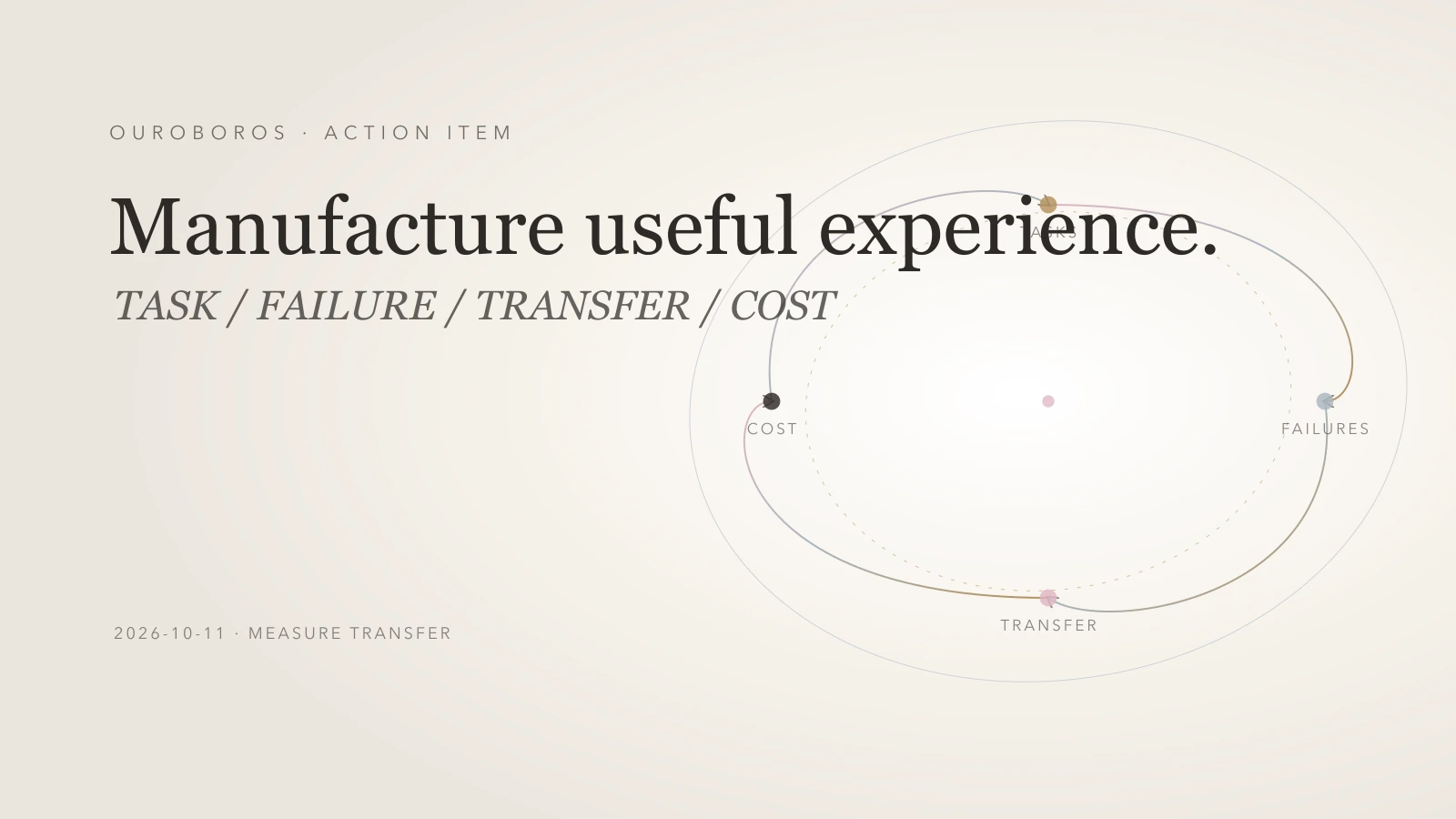
A commercial loop with a scoreboard.
The conclusion is practical: the next important physical-AI factory may manufacture experience rather than robots. A robot gym can place many machines, teleoperators and tasks inside one controlled environment, then turn each attempt into video, actions, force traces and failure records. That sounds like a data flywheel. Its value depends on a harder result: whether the collected experience improves performance on unseen tasks in the real places where robots must work.
Technical University of Munich describes a 2,300-square-metre RoboGym at Munich Airport where a substantial fleet of humanoids can practise activities such as folding boxes, handling components and using tools. NEURA Robotics says it and TUM are investing €17 million in the centre, including €11 million from NEURA, and intend to connect data to the Neuraverse ecosystem. Those are announced inputs and plans. They do not yet establish generalisation, customer economics or a defensible data moat. TUM RoboGym NEURA and TUM
XDOF offers a useful warning from the other direction. Its published work on large-scale manipulation data argues that demonstration quality can dominate raw quantity; in one reported folding setting, adding more demonstrations made results worse because the extra data introduced noise. Its ABC-130K release contains about 130,000 episodes across more than 200 tasks. That is a meaningful research asset. It is still a curated dataset, rather than evidence that any buyer can deploy a robot profitably. XDOF research XDOF datasets
This article turns the robot-gym idea into an underwriting and operating framework. No robot experiment was run for this publication. The measurement design is READY; transfer performance, fully loaded cost and commercial value remain UNKNOWN.
Robots cannot scrape their world
Language models learned from a digital world that people had already recorded. Text, code and images existed at internet scale before modern training runs began. Robots face a different starting point. The useful record of how a gripper approaches a deformable bag, recovers from a slip or places an irregular object is sparse, hardware-specific and expensive to capture.
Physical interaction also hides information. A camera may show that a grasp failed without revealing the contact force, motor current, latency or human correction that caused the failure. Two actions that look similar can produce different outcomes because friction, lighting, calibration or object geometry changed. A robot therefore needs observations joined to actions, timing, embodiment and outcomes.
Simulation helps, especially where physics and geometry can be modelled well. Synthetic variation can expose a policy to many layouts before a machine touches a customer site. The remaining sim-to-real gap is operational. A policy trained on clean objects may meet damaged cartons, reflective surfaces, soft materials, crowded aisles and people who move unpredictably. Reality supplies the long tail that a simulator did not know to generate.
That makes experience a production input. The relevant unit is not an hour of video. It is an episode with enough provenance to explain the task, initial state, action sequence, intervention, outcome and conditions of collection.
A gym is an experience factory
A well-run robot gym combines four functions. It defines tasks, operates hardware, captures aligned data and evaluates transfer. Separating them matters because a busy facility can generate impressive footage while producing little reusable learning.
Task design determines coverage. Repeating one easy movement thousands of times improves density around a narrow behaviour. A useful curriculum also varies objects, starting positions, lighting, clutter, tools and acceptable outcomes. The task distribution should resemble the target operation closely enough to matter while retaining held-out combinations for evaluation.
Hardware operation determines whether the data describes stable learning or maintenance noise. Battery state, calibration, gripper wear and software versions need labels. Otherwise a model may learn around a transient defect or an engineer may mistake hardware drift for policy failure.
Capture joins observations to actions. Video alone is rarely enough. Joint positions, commands, force or torque where available, teleoperator inputs, timestamps and termination reasons make the episode auditable. Failed attempts should remain linked to the recovery that followed.
Evaluation asks whether the policy improves outside the collection loop. The strongest proof uses unseen objects, layouts, operators or sites. A model that memorises the gym can raise an internal score and still fail the first day in a warehouse.
Teleoperation buys interventions
Teleoperation is often described as a way to collect demonstrations. That understates its role. A human operator can show a path, rescue a robot when autonomy drifts and label the exact moment when judgment was required. Each intervention identifies a boundary in the current policy.
The economics depend on how those interventions change over time. If every deployment continues to require one person per robot, the system may be remote labour with robotic hardware. If the same intervention teaches a reusable correction that reduces future rescue across many machines, the data has leverage.
Measure intervention minutes per accepted task, the number of robots supervised per operator and the share of interventions that become reusable training examples. Also separate planned demonstrations from emergency recovery. A polished demonstration reveals how a skilled person performs the task; a recovery reveals where the system actually breaks.
Human effort must stay inside the denominator. Labour used for setup, resets, labelling, quality review and hardware repair can exceed the visible teleoperation time. A claim that autonomy improved is incomplete when the human work merely moved backstage.
Failure is high-value data
Success shows one path through the task. Failure maps the boundary of competence. A dropped object, partial grasp or late correction can reveal more about a policy than another clean repetition.
Failure data becomes useful only when the system records why the episode ended. Labels should distinguish perception errors, planning errors, control instability, hardware faults, task ambiguity and safety stops. These categories will evolve, and disputed labels should remain visible. False certainty in the taxonomy can teach the next model the wrong lesson.
Selection also matters. If a data pipeline filters out ugly attempts to make a dataset look clean, it may erase the exact conditions that deployment will encounter. If it stores every corrupted sensor trace without quality controls, noise can overwhelm the signal. XDOF’s reported folding result illustrates the core point: quantity is not automatically learning progress.
A useful failure record includes the precondition, attempted action, observed deviation, intervention, final outcome and confidence in the label. It should state whether the failure was reproduced. That turns an anecdote into a candidate constraint for training and evaluation.
Transfer decides whether the flywheel exists
A data flywheel has three links: deployment creates experience, experience improves the model, and the improved model expands useful deployment. If any link fails, more activity can produce more cost without compounding advantage.
The decisive metric is held-out transfer. Freeze a test set of objects, layouts and task variants before training. Keep some tests outside the gym. Compare the new policy with the prior version under matched conditions and report every attempted task, exclusion and human rescue.
One transfer score cannot cover everything. Track task success, damage or safety events, completion time, intervention minutes and recovery after perturbation. Report confidence intervals or repeated-run variation where the sample permits. A 90 percent success rate across ten attempts carries a different evidence weight from the same rate across ten thousand attempts.
Cross-embodiment transfer deserves separate treatment. Data from one arm or humanoid may help another platform learn concepts, yet actuator limits, sensing and kinematics change the control problem. Demonstrating value on the collecting robot does not prove value across a fleet of different machines.
Measure the moat rather than the footage
Investors and operators should ask who owns each layer of the experience system. The facility owner may control the gym. The robot maker may control raw telemetry. A model provider may retain gradients or derived policies. A customer may prohibit operational data from leaving its site. Contract language can decide more of the moat than the number of recorded hours.
Five measures expose the economics.
First, cost per accepted episode includes teleoperation, resets, annotation, review, compute, depreciation and maintenance. Second, transfer yield is the share of collected episodes that materially improve held-out performance. Third, intervention compression measures whether human rescue per accepted task falls after retraining. Fourth, failure coverage tracks how many important failure modes have reproducible tests. Fifth, deployment retention asks whether the improvement survives at the customer site over time.
These measures discourage a familiar vanity metric. One million hours can be less valuable than ten thousand well-labelled episodes covering decisive failures. The asset is the information that changes behaviour, plus the rights and infrastructure required to reuse it.
Geography changes the production system
The United States and China can produce physical-AI experience through different industrial structures. US teams may combine venture funding, frontier models and selected customer deployments. Chinese ecosystems can draw on dense manufacturing networks, component suppliers and a large base of operational settings. These are directional observations, rather than a verdict on which system will win.
Robot gyms may narrow some differences by centralising hardware and task collection. They may widen others because the facility closest to diverse factories can capture more relevant variation. Regulation, data rights, labour economics, safety expectations and access to customers also shape what experience can be collected and reused.
Comparisons need matched definitions. Count accepted episodes with stated quality gates, rather than promotional hours. Compare fully loaded costs, rather than wages alone. Separate a laboratory demonstration from a sustained deployment. Keep company announcements distinct from independently observed results.
A bounded SunTV measurement
SunTV offers a useful thought experiment because media operations contain repetitive physical workflows without requiring an immediate purchase or deployment. Choose one harmless tabletop task such as sorting labelled, non-sensitive props into fixed bins. Record the current manual procedure and define an accepted outcome before involving a robot.
The proposed test has three stages. First, create twenty task variants that change object position, orientation and mild clutter. Hold back five variants. Second, collect demonstrations and recoveries on the remaining fifteen under a fixed operator-time budget. Third, evaluate the policy on the held-out variants with the same robot and then in a second layout.
The scorecard should include accepted-task rate, median completion time, object damage, safety stops, intervention minutes, reset minutes and fully loaded cost. Every excluded run needs a reason. The baseline is the manual workflow and a simple scripted policy where feasible.
This is a publication design, not authorization to buy hardware, engage a vendor, collect staff video or run a production experiment. Those actions require their own scope and consent. The present status is NOT_RUN, so every outcome remains UNKNOWN.
The operating checklist
Before treating a robot gym as infrastructure, ask twelve questions:
- What target tasks and environments define the collection distribution?
- Which objects, layouts and failure modes are held out?
- What sensors and action traces are synchronised?
- How are hardware versions, calibration and maintenance labelled?
- How much human work sits outside recorded teleoperation?
- What makes an episode accepted, rejected or disputed?
- Are failures retained with recovery and provenance?
- Does new data beat a frozen prior policy under matched conditions?
- Does improvement survive at an external site?
- Who owns raw data, labels, derived models and reuse rights?
- What is the cost per accepted episode and per transfer gain?
- What observation would falsify the claimed flywheel?
The first promotion gate is modest. A new collection cycle must improve held-out performance without increasing safety events or total human minutes per accepted task. The second gate is external transfer. The third is economic: the saved labour, increased throughput or reduced error must exceed the full cost of data production and deployment.
If those gates pass repeatedly, a robot gym can become a compounding asset. If internal scores rise while external transfer and economics stay flat, it is a training facility with an attractive story. The distinction will be visible in the receipts.
Categories and keywords
Categories: Physical AI; Robotics; Data Infrastructure; Operating Economics
Keywords: robot gyms, physical AI, teleoperation, robot learning, failure data, sim-to-real, transfer yield, embodied AI, SunTV
Hashtags: #PhysicalAI #Robotics #RobotLearning #EmbodiedAI #OperatingSystems