01 · AI Circularity Ledger
The Proof Loop Is the Real Bottleneck
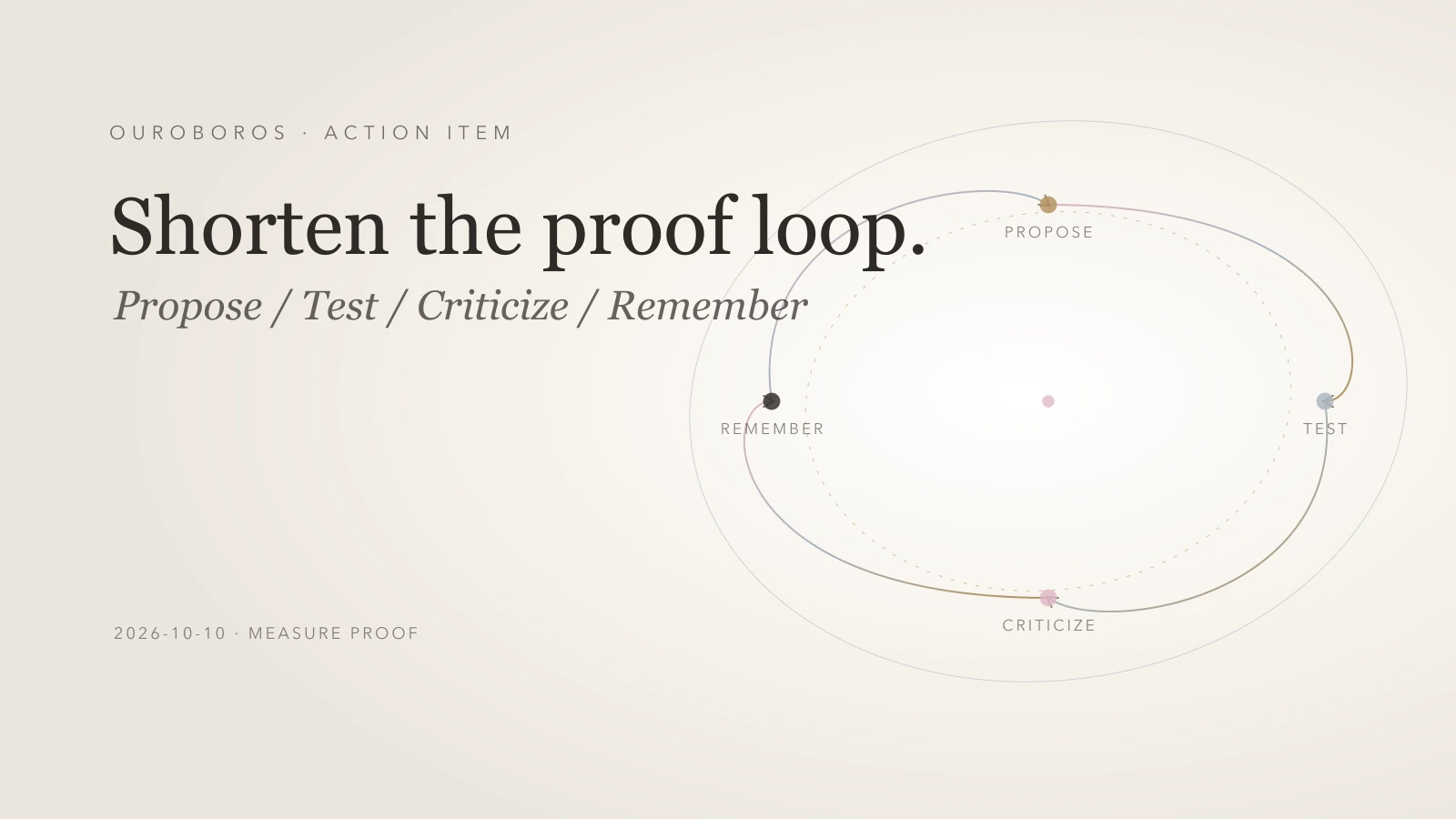
A commercial loop with a scoreboard.
The conclusion is simple: intelligence is becoming abundant faster than proof. An AI system can produce ten plausible hypotheses before breakfast. Biology, capital markets and real operations may take months to tell us whether one survives contact with reality. The durable advantage therefore belongs to whoever can shorten the full loop from proposal to test, criticism and retained learning without lowering the standard of evidence.
BioStudyBench makes the distinction unusually clear. Its agents receive a neutral biomedical question drawn from a study published after their reported knowledge cutoff. They must locate public data, write an analysis and recover the reported finding. Across eight models, access to data and tools lifted the average pass rate by 47 percentage points. The best closed model passed 94.7% of tasks; the best open model reached 81.3%. Those are strong results. They remain benchmark results, and the authors explicitly designed the test to separate genuine derivation from retrieval of a known answer. BioStudyBench
Biohub’s Virtual Biology Initiative attacks a different constraint. It is committing resources to generate open, multimodal biological data and build better predictive models of cells. The premise is sensible: useful models need orders of magnitude more structured observations, and expensive wet-lab work should focus on experiments likely to teach us something. A predictive cell model can narrow the search. It cannot declare a drug safe, make a result reproduce in another laboratory or create patient benefit by itself. Biohub
This article turns those developments into an operating framework for RobinOS, Quant Lab and AI-enabled science. It proposes four stages, four metrics and one hard rule: no generated claim becomes knowledge until evidence has had a fair chance to defeat it. No experiment was run for this publication. The framework is READY; its results remain UNKNOWN.
Hypothesis generation is no longer the scarce step
For most of scientific history, forming a useful hypothesis demanded scarce attention. A researcher had to know the literature, see an anomaly and imagine a mechanism. That work still matters. The marginal cost of producing a fluent, plausible candidate has collapsed.
Ask a capable model for ten mechanisms behind a failed assay, ten explanations for a drawdown or ten architectures for a research agent. It will answer immediately. Some ideas may be insightful. The list itself creates little value because plausibility is cheap. Every candidate competes for data, laboratory time, capital, operator attention and the right to influence a decision.
The same imbalance appears in software agents. A system can draft a plan, generate code and produce a polished report in hours. If its source retrieval silently failed, its test fixture leaked the expected answer or a human repaired the decisive section, the speed belongs to production rather than proof. The output looks complete while the evidence chain is incomplete.
This is why benchmark gains require careful reading. BioStudyBench’s 47-point improvement establishes that tools and data materially improve performance on its tasks. It does not establish that every answer arose through a clean causal path. It does not measure wet-lab validity, clinical usefulness or deployment economics. The benchmark authors make this boundary part of the research question, which is precisely why the work is useful.
Abundant proposal changes management. The first question can no longer be “Can the system think of something?” A better question is “Which claim earned the next unit of verification capacity?”
A proof loop has four accountable stages
The minimum useful loop is propose → test → criticize → remember. Each verb needs an artifact and a failure condition.
Propose creates one falsifiable claim. It names the expected observation, the conditions under which the claim applies and the result that would count against it. “AI will accelerate biology” is a theme. “A tool-using agent can reproduce this post-cutoff analysis from public data without retrieving the published conclusion” is testable.
Test gives the claim a fair encounter with evidence. The data boundary is frozen. The budget is recorded. The scoring rule is chosen before results appear. In software, this may be a sealed task with held-out acceptance tests. In biology, it may require an assay, an external laboratory or a prospective cohort. A virtual experiment can rank candidates; it cannot impersonate the measurement it is meant to predict.
Criticize searches for the easiest way the result could be misleading. Did the agent retrieve the answer? Did the model see a near-duplicate during training? Did an analyst choose a favorable subset after inspecting the data? Did the effect disappear under another seed, laboratory or customer? Criticism is an operating role, not a mood. It receives time, tools and permission to reject attractive work.
Remember preserves the result, including failure, in a form that changes the next proposal. Memory must include the claim, evidence, rejected alternatives, intervention history, cost and decision. A system that remembers only winners manufactures confidence. A system that retains every transcript without curation manufactures noise.
The loop closes when retained evidence changes what the system proposes or refuses to propose next. A database of reports is an archive. A proof loop updates behavior.
Software and biology run on different clocks
Software tempts us to confuse rapid feedback with strong proof. A test suite can run in minutes, deployment can be rolled back and a failed branch can be replayed. Even here, a green test may cover the wrong behavior. Still, the cost of another iteration is usually low and the receipt can be produced quickly.
Biology moves differently. Samples vary. Assays drift. Cell lines behave differently across laboratories. A model may predict a mechanism while the organism responds through an unmodeled pathway. A clinical trial adds recruitment, safety, adherence, regulation and time. Negative evidence can arrive a year after the original enthusiasm.
Biohub’s plan to expand open biological data could improve the proposal and prioritization stages. Larger, standardized datasets may help models identify which experiment has the highest information value. That is real leverage. The initiative’s announced $500 million commitment and open-data ambition remain inputs to a system under construction, rather than proof of a universal virtual cell or a therapeutic outcome. Biohub Virtual Biology Initiative
The difference in clocks should change capital allocation. A software agent can be judged on completed tasks per week. An AI-biotech platform needs milestones that follow biological reality: time to falsify a target hypothesis, cost to reach a decisive assay, external replication rate, progression from prediction to experiment and the fraction of negative results that improve the next campaign.
This also protects against a common category error. A better prediction model may reduce the search space without increasing the probability that the remaining candidates survive clinical development. The economic value depends on where uncertainty was removed, how much time and money were saved, and whether the saved resources were redeployed into better tests.
Four metrics expose whether the loop is improving
The first metric is time per falsified hypothesis. Teams often celebrate confirmation and hide rejection. A fast, credible rejection prevents further spending and should count as productive output. Measure from claim freeze to the evidence-based decision, including queue time and human rescue.
The second is fully loaded cost per decisive test. Include model use, data acquisition, laboratory work, engineering, review and failed retries. Token cost alone is misleading when human interpretation or wet-lab capacity dominates the budget.
The third is external replication rate. Internal repetition catches some errors. Independent reproduction changes the evidence class because another team, environment or dataset must recover the effect. Record the protocol distance as well: repeating the same container is weaker than a different laboratory or prospective cohort.
The fourth is memory yield. Ask what fraction of completed tests produce a reusable constraint that affects later work. A negative result with a clear boundary may have high yield. A positive demo that never changes selection may have low yield. Track whether later proposals cite the retained evidence and whether ablation of that memory worsens unseen-task performance.
These metrics resist vanity. More hypotheses can reduce performance if verification capacity stays fixed. More data can add bias if provenance is weak. More experiments can create less learning if failures disappear. A healthy system improves the ratio between accepted knowledge and total resources consumed.
Run the loop without contaminating the answer
RobinOS can test the framework in a read-only research setting before touching biology, customer systems or capital. Choose a small set of questions with public data and delayed answers. Freeze the questions, source window, model access, budget and acceptance rule. Keep a memoryless baseline and a curated-memory arm.
The baseline receives the task and permitted sources. The memory arm receives only prior evidence records that would have existed before the task date. Both must produce the same structured claim, analysis, uncertainty statement and rejection conditions. A reviewer scores the work against a sealed answer or independently checked evidence.
The most important control is answer leakage. BioStudyBench filtered post-cutoff studies and limited literature search by model cutoff because retrieving the published conclusion can look like re-derivation. A local experiment needs the same discipline. Hash the task packet, record every source URL, preserve tool logs and reject a run that encounters the answer through an unapproved route.
Next, remove one memory component at a time. Delete failed hypotheses, intervention history or source-quality labels. If performance remains unchanged, the memory may be decorative. If the system becomes less accurate, repeats known dead ends or requires more rescue, the missing component carried operational value.
Do not promote from one run. Repeat tasks and seeds. Include a simple rule-based baseline. Report the denominator: total tasks, blocked tasks, accepted outcomes, human rescues and exclusions. The cleanest result may be that curated memory helps only in narrow task families. That finding would be useful because it defines where the loop compounds.
Failure memory needs a budget and an expiry rule
“Remember everything” sounds safe and often produces a landfill. Raw transcripts mix facts, temporary instructions, stale context and accidental success. Retrieval then returns more text while making provenance harder to inspect.
Useful failure memory is compact. It records the claim, test boundary, result, why the result is trusted, what remains unknown and what observation would reopen the question. It also has a review date. A failed approach can become viable after a model, dataset, regulation or cost changes.
The memory store needs two budgets. A storage budget limits how much evidence enters. A decision budget limits how much retrieved evidence can influence one run. Curation should prefer constraints that remove a class of bad actions, not anecdotes that merely resemble the current task.
Expiry is equally important. Evidence can age without becoming false. Mark the event date, verification date and conditions of validity. When those conditions change, downgrade the record to a lead and require a fresh test. This prevents yesterday’s negative result from becoming tomorrow’s unexamined doctrine.
The investment question is who owns the loop
AI life-science companies often describe a model, data asset and pipeline as one platform. The proof-loop lens separates them. Who controls the proprietary observations? Who chooses experiments? Who performs wet-lab validation? Who owns negative results? Who receives economics when a candidate advances? Who pays when it fails?
Iambic Therapeutics brings that question into a public-market process. Its amended prospectus proposes approximately 9.38 million shares at $15 to $17 and describes a clinical-stage pipeline and collaborations. The filing can establish offering terms and disclosed programs. It cannot establish approval or patient benefit. Iambic prospectus
For underwriting, the AI label deserves credit only where it changes the loop’s economics. Evidence might include more decisive experiments per dollar, shorter time to a validated candidate, higher external replication, better selection of targets or partnership terms that transfer enough downstream risk. A beautiful model without those outcomes is research capacity, not yet a durable economic moat.
The same logic travels beyond biology. Quant Lab should value forward tests that kill fragile strategies. RobinOS should value failure receipts that prevent repeated recovery mistakes. Infrastructure investors should ask whether operating evidence shortens underwriting rather than multiplying projections.
A small experiment is enough to begin
Start with five post-cutoff public-data questions. Give each a precise claim format and one independent acceptance rule. Run a memoryless agent and a curated-memory agent under the same total budget. Preserve every failed run. Measure time per falsification, cost per decisive test, external or sealed-answer agreement and memory yield.
The experiment does not need to prove general intelligence. It needs to answer a narrower question: does retained, curated evidence improve unseen research without increasing total budget or hiding human rescue?
If the answer is yes, expand one variable at a time. If the answer is no, inspect whether memory was irrelevant, noisy or leaked the answer. If evidence conflicts, keep the state UNKNOWN and improve the test. The loop earns trust through its ability to reject its own attractive explanation.
That is the deeper promise of AI-assisted science. Faster proposal is useful. Faster, cheaper and more honest correction is transformative.
Categories and keywords
Categories: Agentic AI; Life Sciences; Research Systems; Reproducibility
Keywords: proof loop, AI science, failure memory, falsification, BioStudyBench, Virtual Biology Initiative, clinical validation, RobinOS
Hashtags: #AgenticAI #AIScience #Reproducibility #LifeSciences #RobinOS